
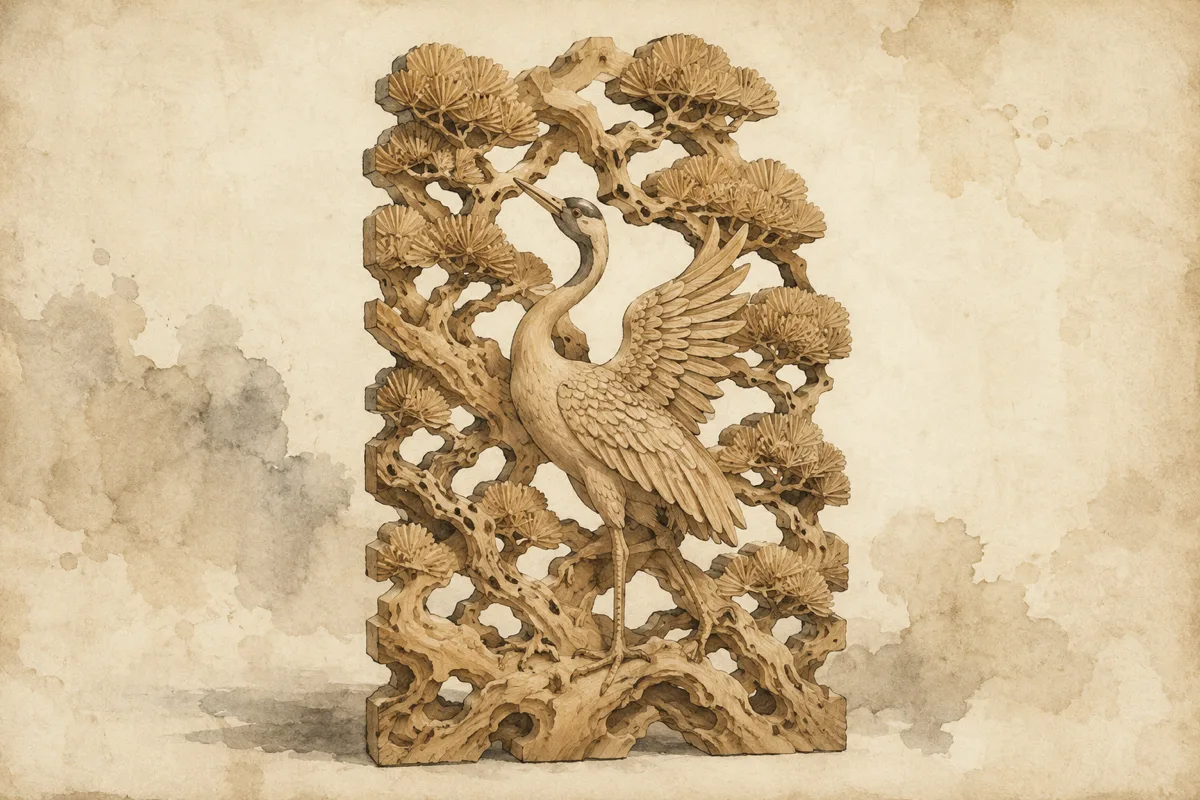
Look up in an old Japanese room and you may find a band of carved wood filling the gap between the tops of the sliding doors and the ceiling. Deep dragons, pine branches, birds worked clean through the plank so light shows behind them. That panel is a ranma (欄間), a transom, and the town most associated with carving them is Inami, in Toyama.
A ranma is not hung on a wall like a picture. It is set into the wall itself, in the open strip above the sliding partitions, and that strip is shared: one room sits on each side of it. That fact shapes everything about how Inami carves.
A panel two rooms have to share
A carving finished on one face only would give the near room a scene and the far room its rough back.
So Inami carvers do not carve a front. They carve a ranma from face to face. The technique has a name, sukashi-fukabori, which is deep openwork cutting worked from both faces of the plank. The carver goes in from one side and from the other, meeting in the middle, opening the wood into layers, until the panel holds a full three-dimensional scene that reads completely from either room. From the far room a carved bird is still a full bird, not a flat silhouette.
This is what separates Inami work from relief carving, where the design stands off a solid backing and has a definite front. A ranma is cut clean through, with no solid back for the design to stand on.
Compare it with kumiko, the other openwork you find in the same wall. Kumiko builds its lattice up from hundreds of tiny slotted strips fitted together. A ranma goes the opposite way: it starts as one solid plank and everything you see is what the carver left behind after cutting the rest away.
The skill came from a burned temple
Inami's carving began as temple work.
The town grew up around Zuisen-ji, a Pure Land temple founded in 1390, and for centuries that temple was the center of local life. In the 1760s a fire destroyed its wooden halls. To rebuild them, woodcarvers were sent from the sect's headquarters temple in Kyoto, led by a master carver named Maekawa Sanshiro, and the reconstruction became a school. Local carpenters worked alongside the Kyoto men, learned how temple ornament was carved, and kept the knowledge after the scaffolding came down.
Maekawa left his own mark on the rebuilt temple gate: a dragon carved into its transom. The town still tells the story that this dragon once drew water from the well to spit on a fire, a legend, though a fitting one for a craft that grew out of a fire.
Inami then moved that temple-scale carving indoors. The deep ornament that had decorated a Buddhist hall was scaled to fit the transom of an ordinary house, and a religious carving tradition became a domestic one. By the time it had matured, roughly a century and a half of refinement later, Inami was known across Japan for it, and in 1975 the craft was designated a traditional craft by the national government.
Two hundred chisels, no sandpaper
An Inami carver's bench is mostly blades. A single piece can call for more than two hundred different chisels and knives, switched constantly as the cut moves from rough clearing to the fine work of a feather or a scale.
There are no files and no sandpaper. The finished surface is the cut surface, taken straight off the edge of the tool, which is why a good ranma keeps its crispness where a sanded carving would go soft. The wood is usually Japanese camphor, paulownia, or zelkova, chosen to hold a clean edge through that kind of deep cutting.
The trade has thinned. Where Inami once had around two hundred carvers, today there are roughly a hundred and forty, and much of their work has shifted from transoms, which fewer new houses have room for, toward Buddhist altars and temple figures, and increasingly toward decorative pieces, up to carved light fixtures. The carpentry that framed those old rooms is fading for the same reason: those rooms are disappearing too.
Why it looks the way it does
An Inami ranma is a screen built to be seen from two directions at once, by the two rooms that share one wall. Everything deep and open about it follows from that. The town learned to carve like this rebuilding a temple, then spent two centuries fitting that skill into the space above a door.