
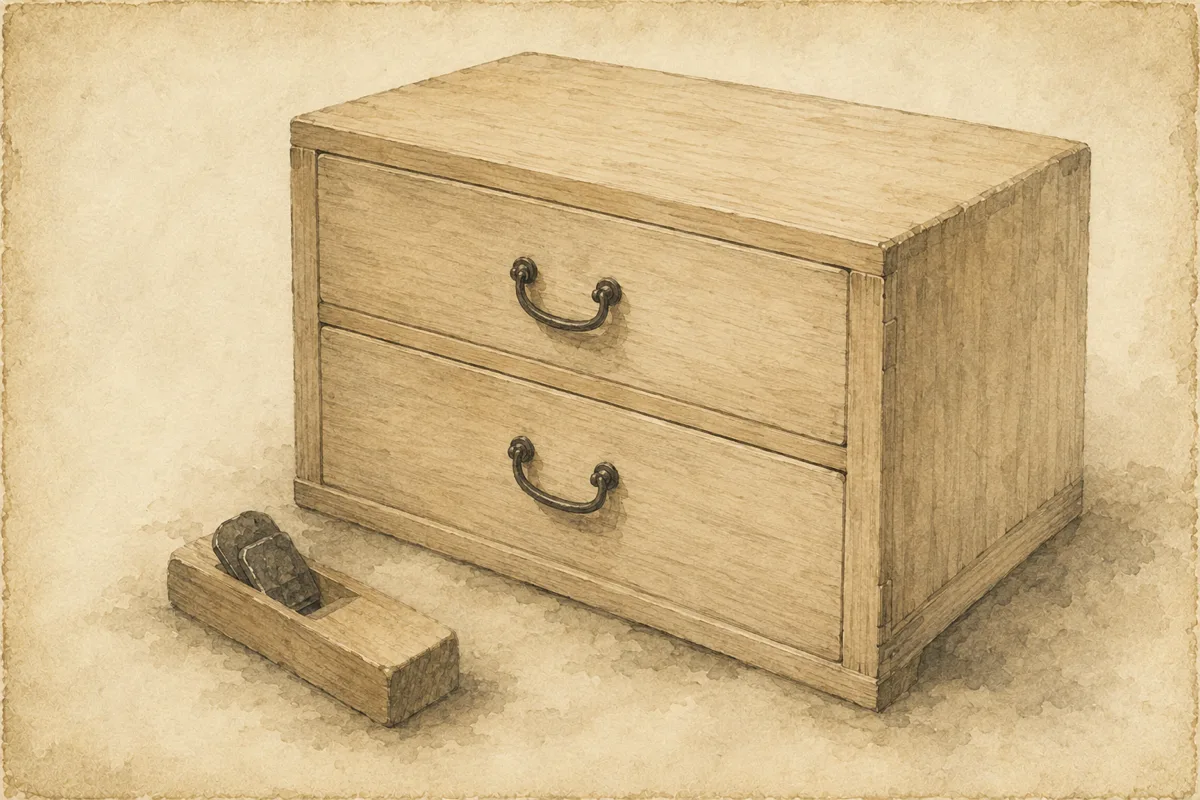
Push a drawer into a good paulownia chest and a different drawer slides open on its own.
Why closing one drawer opens another
The fit is close enough that the drawer works as a piston. Air displaced by the drawer you are closing has to go somewhere, and Shimizu Kiri Kobo describes the path: it escapes through a hole behind the shelf and pushes the neighbouring drawer out.
Getting there is less romantic than the result. The drawer starts too big to go in at all, and the craftsman planes it down by degrees until it just seats. Top and bottom are the straightforward part. The sides are where the fit is won or lost, and flushing them matters as much as the faces above and below.
Which is also the answer to the complaint new owners make most often, that the drawers have gone stiff. A chest fitted this precisely will bind on a floor that is even slightly out of true, and that is the first thing to check before assuming the furniture is at fault.
What the wood is for
Paulownia, kiri, is the lightest timber in common Japanese use: a specific gravity of 0.17 to 0.37 oven dry, 0.18 to 0.38 at twelve percent moisture. That is roughly a third the weight of oak, and it is why a chest tall enough to hold a full kimono wardrobe can be moved by two people.
Paulownia also swells when the air is humid and contracts when it dries, and that is the property the chest is built around. In a piece where the drawers are fitted to that tolerance, swelling closes the gaps and the interior seals itself against the wet season. When the air dries out, the wood pulls back and the chest opens up again. The Kasukabe union and KOGEI JAPAN both describe the behaviour in these terms, and it is the reason the form attached itself to silk and kimono storage rather than to crockery or tools.
Fire is the claim repeated most often in sales copy and the one most often stretched. KOGEI JAPAN calls the wood flame retardant. Masuya Kiribako puts the ignition point at 400°C or above and adds the more useful detail, which is that paulownia chars instead of burning cleanly, and that this is why it turns up as a lining inside fire safes. A charred layer buys time for whatever is inside. It does not make a chest fireproof, and none of the sources say it does.
Something similar has happened to the insect story, where the flattest correction comes from a company that sells paulownia boxes for a living. Masuya Kiribako states that the insecticidal effect attributed to the wood's tannins is not really present, and that what actually keeps insects out is construction with no gaps for them to enter through. So the protection is real, but it comes from the tightness of the box rather than from anything in the timber.
Where they come from
Kasukabe, in Saitama, was settled by craftsmen who came to build the Nikko Toshogu shrine between 1624 and 1644 and stayed on afterwards, making small boxes from local paulownia. It became a specialised trade around 1830, when better river transport opened the Edo market, and went national under Meiji. Designation followed in 1979, and the union today lists fourteen member workshops.
Kamo, in Niigata, has a founder and a date. A joiner named Maruya Kouemon made a chest there in the Tenmei era, between 1781 and 1789, out of cedar rather than paulownia, and the oldest surviving paulownia chest from the town carries an inscription recording its purchase in 1814. By around 1820 chests were going out down the Kamo and Shinano rivers to Niigata and Tohoku, and by the early Meiji years they were reaching Hokkaido; production records from 1877 count four hundred chests of drawers and two hundred large clothing chests in a single year. Kamo took its designation in 1976, three years ahead of Kasukabe, and according to KOGEI JAPAN most paulownia chests made in Japan now come from there.
Three years before anyone cuts anything
The Kamo sequence begins with drying, and it takes about three years. Then the timber is cut, and the yield is poor: only around a third of it comes out at the quality the work needs.
Assembly is dovetailed and pegged. Wooden pegs, not nails, which is the decision that everything downstream depends on. Kasukabe cuts its pegs from deutzia. Drawers and doors are then planed to fit, the surface is finished with polishing powder, alder extract and wax, and the metal fittings go on last.
Kasukabe's process is documented in more detail on the timber side. Boards are cut at 9 to 21 mm for standard work and 5.5 mm for the premium grade, then air dried for three to four months. Then comes the stage KOGEI JAPAN singles out as the hard one: correcting warp in the boards, which it says takes a craftsman more than three years to learn. The paulownia is mainly from Aizu in Fukushima, with big-leaf magnolia and mulberry from Hokkaido used alongside it.
Priced across a hundred years
Pegged rather than nailed, with boards left thicker than they need to be, an aged chest can be dismantled and taken back to fresh wood. The Tokyo restorer Tansu no Matsumoto sets out the sequence: strip the fittings, wash the whole carcass in hot water to lift decades of grime, plane every surface, clamp the loosened joints back true, refinish, and refit each drawer by hand. Then comes the arithmetic that justifies what the chest cost in the first place. One overhaul every forty to sixty years, and the piece reaches a hundred years of use; the wood carries enough thickness for two full resurfacings, and no more. An ordinary hardwood chest, by the same firm's reckoning, has a working life of thirty to forty years.
None of that is free. The base price for the overhaul is 160,000 yen, 176,000 with tax, with the aged finish adding at least 22,000 more. It is a real second payment, decades later, and it is roughly what a decent new chest of drawers costs. What you are buying with it is the same piece of furniture again.
The check to make before you buy
What a restorer actually finds, once the drawers are out, is that plenty of chests are paulownia on every surface you can see and cedar or something else in the frame beneath. That hidden framing is what warps and bends over the years, and a chest built that way tends not to recover its airtightness after restoration, because the part that moved is not the part being planed.
Worse, a faced chest cannot be resurfaced at all in the way described above. There is only a skin of paulownia, and planing it takes it off. Everything in the hundred-year case assumes solid wood underneath.
Which is why the view from inside an open drawer tells you more than any amount of looking at the outside. Take one right out and inspect the carcass from within.
Which finish, and what it costs you
Matsumoto offers three finishes on a restored chest. They differ in how much maintenance they demand and how much of the wood's behaviour they give up.
Tonoko is the standard, made by working alder decoction and polishing powder into the wood over several coats. It gives the yellowish-white surface with sharp grain lines that most people picture when they picture a kiri-tansu. It is also the fussiest to live with, because the maintenance instruction is dry wiping only.
Jidai is the aged finish, produced by scorching the surface for colour. It hardens the wood, barely shifts in colour over the years, and resists marking from hand oils. Because the burn goes into the wood, though, any future resurfacing means redoing the jidai finish along with it.
The third option is the modern one, and it has no traditional name: a urethane or lacquer coating. It opens up colour choices, shrugs off stains and hand oils, and can be cleaned with a well wrung cloth rather than a dry one. What that convenience costs is stated on the same page. Under a coating, the paulownia becomes less able to breathe, and since the humidity response is the reason the chest exists, it is a fair trade only for someone who was never relying on it. The magewappa bento box asks its buyer to make the same call about sealing cedar, in a smaller object at a hundredth of the price.
Whichever surface you choose, check the carcass first. A coating can be stripped and redone. Cedar hiding under a paulownia face cannot be turned into the chest you thought you were buying, and the hand plane that does the resurfacing has nothing to work with.