
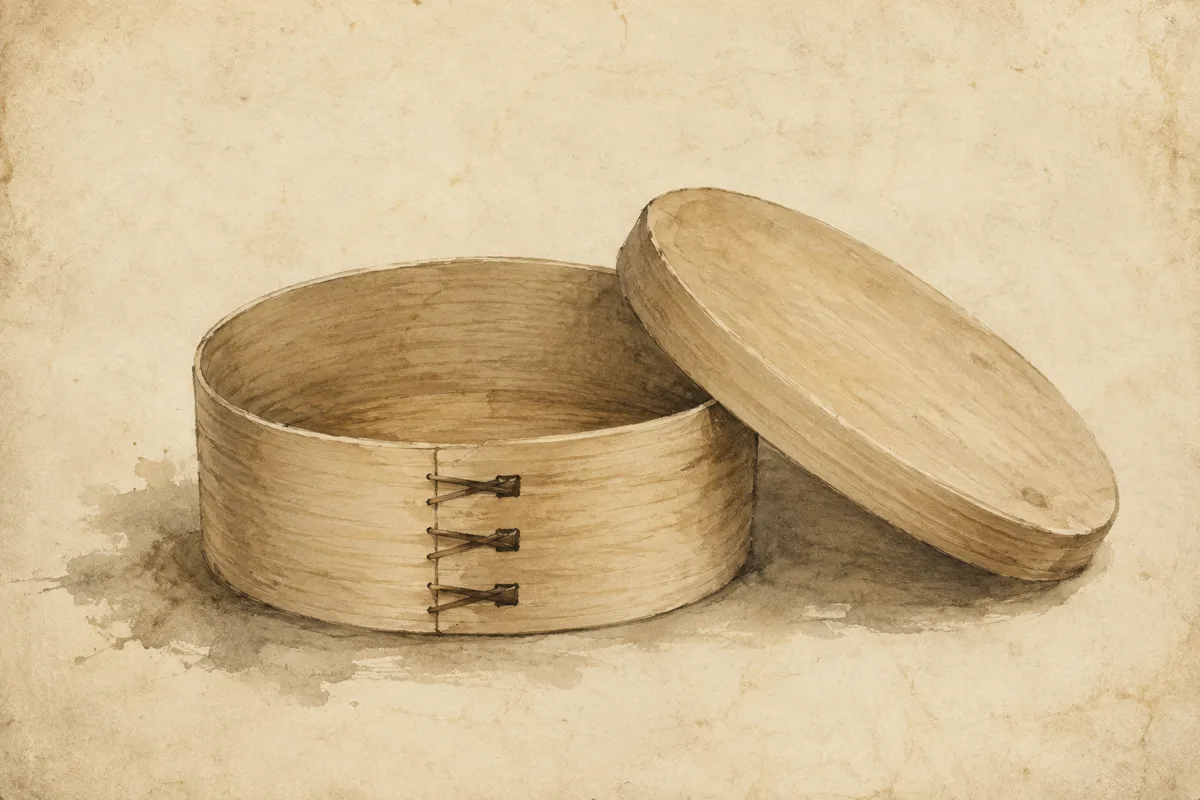
A magewappa has no corners, because the wall of it is one bent plank rather than four joined boards.
What it is
A thin sheet of cedar is boiled until it will bend, wrapped around a mould, held there until it dries, and stitched shut where it laps over itself. A flat base drops into a groove. The whole box is a bent wall, a base and a seam.
The seam is sewn, not nailed or clipped, with strips of bark taken from wild cherry. The technique is called kaba-nui, and it is the stage where makers differ most visibly from one another.
The centre of the trade is Odate, in Akita prefecture, at the northern end of Honshu. The national government designated Odate's version a traditional craft in 1980, and the cooperative's own site listed fifteen certified traditional craftsmen as of July 2026.
How the bend happens
The craft body KOGEI JAPAN sets the sequence out as follows.
Old cedar is selected and dried for years before anything happens to it. Logs are quartered and planed into strips, taken from the quarter-sawn face where the grain runs straight and even. The strip soaks overnight in cold water, then goes into boiling water for fifteen minutes.
It comes out pliable and has to be bent immediately, while it is still hot, around a wooden form. Then it waits again: roughly two days and nights of drying in that shape. The overlap is glued and clamped for three hours before the cherry bark stitching goes in. Last, the base is fitted into its groove, the squeezed-out glue is wiped off, and the whole thing is sanded.
The cedar it was built on is no longer cut
Magewappa has a supply problem, and it is the reason the prices look the way they do.
The craft was built on ten'nen akita-sugi, natural Akita cedar: old-growth timber flexible enough to take the bend. The Tohoku Regional Forest Office states plainly that supply of it ended after the 2012 fiscal year, and that the agency now works to supply older plantation-grown Akita cedar on a planned basis instead. The Odate cooperative describes the same turn from the other end: the natural stock had declined severely, and felling has been prohibited from fiscal 2013 onward on conservation grounds.
The industry moved to plantation-grown cedar, which the cooperative describes as less flexible than the natural timber.
The cooperative gives a number for what that costs them. Of plantation timber, the proportion flexible enough to be bent at all is around seven percent. The cooperative is working with Akita Prefectural University on the problem.
None of the sources cost that out. But a workshop buying cedar in order to find bendable strips is buying a great deal of cedar it cannot bend.
Three finishes, three different lives
This is the actual decision, and it is the one retail listings tend to blur. The same shape comes in three surfaces.
Bare wood (shiraki, 白木) is the unfinished version, and it is the one the reputation rests on. Nothing seals the surface, so the wood takes up and gives off moisture and smells of cedar. That openness is also the liability. Bare wood stains, it can grow mould if it is put away damp, and it needs drying attention on every evening you use it. Nearly all the care advice Japanese Crafts gives is addressed to this version.
Lacquered boxes have urushi over the bare wood, either as an opaque coloured coat that hides the grain or as a wiped translucent one that leaves it visible. Lacquer takes detergent without trouble, and Japanese Crafts puts it as the most expensive of the three.
Urethane-coated boxes are sealed in urethane resin, and they are the cheapest and the easiest to live with: detergent, a sponge, dry it, done. The same coating that makes it easy also seals off the cedar aroma and the moisture regulation, which are the reasons most people want a magewappa in the first place.
Bare wood asks something of you every evening it is used. Urethane asks nothing. On price the order is different again: Japanese Crafts puts lacquer highest and urethane lowest, with bare wood between them.
What none of them do
No magewappa goes in a dishwasher. Japanese Crafts is unambiguous: none of the three can be machine-washed, and hand washing is the baseline for all of them.
The point is worth stating flatly because the inference is so easy to make from the fact that a coated box takes detergent. The guidance draws no exception for the sealed finishes.
Living with one
For bare wood, the routine is short but non-negotiable: wash it, then dry it thoroughly overnight, standing upright rather than lying flat so that moisture can leave. Japanese Crafts suggests keeping two boxes and alternating them if you pack lunch daily, which gives each one a full day to dry out. If mould does appear, the recommended fix is a short soak in hot water and a scrub with cleanser.
One honest caveat on detergent, since the sources do not agree. One Japanese Crafts guide says bare wood should not meet detergent, on the grounds that raw wood absorbs it; another of their pages says cleanser and detergent are fine on bare wood. When the specialists split, follow whatever your specific maker tells you, because they know what is on their own wood.
The reward for the fuss is that a well-kept box wears in rather than out. JustBento, profiling the Odate maker Shibata Yoshinobu Shoten, describes a box after ten years of heavy use and constant washing as darkened, with the grain grown more prominent, and still beautiful. The same profile puts that maker's boxes at around 8,000 yen and up, two to three times the price of other magewappa.
Reading one before you buy
Look at the seam first. Cherry bark stitching is the most visible handwork on the box, and the detail worth comparing between workshops before the shape or the size.
Then ask what the surface is, and do not accept "wood" as an answer. Bare, lacquered and urethane are three different maintenance commitments at three different prices.
Then consider what is behind the price. A craft whose defining timber was withdrawn from supply, and of which only about seven percent is bendable, does not have much room to compete on cost. Some of what looks like a premium for handwork is a premium for wood.
It is the same pattern that runs through the rest of Japanese woodwork: a plane that must be rebuilt by its user to work at all, and joints that hold buildings together without a single nail. In each case the material decides what the tool, the joint or the box is allowed to be.