
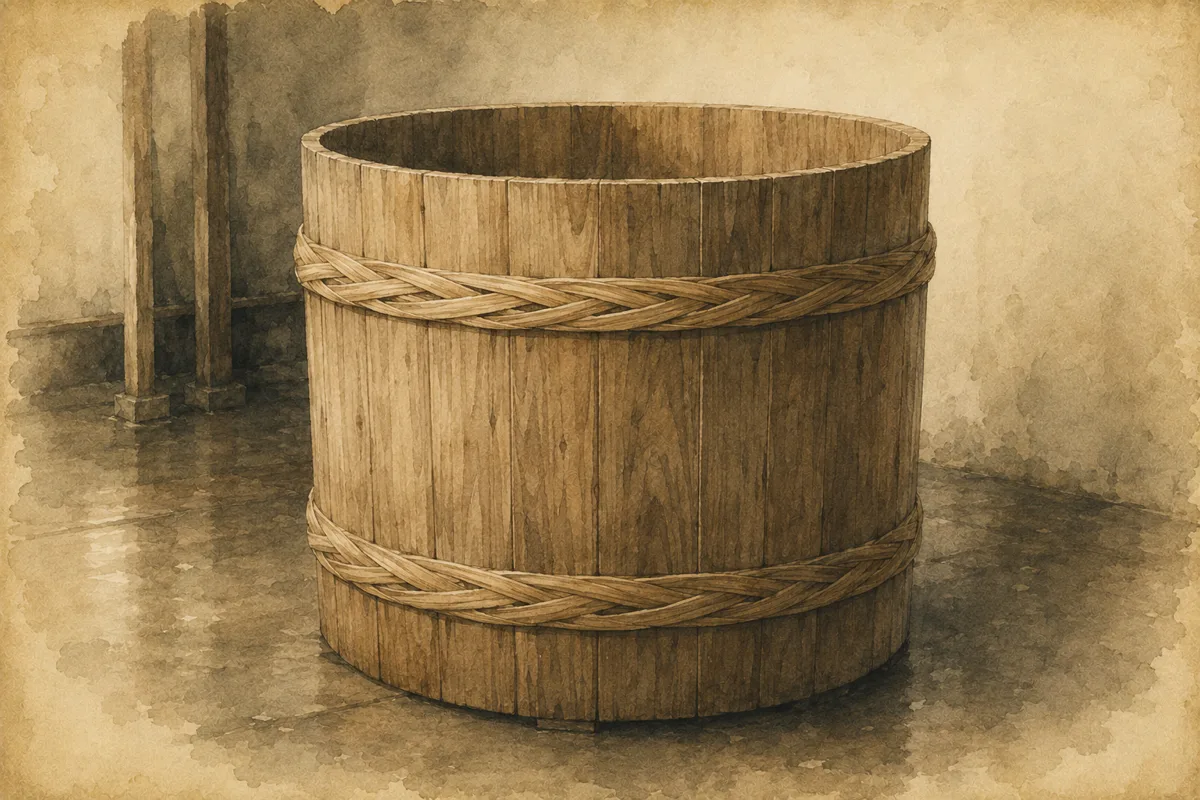
A soy sauce vat in the old style holds around 6,000 litres and contains no nails, no screws and no glue. The staves are cedar, and what keeps them together is a set of hoops split from bamboo and woven into rings around the outside. Nothing else is doing the work, and the vessel then stands in a brewery for a century and a half.
Woven, not fastened
The trade's own description of the build is short on romance. The timber is cedar, and the good stuff is scarce inside the log: from a single tree, only about four boards of usable quality come out. The making runs through five stages, laying out the timber, marking it, weaving the hoops, fitting the base, and raising the body.
The hoops carry more of the engineering than they look like they do. One hoop takes four lengths of bamboo of around 15 metres each, split and woven into a ring, and that ring is what holds several thousand litres of fermenting liquid against the pressure of its own weight.
The Japanese language has kept a record of how much this mattered. The hoop is a taga, and the phrases taga ga yurumu and taga ga hazureru, the hoop loosening and the hoop coming off, are ordinary idioms for discipline going slack and things falling apart.
Sawn one way or the other
Japanese woodwork distinguishes oke from taru, and the distinction sits in how the log was sawn.
An explanation published by the Japan Science Society lays it out by purpose. An oke is described as a tool for drawing water, and what it needs is to stay true, so it is cut masame, quarter-sawn, split through the centre of the log, giving boards with the growth rings running as straight stripes down the face and very little tendency to warp. A taru stores and transports liquids like sake and soy sauce, and what it needs is to not leak, so it is cut itame, flat-sawn from outside the centre, giving the contour-line figure and boards that swell and shrink with humidity in a way that closes gaps rather than opening them. A taru also has a lid fixed on; an oke has none, or one you can lift off.
That framing describes a bucket and a barrel, and a fermentation vat is an oke that holds liquid for years, so the neat opposition strains a little at the edges. The category rule is the one the sources state; the cut used in any particular vessel is a question for its maker. Either way the grain is settled at the saw, before a single board is shaped, which is the same decision the magewappa bento box answers the other way by bending a single plank instead of assembling many.
The cedar is older than the brewery
Vats are built from cedar aged 100 to 150 years, and they then last 100 to 150 years themselves.
Not any cedar will do. Nara Prefecture's account of the timber side sets out the specification: the tree has to be close to a true circle in section, with tightly spaced growth rings, few knots, and a straight trunk. Yoshino supplies it because Yoshino has spent several hundred years planting densely and thinning repeatedly, a regime that raises the proportion of trees meeting that description. Long-horizon forestry of this kind is the same arithmetic that governs hinoki for shrine timber, where the planting decision and the harvest belong to different centuries.
On the customer side the arithmetic is awkward. A brewery buying a vat that lasts 150 years places that order roughly once or twice in its entire existence, so whatever kept the people who built them in work, it was not repeat orders from breweries.
What was sustaining it
Vats circulated. Nara Prefecture's account of the craft describes the arrangement plainly: a new vat was used first as a sake cask at a sake maker, then taken apart and reassembled by craftsmen for use at a soy sauce or miso maker. The trade ran on a cycle, and a vat could have more than one working life in more than one industry.
Then the top of the cycle left. After the war, demand for sake ran past what wooden vessels could hold, and the wood had never been ideal to begin with: it leaks, it absorbs the liquid it holds, and there is a size beyond which you cannot build it. Enamel-lined tanks arrived with more capacity and far easier maintenance, and within roughly ten years wooden equipment had lost most of its market. Rows of them are what a sake brewery looks like now, and they hold the parallel fermentation behind almost every bottle sold today.
Soy sauce went the same way, with a legislative push. A 1963 law promoting the modernisation of small businesses drove consolidation among soy sauce breweries, and consolidation meant tanks. One of the survivors makes the mechanism plain in an interview: Yamaroku Shoyu, on Shodoshima, kept its wooden vats because it did not have the money to replace them.
The Nara account describes both halves of the collapse together: fewer new sake casks were being made, and soy sauce makers were discarding their wooden vats for plastic and stainless steel. Whatever the exact mechanism, the count of workshops able to build a brewing vat fell to one.
The trip to Sakai
On 10 January 2012, three men arrived at Fujii Seiokesho in Sakai, Osaka, for two nights and three days. They were Yamamoto Yasuo, the fifth-generation head of Yamaroku Shoyu, Sakaguchi Naoto, and Miyake Shinichi, a carpenter from Shodoshima. Fujii was, at that date, the only workshop in Japan still capable of making a brewing kioke, and it had been expected to stop.
What they went to learn was planing staves and weaving bamboo hoops. The record of the visit is candid that the hoop weaving was the hard part.
That trip is what the Kioke Coopers Revival Project grew out of, started on Yamamoto's initiative. Yoshino had run at the problem from the timber side two years earlier, reviving cedar vats in 2010 for sake brewing. The stated commercial goal is modest and specific: take wooden-vat soy sauce from about 1 percent of Japanese production to 2 percent, on the reasoning that a bigger market for wooden-vat products is what would put coopers back in business around the country.
The claim the whole thing rests on
The reason anyone goes to this trouble is a biological claim, and it deserves to be labelled as one.
Brewers hold that the vessel itself carries a resident population of microorganisms that a steel tank cannot support, and that the brewer's job is partly to keep conditions comfortable for the lactic acid bacteria and yeasts living in the wood. An account of Yamaroku's vats puts the figure above a hundred species. Coopers reinforce the point from their side by teaching brewery owners how to carry out repairs themselves, treating a vat as a thing to be kept alive rather than serviced.
That is the makers' account of why wood is worth the trouble, stated confidently by people with long experience of both. It is not the same thing as an independently settled result, and a bottle carrying the wooden-vat label is selling you that account along with the soy sauce.
The arithmetic underneath it is not in dispute. The vessel outlives its buyer, the timber outlived whoever planted it, and for as long as the craft was healthy a single vat could pass between industries and be rebuilt for a second owner. Both ends of that traffic stopped inside a generation. What survived the stopping was one workshop in Sakai, and recovering the skill took three men taking three days off in January.