
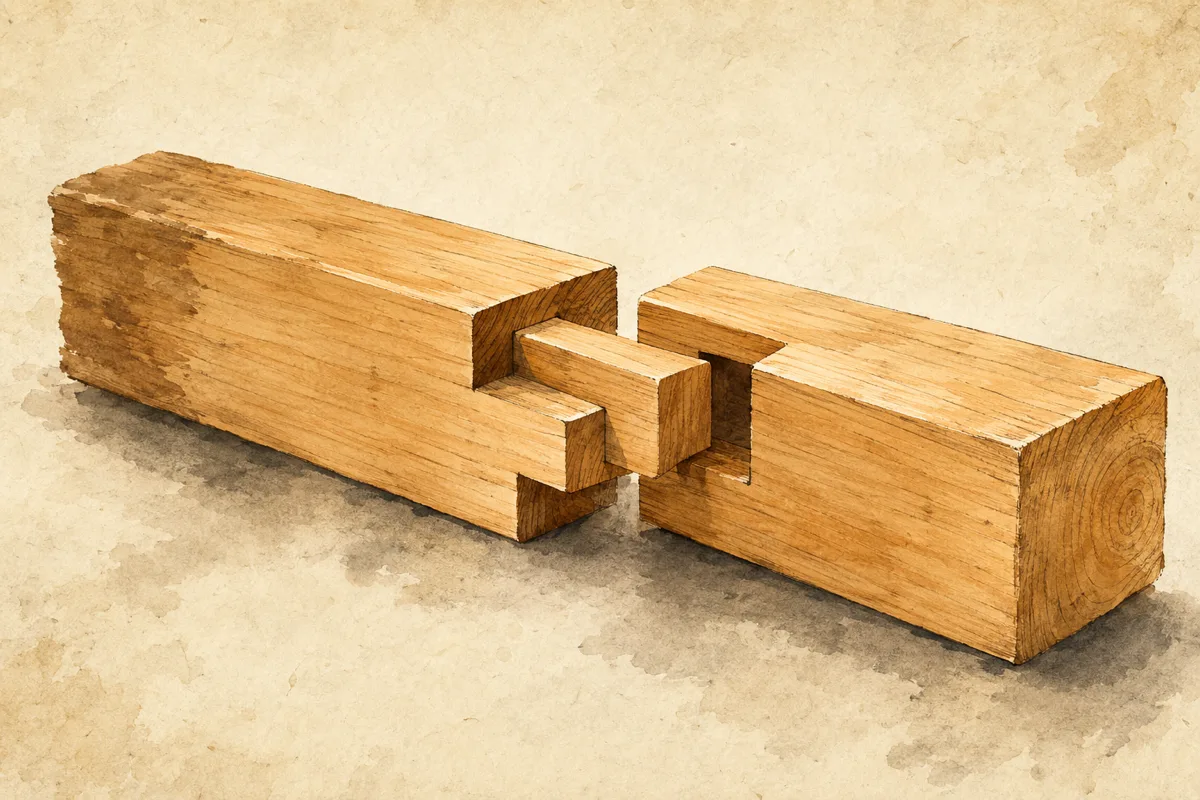
Two blocks of wood slide toward each other, a hidden tongue disappears into a matching pocket, and the join closes with no nail, no screw, no smear of glue. Furniture built this way has served for generations; temple halls have stood over a thousand years. The principle underneath is one line: cut the wood so it grips itself.
Held by friction and shape, not fasteners
Japanese carpentry "is characterized by the use of wooden joints and almost no nails." Instead of bonding two pieces, the carpenter cuts them so that carved tongues, pockets, flared tails and driven wedges interlock and lock by friction. A joint stays fixed even when force is applied to it, because the geometry itself resists pulling apart. Where a little extra locking is wanted, the answer is still wood: a hardwood or bamboo peg driven through the joint, a wooden pin doing the job a nail would do elsewhere.
Why go to all this trouble to avoid metal? Part of the answer is the Japanese climate. The tradition developed in part around hot, humid summers, and metal fasteners rust in that damp, which rots the wood around them from the inside. An all-wood structure sidesteps that. It also lets the building breathe: the timber takes up moisture when the air is wet and gives it back when the air is dry. In this tradition the wood is never treated as a rigid, finished thing. It keeps moving, swelling and shrinking with the seasons for as long as it stands, and the joints are cut to live with that movement rather than fight it.
The two families: splices and corners
Almost the whole vocabulary sorts into two families, and everything else hangs off their names.
A tsugite (継手) is a splice. It joins two members end to end in the same direction to make one longer piece, the way you would lengthen a beam or a post. A grooved notch on one end receives a tongue carved on the other, fitting together, as one carpentry account puts it, "like a puzzle," so that the two lengths read as a single straight line. A shiguchi (仕口) is a connecting joint. It joins members that meet at an angle, most often a right angle, like a post going into a beam, or a rail into a leg. Once you can tell a lengthening joint from an angle joint, the catalog of named joints starts to fall into order.
The catalog is large. By one count there are "over 200 types of joints in existence," chosen according to the shape of the wood and what the structure needs; a well-known reference book, Kiyosi Seike's The Art of Japanese Joinery, lays out 48. Those are two ways of counting the same deep vocabulary, not a contradiction: one a living working tradition, the other a single book's selection.
From a chest to a temple roof
The same idea runs at two very different sizes.
At furniture scale it is called sashimono (指物): assembling chests and cabinets with interlocking wooden joints and no nails. The core move is a mortise-and-tenon worked so cleanly that it becomes, in the words of the Japan Woodcraft Association, "a blind joint that's not visible from the surface." The name itself comes from the monosashi, the measuring ruler, a reminder that the whole craft rests on measured, exact cutting. Three regional schools are recognized as official Traditional Crafts of Japan, and they diverge in taste. Edo Sashimono, from Tokyo, is restrained and made for daily use by merchants and kabuki actors, its hand-cut dovetail joints "barely seen from the outside." Kyo Sashimono traces to Heian-period court culture and leans elegant, refined for the tea ceremony. Osaka Karaki Sashimono works imported tropical hardwoods like rosewood and ebony to a mirror finish. One nailless method, three sensibilities of what it should look like.
At building scale it is the work of the miyadaiku (宮大工), the temple-and-shrine carpenters, "renowned for their use of elaborate wooden joints." Here the interlocking joinery carries roofs, and the stakes of the "wood moves" philosophy are highest. A structure is planned not for a lifetime but for centuries, on the assumption that any part can be taken apart and replaced by later generations. Reversibility is the whole design goal. The landmark example is Hōryū-ji in Nara, whose main hall, the Kondō, is widely recognized as the world's oldest surviving wooden building; timber in the pagoda's central pillar has been dated by tree rings to a felling around 594. The frame is meant to outlast every board in it, repaired and rebuilt across the centuries rather than preserved untouched.
The earthquake question
If you have read anything about this craft, you have met the claim that these joints survive earthquakes. There is real support for it. Accounts describe the small gaps between fitted pieces letting a frame disperse the force of quakes and typhoons, and temple structures absorbing seismic shock by flexing rather than resisting rigidly. So the idea that give in the joinery sheds energy is widely held among carpenters, not folklore. But the strongest numerical versions come from a single engineering article and should not be repeated as established fact, and that same source concedes that traditional post-and-beam framing lacks the engineered lateral systems modern building codes require. The flex may well help. On its own, though, traditional joinery does not satisfy a modern seismic code.
Where it becomes ornament
The nailless idea has a decorative sibling. Kumiko (組子) takes thin slit pieces of wood and assembles them into geometric lattice, again with no nails or metal, fitted to an accuracy of around 0.1mm and set into shoji screens and transoms to filter light into patterns. The structural logic, scaled down to ornament.
Once you see the joint as an answer to a moving material, the furniture, the temple frame and the lattice screen all read as one idea. The same instinct shows up next door in lacquerware, whose bare wooden cores are joined the same nailless way before a drop of urushi goes on: see how Japanese lacquerware is made.