
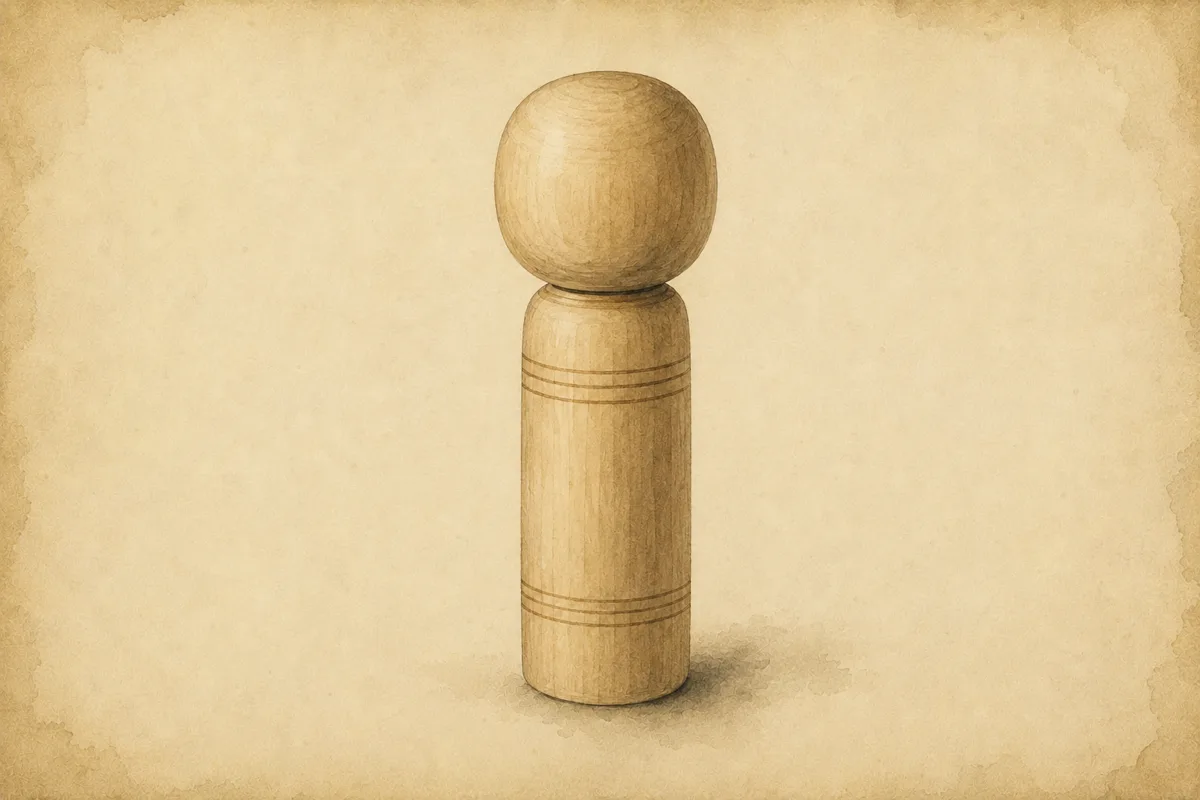
The plainest fact about a kokeshi is the one most descriptions skip. It has no arms, no legs, no fingers, nothing that projects at all, which is what happens to an object made on a lathe. Wood spins against a fixed blade, so every surface the machine can reach is round in cross section. A sphere on a cylinder is what that leaves you with.
Almost everything else about kokeshi, including the name and the tidy list of regional types you find in English, was fixed considerably later, and by people who collected the dolls rather than made them.
Made by people who normally made bowls
Kokeshi come from the hot spring towns of Tohoku, and they are not old. They appear in the late Edo period, in the Bunka and Bunsei years of the early nineteenth century, as souvenirs for toji, the long therapeutic stays people took at the baths.
The makers were kijishi, woodturners, whose living came from bowls and trays. It is a trade that props up other industries without being visible in them, including the turned blanks that the lacquer towns are built on. What the kijishi in the spa valleys added was a sideline. They made small dolls out of leftover material and sold them to the visitors as toys for children, which is the same commercial reflex that produced the marquetry souvenirs of Hakone on another travel route: a resident craft finds a passing market and shrinks its product to fit a bag.
The lathe does the drawing too
A Tsuchiyu doll from Fukushima has coloured bands circling its body. Those are not brushwork in the ordinary sense. The Tsuchiyu makers describe drawing the body pattern using the rotation of the lathe, the brush held against a spinning blank, which is how a band comes out as a clean unbroken ring. The decoration is a turning as much as the shape is.
The same machine makes the joint. On many kokeshi the head is not glued but pressed into the body, and Tsuchiyu describes using the heat generated by the lathe's own rotation in the process of fitting it. A press fit that holds without adhesive is the same instinct that runs through Japanese woodwork more broadly, where the parts are shaped to grip each other rather than fastened. The famous consequence is audible: on a hamekomi fitted head, turning the head makes it squeak. Naruko dolls are known for it, and Tsuchiyu describes its own dolls as crying kii-kii when you twist them.
There are other ways of attaching a head, and they sort the regional styles as reliably as the painting does. Some are turned integral with the body from a single piece, the Tsugaru dolls among them. Some are inserted on a tenon and immovable. The old Nanbu style, called kinakina, has a head left loose enough to move.
The eleven types are twelve, and were once ten
English writing on kokeshi almost always gives eleven traditional lineages, each tied to a town or valley in Tohoku. The Japanese list currently runs to twelve: Tsuchiyu, Yajiro, Togatta, Naruko, Sakunami, Yamagata, Zao, Hijiori, Kijiyama, Nanbu, Tsugaru and Nakanosawa.
The number is a classification rather than a census, and it has moved. The scheme once counted ten. It became eleven when the Yamagata group was separated out from the Sakunami group. Since 2018 it has been twelve, after the Nakanosawa dolls were split off from the Tsuchiyu group and recognised on their own. English sources have not caught up. Treat any list of types as the current state of an argument.
Underneath the taxonomy there is a simpler geography. Togatta, Naruko and Tsuchiyu are described as the three towns the craft came out of, and the other lineages sit around them.
The name was decided by a vote
For most of their history these dolls did not have one name. Around Tohoku they were kideko, kogesu, kiboko and other local words, written with whichever characters someone fancied.
The name was standardised in a room. On 27 July 1940, at the first regional meeting of the Tokyo Kokeshi Society, held at Naruko, the assembled enthusiasts and makers resolved that the word should be written in hiragana as こけし. Everyone who now argues about what the name means is arguing about a spelling chosen at a collectors' convention in the middle of the twentieth century.
The sinister story is younger than the spelling
A claim circulates in English that the dolls commemorate children killed during famines, on the reading ko-keshi, child-erasing.
It is not supported. The theory was advanced by the poet Matsunaga Goichi in the 1960s, and Japanese reference sources note that no writing from before Matsunaga has been found saying anything of the kind. It is filed as a modern legend of roughly the urban-legend kind, which is a fair account of how it travelled.
The older explanations are duller and better attested as tradition. One line derives the name from keshi dolls, the tiny figures of the Edo period, the doll being a wooden version of them; another points at a child's haircut. Neither is provable at this distance, which is rather the point. A trade of village turners had no reason to record why it called its offcut toys what it called them.
What is on the shelf today
Kokeshi have come back into fashion three times. The first revival came in the early Showa years, when the first specialist book on them appeared and reframed a souvenir as a folk art. The second came in the late 1960s, when the economy was booming and the Tohoku spa towns were full. The third began around 2010 and is driven largely by young women collectors, which is where the term kokeshi joshi comes from.
Each wave widened the shelf. Alongside dento kokeshi, made in a recognised lineage to that lineage's form and painting, there are new-style and creative kokeshi, which are a separate category with free designs, made anywhere, answerable to nobody's regional pattern. Both are worth owning. The difference is that only one of them has proportions that were settled by a machine in a mountain valley two hundred years ago.