
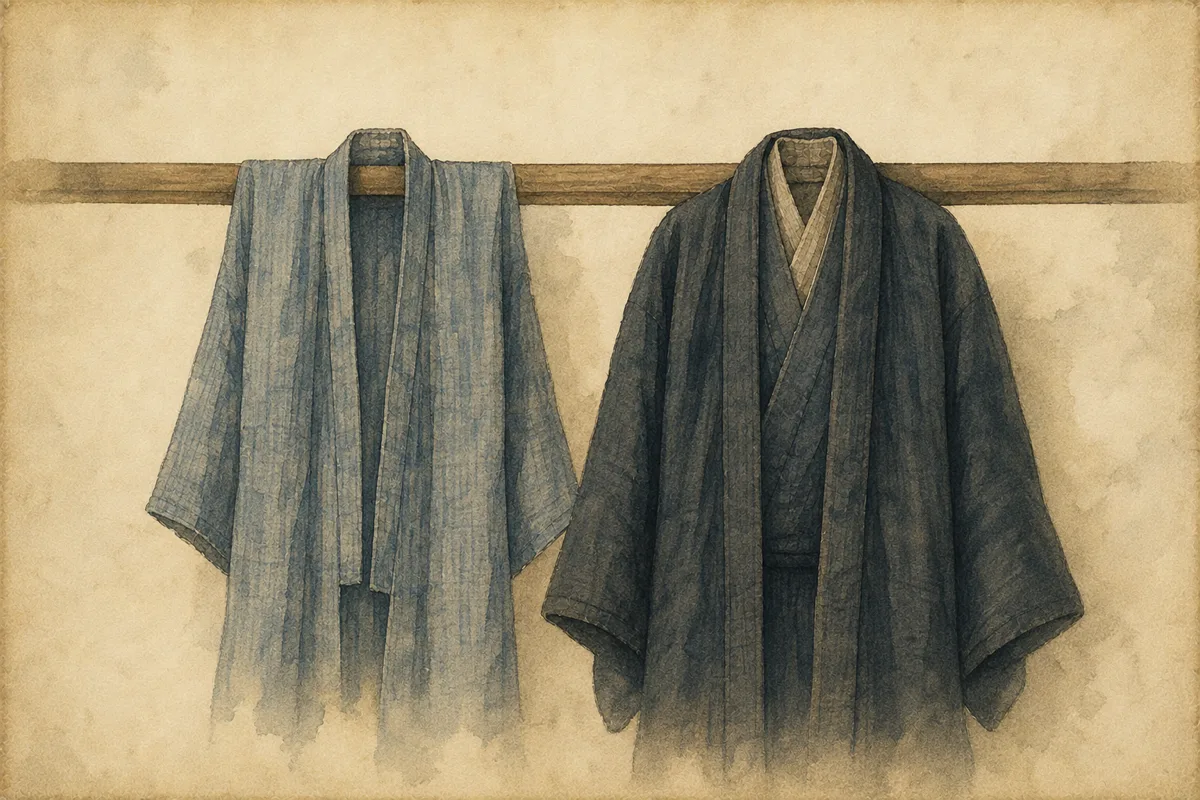
Two long wrapped robes, wide sleeves, a sash tied at the back, wooden sandals underneath. One of them is a kimono and one is a yukata, and the pattern, the colour and the silhouette will not tell you which. What separates them was decided before either garment went on.
Five cords or one
Dressing in a kimono means building up. Underwear first, a hadajuban and a susoyoke or the one-piece version of the same thing. Then a nagajuban, a full-length under-kimono with a han-eri, a half-collar sewn to it, which is the strip that shows at the neck once everything is closed. Then the kimono itself. Amina Collection's guide counts the fastenings for that: five waist cords and two datejime sashes, plus an obi pillow, an obi scarf and an obi cord for the sash at the back.
A yukata skips the middle layer. Underwear, then the yukata. One waist cord and one datejime, then a narrow sash. No juban means no half-collar, and the convention travelling with it puts bare feet into geta instead of tabi and zori.
So the signs a passer-by can read all point back to the same thing.
The neck, the feet, the sash, the cloth
| Yukata | Kimono | |
|---|---|---|
| At the neck | nothing inside the collar | a half-collar in a second fabric |
| On the feet | bare, in geta | tabi, usually with zori |
| The sash | half-width hanhaba obi, or a soft heko obi | Nagoya or fukuro obi, plus a cord and a folded scarf |
| The cloth | cotton, cotton-hemp, hemp, polyester | usually silk; also hemp for summer, polyester, wool |
The neck is the one to learn first. Kimono dressing guides treat balancing the half-collar evenly on both sides as part of the job, so nobody is hiding it, and a strip of contrasting fabric inside the collar is as close to proof as you will get from across a street. The obi cord and the folded scarf travel together, and both exist to support a knot that a yukata sash never has to hold.
The summer kimono that fools everyone
The trap is thinness. Kimono are made to a seasonal calendar: lined garments through the cold months, unlined ones through the warm ones, and in high summer the sheer ro and sha weaves, which are silk fabrics you can partly see through. One Japanese rental guide gives lined from October to April, unlined from June to September, and the sheer weaves for July and August. The detail of that calendar varies between schools and households, so treat it as the shape of the convention rather than a rule with fixed edges.
The result is a silk garment worn in August that is light, cool and semi-transparent, and to an untrained eye looks like exactly what a yukata is supposed to be. It is worn over a juban, with a half-collar and tabi, and it outranks any yukata in the room.
Which is why the test stays at the neck and the feet, where sheerness cannot interfere with it.
The collar gives it away on the hanger
One test works before anybody has put the garment on.
Japanese collars come in three constructions. A hiro-eri, wide collar, is sewn wide and folded in half by the wearer while dressing; it is standard on formal and semi-formal women's kimono, and a kimono shop's guide notes that most modern women's kimono are made this way. A bachi-eri is named after the plectrum used on a shamisen, because it is already folded and widens gradually toward the ends. It is the casual construction, used on komon, cotton, wool and yukata, and on most men's kimono, and the same guide calls it unsuited to formal wear. A bō-eri, stick collar, keeps one width from end to end and turns up on yukata, cotton, wool, tsumugi and workwear.
Hold the collar. If it is wide and wants folding, you have a kimono in your hands, and probably a fairly formal one. If it arrives pre-folded, or holds one width all the way down, you are looking at everyday clothing, which includes every yukata.
It came out of the bathhouse
The reason a yukata has no rank is that it started as bathing equipment.
The word comes from yukatabira, and the garment is traced to Heian-period aristocrats wearing a light hemp robe into the bath. Baths then were steam rooms, and one account offers two purposes for the robe: protection from scalding by the steam, and covering the body when several people bathed together. That account puts both forward as supposition rather than record, so carry them loosely. By the Muromachi period the thing was called minugui, a body-wipe, which places it firmly among the bath tools.
Bathing habits then changed. Once people began soaking naked, around the Azuchi-Momoyama period, the robe moved to after the bath, worn to take the water off the skin, and from there into sleepwear. Cotton arrived and displaced the hemp because it absorbs better. Then public bathhouses spread through Edo, and the garment made its move: people put it on upstairs at the bathhouse, and eventually simply walked home in it. By the mid-Edo period it had become fashionable among ordinary townspeople and established itself as an outer garment. In the Meiji period the invention of chūsen, the pour-through dyeing that also produces hand-dyed tenugui, made mass production possible and finished the job.
The better part of a millennium separates the steam room from the street, and the garment arrived at the far end carrying no formality at all, having never had any to lose.
Dress it up, and it still will not count
You can push a yukata toward kimono territory, and the trade is relaxed about people doing it. A styling column on Kimono-to, the kimono media site run by Kyoto Kimono Ichiba, works through the whole question.
A Nagoya obi on a yukata is, in its words, entirely acceptable, and suits an adult woman very well; choosing between that and a half-width sash is purely taste. Tabi are fine too, and the writer is blunt that no rule requires bare feet. Adding a half-collar works on the lighter, slightly sheer cottons, cotton ro, cotton kōbai, novelty weaves and cotton-hemp blends, while a plain-weave cotton or a heavily crinkled shibori is better worn on its own because the extra layer gets stifling.
The pieces do have to agree with each other. Half-collar on means tabi and proper footwear; half-collar off leaves the feet to your discretion. A half-collar above bare feet in geta gets compared to a suit and tie worn with bare feet in leather shoes, and is not recommended. For sashes, sha and ra Hakata obi and hemp Nagoya obi are named as the classic choices, natural bast fabrics suit it well, and dyed ro or sha obi are probably too dressy.
None of which changes the rank. The limit arrives in one line: a yukata is a yukata, and tying a Nagoya obi on it does not raise its formality. The garment can be styled up, and it stays a casual garment while it is being styled up, in the same way that tsumugi silk can cost a fortune and still not be admissible as formal dress.
Where each one is allowed
Yukata belong to summer, roughly June through September, and to summer's informal occasions: festivals, fireworks displays, evening cooling boats, beer gardens, inns. Japanese guides put weddings, receptions, parties and coming-of-age ceremonies outside its range without qualification.
Kimono runs the rest. Theatre, museums, a restaurant meal, all year round, and upward from there into formal and ceremonial wear, where the fabric, the crest and the obi decide how high.
For a day walking around a city in August, either one is correct. The yukata is cotton, quicker to get into, cooler, and worn on bare feet. The kimono puts a collar at your throat and socks on your feet, takes four more cords to assemble, and reads, to anyone Japanese who glances at you, as a slightly more serious thing to have decided to do that morning.