
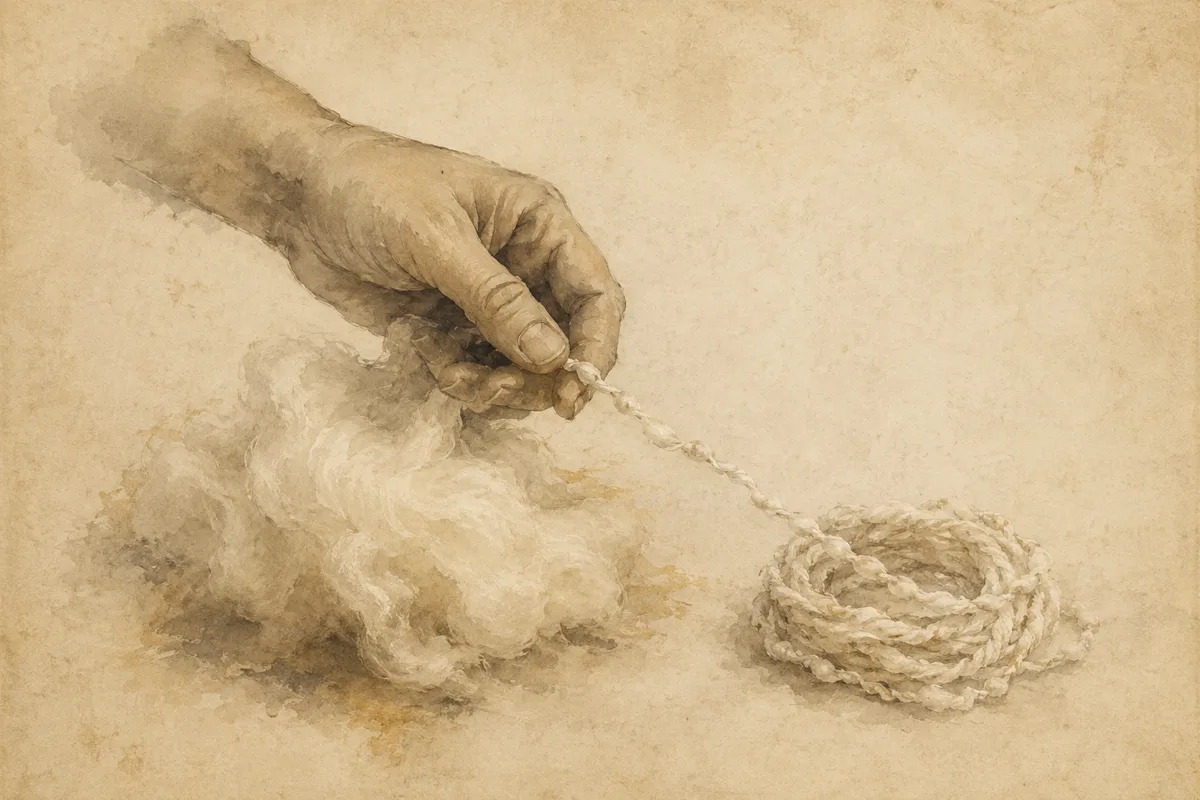
Ordinary silk is made by finding the loose end of a boiled cocoon and unwinding it, because a single silkworm cocoon is one continuous filament hundreds of metres long. Tsumugi is made from the cocoons that cannot be unwound, spun by hand instead. The whole character of the cloth comes from that one difference in how the thread is made, and so does the gap between what it costs and how it ranks.
Silk you spin instead of reel
Not every cocoon can be reeled. Some are damaged, some are doubles where two worms spun together, and reeling always leaves waste behind. That material cannot be pulled off as a filament, so it is treated more like cotton or wool: boiled and softened, pulled out into a fluffy floss called mawata, and then twisted between the fingers into a yarn.
Spinning short fibres by hand cannot make a perfectly even thread. Little lumps and knots ride along the yarn, the slubs, and when it is woven the cloth comes out with a faint, irregular texture of small bumps rather than the flat sheen of the reeled filament silk that goes into formal cloth. Tsumugi is matte, slightly rough to the hand, and unusually strong; it is soft enough to drape, and it grows softer the more it is worn. In English it usually goes by the old trade name pongee.
The peasant's silk
For much of Japanese history fine silk was restricted, and ordinary people were forbidden the soft, lustrous cloth of the upper classes. But the broken cocoons were waste, and a fabric spun from waste at home slipped through. Tsumugi was homemade from damaged or wild-gathered cocoons, the silk that commoners were permitted, and it became everyday clothing and farmers' working wear.
Tsumugi is so hard-wearing that a good piece was handed down for generations, from parent to child. There is an old habit recorded in which a new bolt was first worn by the shop's apprentices until it had softened up, and only then passed to the owner. The slubs that made it too rough for the court were, to the people who wore it, simply what durable silk looked like.
How a poor cloth became a costly one
Making tsumugi entirely by hand is enormously slow, and slow handwork, over time, is what turns a humble material into a luxury. The clearest case is Yūki-tsumugi, made around Yūki in Ibaraki, which is produced by three hand techniques that have barely changed. The yarn is spun from floss without even a spinning wheel. The patterns are set by hand-tying thousands of tiny resists into the yarn before it is dyed, the same kasuri, or ikat, logic of dyeing the thread before it is woven. And the weaving is done on a jibata, a loom so low the weaver sits on the floor and uses the whole body to hold the warp under tension.
A plain length can take up to fifteen days to weave, and a patterned one up to forty-five days, before you count the spinning and the dyeing. A single bolt can be close to a year of one person's work. That labour is why Yūki-tsumugi was designated an Important Intangible Cultural Property of Japan in 1956 and inscribed by UNESCO on its list of Intangible Cultural Heritage in 2010, and it is why a peasant's cloth now carries the price of a treasure.
The other name people know is Ōshima-tsumugi, from the Amami islands in the far south, prized for extraordinarily fine kasuri and for dyeing the thread in local iron-rich mud. Although it is called a tsumugi, Ōshima cloth today is generally not woven from hand-spun tsumugi thread at all. The word has become a name for the tradition rather than a description of the yarn.
Expensive, and still casual
Tsumugi stayed informal even as its price climbed. Kimono dress is governed by a strict grammar of formality, and in it tsumugi is fixed as informal, an everyday cloth, because that is where it started. A bolt of Yūki-tsumugi that cost a year of skilled labour still belongs with everyday dress, not the wedding or the formal reception.
The silk permitted to the poor because it was spun from what everyone else threw away is now sought for exactly the slubs that once marked it as beneath the court, a quiet, durable, individual cloth that money can make expensive but not formal.