
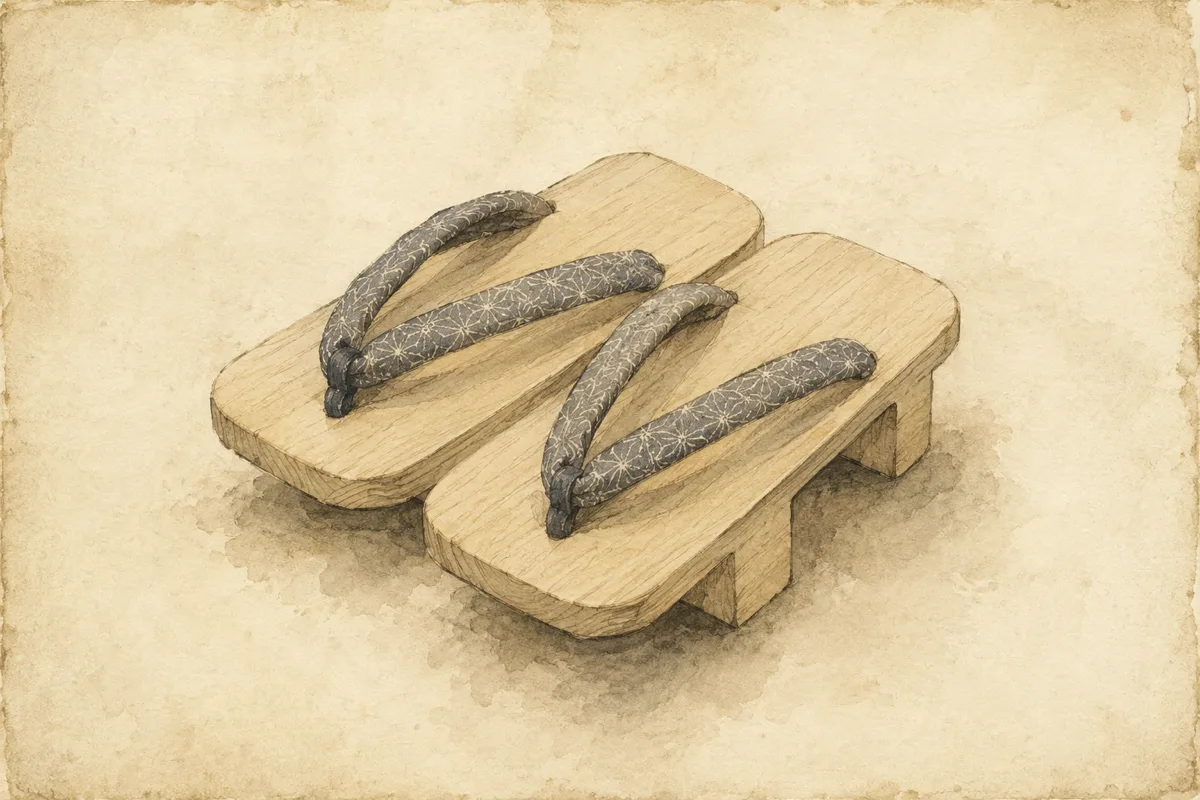
A pair of geta is mostly the gap under it. The wooden board your foot rests on is doing the least interesting part of the job. The two blocks beneath it, the teeth, are what the sandal is really about, because they hold you a few centimetres off the ground, and almost everything that makes a geta a geta follows from that gap.
Standing on teeth
The board is the dai, a flat plank of wood. Under it are the ha, which means "teeth," usually two blocks running side to side, one toward the toe and one toward the heel. Often the whole sandal, board and teeth together, is cut from a single piece of wood, though the teeth can also be made separately and fitted. The wood is very often paulownia, kiri, the light and moisture-shy timber used for storage chests; some regions favour cedar instead.
The gap those teeth open up is the whole point. Geta lift the wearer above dirt, water and snow, and in a country that spent centuries in long kimono, that clearance is what kept a trailing hem out of the mud. How tall the teeth stand and how many there are both come down to the same thing: how far above the ground the wearer needs to be.
The teeth are also where the sound comes from. Wood knocking on stone, one block landing after another, gives the loose karan-koron clatter that in Japan still announces a summer evening as plainly as anything you could smell or hear. It carries far enough that it also served as a warning, telling people someone was coming before they turned the corner.
No left, no right
Look for a left geta and a right geta and there is not one. The board is symmetrical and the strap sits down the middle, so either sandal goes on either foot. In that sense a geta is not really a shoe.
The strap is the hanao, a V of cloth whose point sits between the big toe and the second toe. It is anchored through three holes bored in the board, one at the front and two set side by side at the back, with a cord threaded and knotted underneath; that cord was hemp in the old days and is usually synthetic now. The cloth of the hanao can be wide and padded for comfort or narrow and firm, which is most of what decides whether a given pair is pleasant to walk in.
You do not step into a geta so much as pinch it. Worn correctly, your heel hangs a little off the back edge of the board rather than sitting fully on it, and your toes grip the thong to pick the sandal up and steer it with each step. That grip is why a first afternoon in geta tires the feet, and why the sound has a rhythm to it once you stop fighting them.
Fair weather and foul
The everyday geta split into two kinds by weather. Hiyori-geta are the fair-weather kind, named in opposition to the rain sort, with modest teeth for dry days. Ashida, also called taka-ashida, are rain geta, and they raise the teeth much taller so the wearer stands well above puddles and slush. Some rain geta added a cover over the toes to keep the water off, turning the sandal into something closer to a bad-weather boot with a wooden stilt for a sole.
The far ends of the family
Two special forms sit at the extremes of that idea. One takes the platform as high and solid as it goes. Pokkuri, also known as okobo, are the tall geta worn by maiko in Kyoto and by young girls at festivals. Rather than two thin teeth they have one deep block, hollowed out from below and sloped at the front so the wearer can roll forward into each step; a small bell is sometimes set into the cavity. They are less about clearing mud than about height, formality and a soft rounded sound.
The other end abandons stability entirely. The ippon-ba, or single-tooth geta, has one blade of wood down the centre instead of two teeth. It is said to have been worn by the long-nosed tengu of the mountains and used by yamabushi, the ascetics who trained in high country, and it turns up as well among performers showing off their balance. Standing on a single central bar is genuinely difficult, which is exactly why it survives today as a training tool, worn to build a sense of balance and strengthen the legs. It strips the design down to one bar of wood, the least you can stand on and still be held clear of the ground.
Line these up, the low everyday pair, the tall rain geta and the single-tooth trainer, and they are the same object built at different heights. A geta is a wooden platform you wear, and the teeth underneath set how far off the ground you stand.