
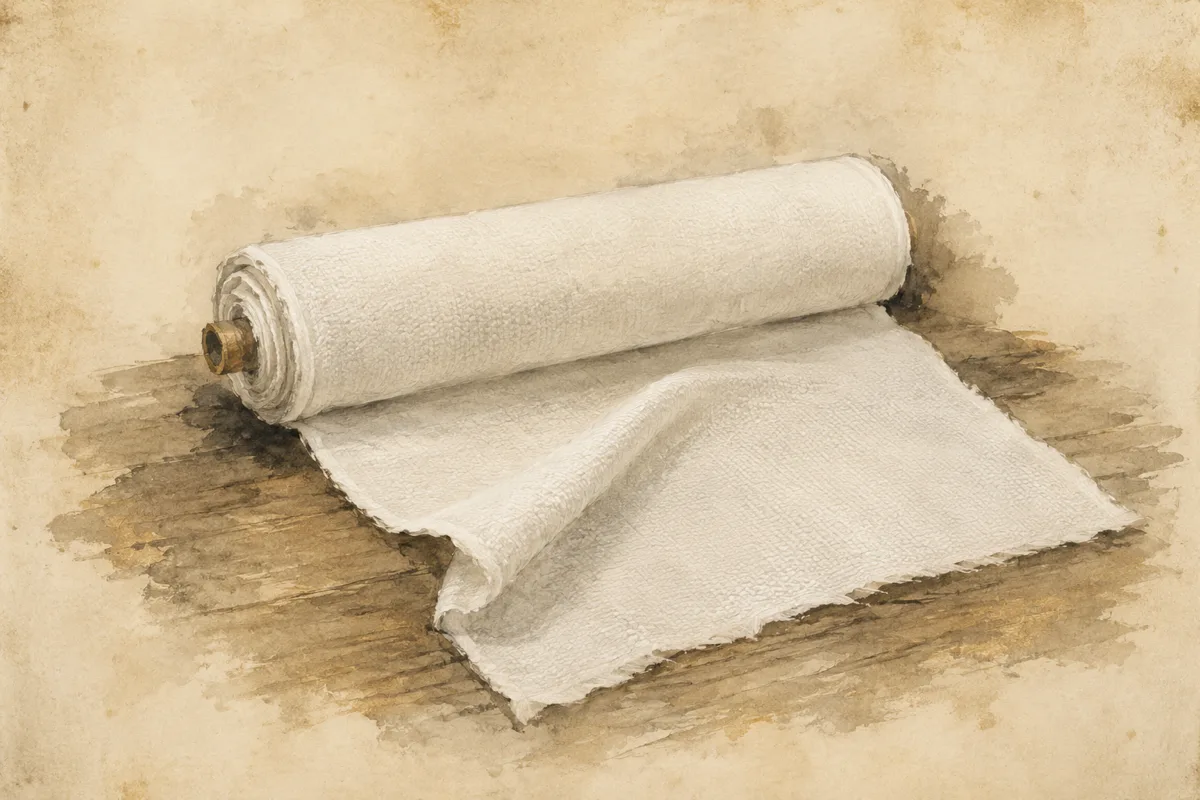
The little hills and valleys on a piece of chirimen are not woven into it. The cloth comes off the loom smooth and stiff and looks like nothing special. The texture, the thing that makes it chirimen, arrives later, in a bath of hot water, and it arrives because the fabric shrinks.
Two yarns doing opposite things
Chirimen is built from two silks that behave nothing alike. The warp, the threads running the length of the cloth, is raw silk left untwisted: flat, straight, smooth. The weft, the threads running across, is twisted hard, to somewhere between three thousand and four thousand turns for every metre of thread. One yarn wants to lie still and the other is wound up like a spring.
Getting that much twist into silk without it kinking back on itself is a wet job. In Tango the weft is spun on a Hatcho twisting machine that drips water over the thread as it turns, because the silk's natural gum, sericin, dissolves just enough in water to let the fibre take the twist and then sets again to hold it. The gum is the only thing holding that twist in place. When the cloth is woven, that gum is still in every thread, so the weft stays wound and the fabric stays flat. There is no shibo yet. There is just a stiff bolt of silk that gives no hint of what it is about to become.
The texture appears in the wash
The shibo is released, not woven. After weaving, the cloth is scoured: washed in hot water to strip out the sericin and the other impurities in the silk. The moment the gum dissolves, the weft has nothing holding its twist, and every wound thread releases at once toward straight. It cannot get there, because it is locked into a woven cloth, so instead of untwisting it buckles the fabric around itself. The whole bolt shrinks and puckers into the fine, even, three-dimensional crimp that the Tango weavers call shibo.
The texture looks decorative, but it is really a record of what a few thousand twists per metre do to a piece of cloth the instant you take away the glue holding them still.
What the wrinkle is for
A crimped surface does not reflect light the way a flat one does. Instead of throwing back a single sheen, the shibo scatters light across all its tiny facets, and Japan Objects describes the result plainly: the silk "diffuses light in a different way, making for a deeper overall tone." A flat dye reads with more depth on this broken surface than it would on smooth silk. The same surface makes the cloth drape softly, spring back from creasing rather than holding a hard fold, and sit gently against skin.
Chirimen is coloured after it is woven, as white cloth, and it takes dye readily and repeatedly. That is precisely why it became the standard ground for Japan's post-weave dyeing: the painted resist work of yuzen is laid onto a white chirimen bolt, and the shibo is part of why those colours look as deep as they do. A cloth like tsumugi gets its character from slubby, spun yarn before any dye touches it; chirimen goes onto the loom blank and smooth and gets its texture only in the scouring bath.
Tango, and a man who went to spy on Nishijin
Almost all of it comes from one stretch of coast. The Tango peninsula, in the north of Kyoto Prefecture, has been weaving silk for more than thirteen centuries; the local industry dates its origins to the year 711, and the oldest surviving Tango silk was presented to the court in 739. Chirimen is much younger than that. Its arrival has a date and a culprit.
In 1720 a Mineyama man remembered as Kinuya Saheiji came home from Kyoto carrying a technique that was not supposed to leave the city. Chirimen weaving belonged to Nishijin, Kyoto's guarded silk quarter, and Saheiji had gone there and quietly worked out how the crepe was made. Back in Tango he reproduced the shibo and, unlike the guild he had learned it from, taught it to the weavers around him. His first bolt was dedicated at Zenjoji temple and is still kept there, and in 1964 he and three others were honoured with a monument as the founders of the trade. Three hundred years on, in 2020, Tango marked the anniversary as the place that now weaves the majority of the white silk for Japan's kimono, a share commonly cited at sixty to seventy percent.
Why water is the enemy
The shibo exists because the cloth was shrunk once, on purpose and under control. Wet it again and you invite the same shrinkage back, this time without control. Water lets the silk contract further and unevenly, so a single splash can pull the crimp flat in one spot and leave a permanent water mark where the surface no longer matches its surroundings. On silk and rayon chirimen the colour can move as well as the texture. The water-sensitivity is not a defect added on top; it is the same shrinkage that built the surface, now working against you.
Fibre decides how bad it is. Yuzawaya, a Japanese craft supplier, puts it simply: rayon chirimen shrinks easily and needs care, while polyester chirimen can be washed with water. Silk sits with the rayon. That is why the care label on a good chirimen kimono says dry-clean and nothing else, and why a caught shower is a genuine problem rather than an inconvenience.
Telling silk chirimen in the hand
Look at the shibo in raking light first. On silk it is fine, dense and slightly irregular, and it holds a soft depth as you tilt the cloth; a printed or heat-embossed imitation tends to be shallower, more regular, and flattens if you stretch it. Then feel the weight and the spring. Silk chirimen has a cool, fluid drape and recovers from a squeeze in the hand without a sharp crease. Then, if you can, check the fibre content, because it changes everything about care: silk and rayon want the dry cleaner, polyester will forgive a wash.
If what you own is a formal piece rather than an everyday one, chirimen is a signal in itself. It is the dressed-up end of the wardrobe, the crepe of a good kimono rather than the plain cotton of a summer yukata, and it asks to be treated accordingly: kept dry, kept off direct heat, and blotted and air-dried rather than rubbed if it ever does get caught in the rain.