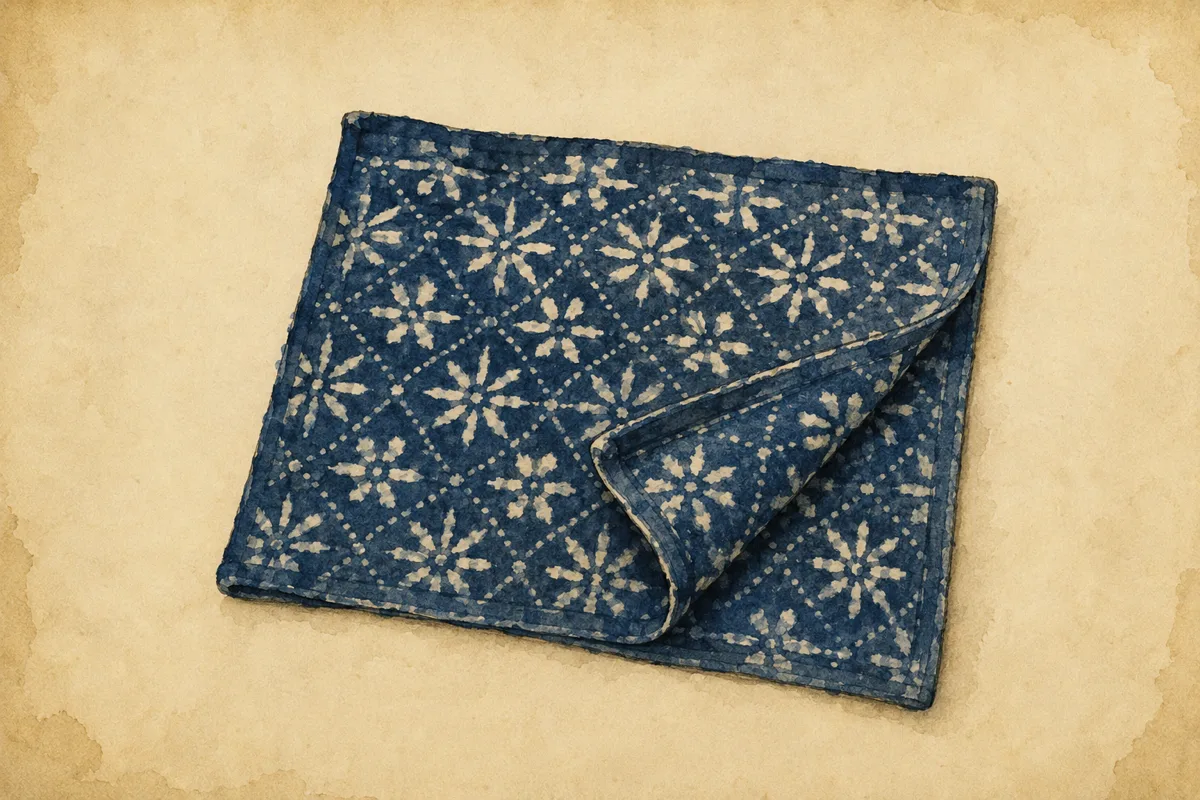
You are holding two tenugui at the same price. One is dyed and one is printed, and the front will not tell you which.
What the reverse shows
On a chusen tenugui, the reverse carries the design in full colour, mirrored. A dyer pours dye through the cloth rather than laying it on top, so both faces take colour and the back is the front seen from behind.
A printed tenugui has a front and a back. Ink sits on the surface, and the reverse shows a faint shadow of it at best. None of that makes it a bad object, only a different product made a different way. A label may say chusen, or say nothing at all, or say hand-finished and mean printed. The back does not have that problem.
Feel it as well. Printed areas stiffen the cloth in proportion to how much ink covers them, so a heavily printed piece can go slightly boardy. Chusen finishes with the cloth being washed out, and comes back soft even when the design covers the whole surface.
How chusen is made
Resist paste goes onto the cloth through a stencil, marking off everything that is to stay white. The cloth is then folded into layers, dye is poured through the whole stack in a single operation, and the piece is rinsed in water at the end to carry off the paste and the surplus dye. That final rinse is the reason the cloth stays soft.
The Sakai crafts association dates the invention to around Meiji 20, which is roughly 1887, in Osaka. It spread to yukata, took a prize at a national exposition in 1903, and became a national industry. Sakai's own claim to it is more recent and more accidental: Osaka dyers relocated there during the war, and the trade settled into a city that already had textile history behind it. The designation of Sakai's chusen and bleaching as a national traditional craft came in 2019.
Everything except the water rinsing is still done by hand, according to the Sakai association. Indigo dyeing sits in the same territory. Nobody has found a machine that controls the result.
Why chusen designs are always broad
The aesthetic follows from the constraints, and makers publish the constraints, because customers submit artwork.
Kanno's guidance is that in chusen, lines and dots under 2 mm are likely to collapse or disappear altogether. Another supplier asks designers to keep every line at 3 mm or wider, and to leave at least 20 mm between one colour and the next. Gradations are difficult. Many-coloured designs are difficult.
Set those numbers against print, where Kanno warns only about lines below 1 mm, and the divide is obvious. Print can render a photograph. Chusen renders a stencil, in a handful of flat colours, with generous space between them.
A floor somewhere between 2 and 3 mm rules out everything else, which is why traditional tenugui carry broad shapes and flat colour fields. A tenugui with fine gradients or photographic detail is printed, and you do not need to turn it over to know.
The raw edge, and where the fraying stops
Nobody hems a tenugui. Edo-period economics explain it: the cloth was made from leftovers and used as a disposable, so there was no case for spending time and money finishing the ends.
The habit turned out to have advantages the dyers still list. A folded hem is the one part of a cloth with two layers and poor airflow, so it holds water longest, and water held in cloth grows mould. A cut edge also tears. Tenugui were the cloth to hand in an emergency, ripped into a bandage, a tie for a broken clog thong, or a strap, and that only works if no hem is holding the weave together.
Threads work loose in the first few washes. Then they knit into one another, the edge settles into a short fringe, and one maker's guidance puts the stopping point at about 1 cm in from the cut. It does not keep unravelling into the body of the cloth.
Trim the loose threads after each of the first several washes. After that, leave it alone. Wash it gently and on its own to begin with, since dyers warn that colour can run, and adjacent colours in a chusen design sometimes bleed into each other.
What a tenugui is for
A tenugui is a thin single layer of cotton, roughly hand-towel size, and it dries far faster than a terry towel because there is no pile to hold water. That makes it good in a bag and good in heat. The same thinness makes it a wrapping cloth, which is furoshiki territory at a smaller scale, and it is why the same object works as a head covering, a bottle wrap or something framed on a wall.
Chusen stays softer under heavy coverage and looks the same from both sides. Print holds detail chusen cannot. If the design you want is photographic, the choice has already been made for you.