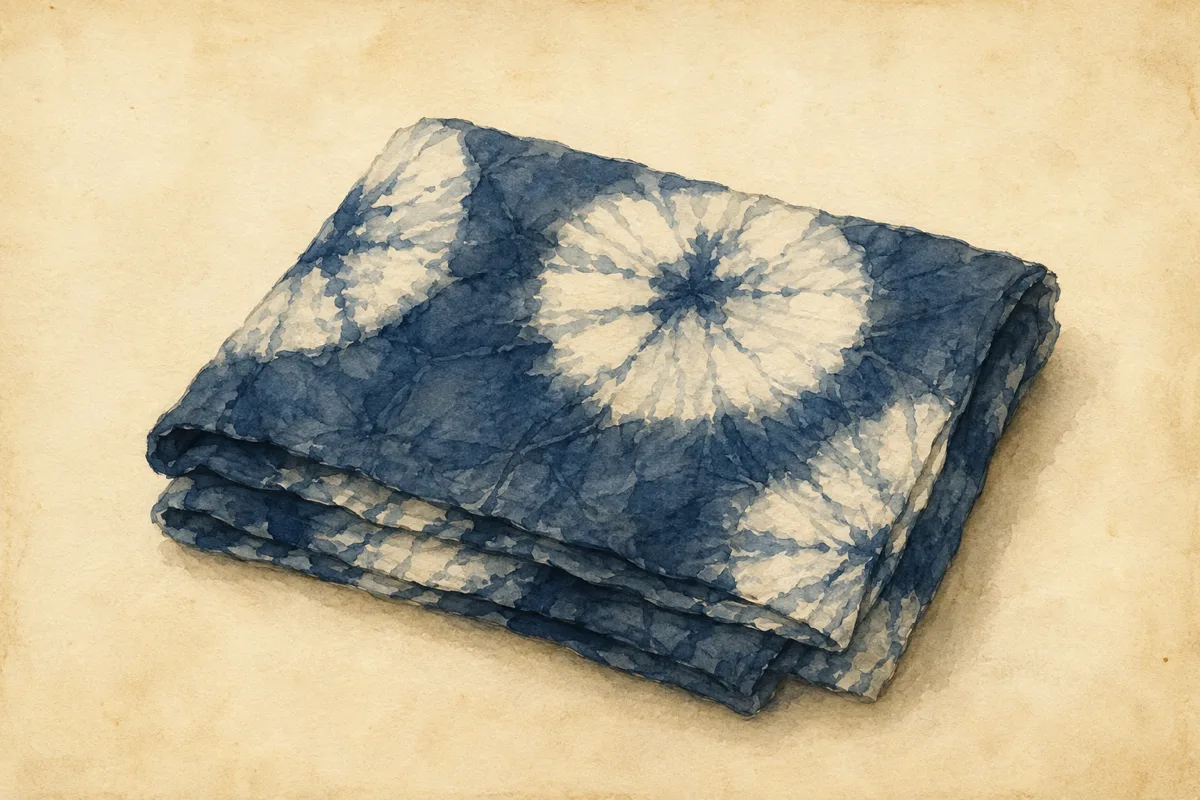
The cloth doesn't lie flat. Puckered into ridges, it carries a soft, bleeding edge on every motif where a printed pattern would have a hard one. That texture isn't decoration added at the end; it's the record of the fabric having been bound, stitched, or crushed into shape before it ever met the dye. The usual label, "Japanese tie-dye," skips right over it.
What the word actually means
Shibori (絞り) is a shaped-resist dyeing technique, and the name is a set of instructions in disguise. It comes from the verb shiboru, to wring, squeeze, or press, which is just what you do to the cloth. Before any dye touches it you deform it: bind it with thread, sew a line of stitches and pull them tight, fold it and clamp it between boards, or wrap it around a pole and scrunch it down. Those compressed places can't absorb the dye, so they stay pale while everything exposed goes dark. You plan the whole pattern by how you handle the cloth beforehand.
Because the fabric is gathered in three dimensions rather than stamped flat, the reserved areas come out of the vat with a raised, crinkled texture, and the boundary between white and color is a gentle gradient instead of a printed line. Some makers keep that pucker in the finished piece as evidence it was tied by hand.
It is not really tie-dye
Western tie-dye and shibori are related, but not as equals. The rubber-band spiral most people have made at summer camp corresponds to just one corner of shibori: kanoko, the plucked-and-bound method that leaves small rings. Shibori is the whole family that kanoko belongs to, and the rest of the family is more patient and more precise. Historically the resists sort into three groups: tied or bound (kōkechi), wax (rōkechi), and folded-and-clamped between carved boards (kyōkechi). Stitched and pole-wrapped methods sit alongside those.
The oldest surviving Japanese examples are eighth-century fragments donated to Tōdai-ji in Nara in 756, and they already show bound, waxed, and clamped resists, so the basic vocabulary was largely settled that early.
The techniques, by name
Most shibori you'll meet is one of a handful of methods, often several combined on the same cloth.
| Technique | How it works | What it looks like |
|---|---|---|
| Kanoko (鹿の子, "fawn spot") | Small sections plucked up and bound with thread | Fields of tiny rings, the branch closest to Western tie-dye |
| Miura (三浦) | Thread looped around plucked sections by a hooked needle, held by tension with no knots | Soft, watery ripples; fast to tie and untie |
| Kumo (蜘蛛, "spider") | Cloth finely, evenly pleated around a point, then bound in tight bands | Radiating spiderweb lines |
| Nui (縫い, "stitched") | A running stitch sewn along a drawn design, then pulled up tight | Controllable, almost drawn patterns |
| Arashi (嵐, "storm") | Cloth wrapped diagonally around a pole, bound, and pushed down it | Diagonal rain-like streaks |
| Itajime (板締め) | Cloth folded, often more than once, and clamped between two shaped wooden boards | Symmetrical geometric grids, kaleidoscopic florals like sekka ("snow flower") |
Of these, miura is the one with a story attached to how it arrived. It holds by tension alone rather than knots, so a worker can tie and later release a whole cloth fast, which made it a mainstay of the trade. It reached Arimatsu by a roundabout route, and that route is really the story of the town.
One town, one craft
Shibori as an industry lives in two adjacent districts near Nagoya, Arimatsu and Narumi, in Midori Ward, Aichi Prefecture, on the old Tōkaidō highway that once carried travelers between Kyoto and Edo. Narumi was a post-station on that road, and passersby bought shibori hand towels as souvenirs, so the trade has been tied to that highway since it began.
Its founder was Takeda Shōkurō, who began the settlement's dyeing trade around 1608, in the early Edo period. The technique itself arrived with outsiders. Laborers from Bungo, in what is now Ōita, had come to build Nagoya Castle in the 1610s, and they brought a tying method with them; Takeda applied it to locally grown cotton and sold the results. A later Bungo import, in 1655, became the source of the miura method. The Owari domain then protected the trade as a regional monopoly, which is why the craft concentrated in this one stretch of road rather than spreading.
What kept it there was a division of labor that still works this way. A design is marked onto the cloth, then handed out to many households, each doing only the tying; separate specialist houses do the dyeing. The tying stage alone can take four to ten months of lead time for a full piece, and across all the specialized hands a single cloth averages fifty to sixty days of actual work. No single pair of hands takes a cloth from marked design to finished dye. Arimatsu-Narumi shibori was designated a national Traditional Craft in 1975, and the town's old merchant streetscape is a protected preservation district.
Why it's blue, and the blue that washes out
So much traditional shibori is blue and white because the original Arimatsu cloth was local cotton dyed in natural indigo (aizome). Indigo is the traditional color, not a requirement, and modern shibori comes in every shade. But the deep blue yukata and hand towel is the product the town built its reputation on.
Watch shibori being made and you'll notice a second blue brushed onto the white cloth before any tying begins, and it isn't the dye. It's a washable ink pressed from the dayflower (aobana), used to print the guide pattern so the tier knows where to bind, and it rinses out completely in the finishing wash, leaving only the indigo behind.
If you want to see it
There's one weekend a year to catch it live. The Arimatsu Shibori Festival takes over the old district on the first Saturday and Sunday of June, with the tying demonstrated by the households that still do it. Short of a plane ticket, the surest test for real hand-worked shibori is a tactile one: run a thumb across it. A print stays flat, while hand-tied cloth has ridges you can feel.
For the cloth itself, the textiles shop carries indigo-dyed pieces from Tokushima, the region that supplies much of the country's traditional blue.