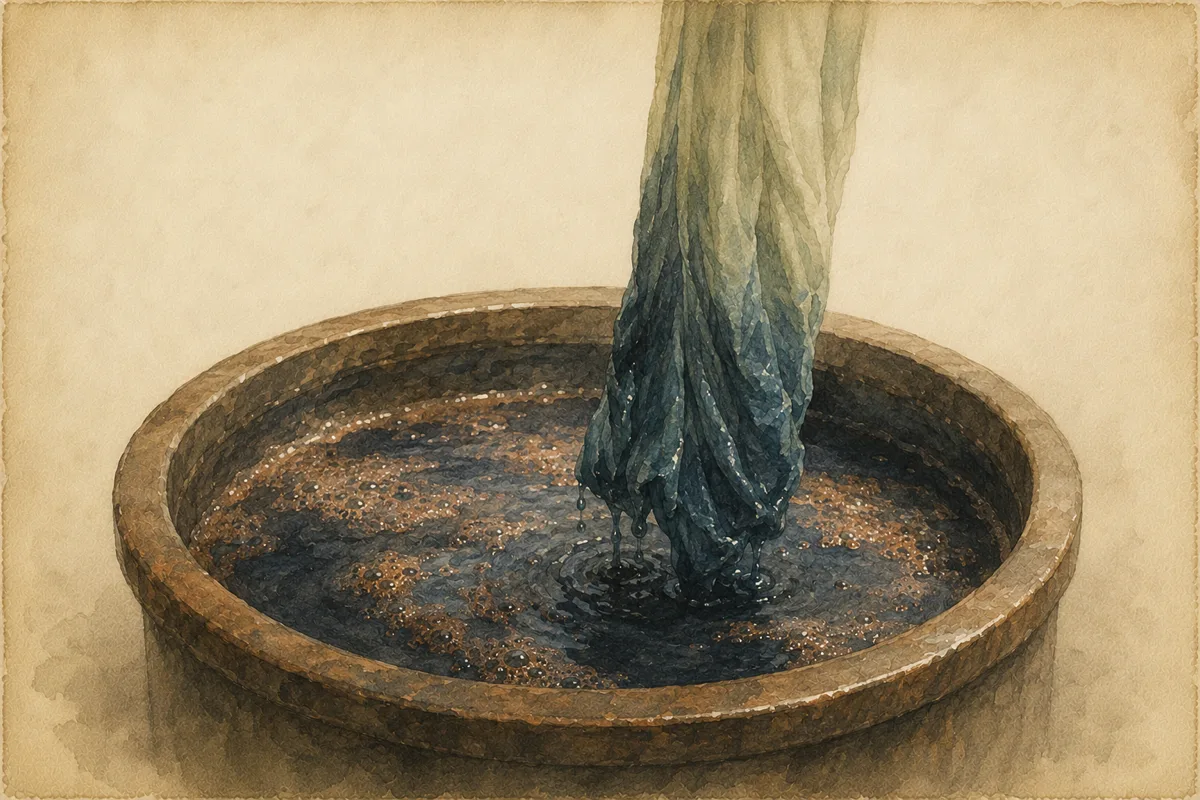
Cloth comes out of an indigo vat green, not blue. For a few seconds it stays that murky, mineral green, and then, as the air gets at it, blue spreads across the surface. Nobody adds anything. The dyeing simply isn't finished until the cloth meets the air, which is the reason real Japanese indigo has almost nothing in common with the bottle of synthetic dye in a tie-dye kit.
A word with a chemical problem inside it
Aizome (藍染) is ai, indigo, plus some, from someru, to dye. The complication is chemical, and it is the thing most admiring articles about "Japan Blue" skip over.
Indigo, the pigment, does not dissolve in water. You cannot steep cloth in it the way you steep tea and expect the color to soak in, because the blue compound is stubbornly insoluble and has no way to enter the fiber. So before indigo can dye anything, someone has to change it into a different, soluble form, hold it there long enough to bond with the cloth, and then let it flip back to blue. Traditional Japan solved this with fermentation, and that solution is what makes the craft a craft.
Sukumo: fermenting the leaf first
The plant is Persicaria tinctoria, Japanese indigo, known as tade-ai. Its leaves carry the raw material for the color, but a fresh leaf is close to useless to a dyer. It has to be processed first, and the processing is a fermentation of its own.
Harvested leaves are dried, then piled up and composted. Over roughly three months the maker keeps the heap damp and turns it as it heats itself from the inside, coaxing the leaves to break down into a dark, pungent, concentrated material called sukumo (蒅). Only now is there something a dyer can use. Sukumo, not the leaf, is the actual trade good, and the person who makes it has their own title, aishi (藍師), separate from the dyer. Very few aishi are left.
This is the first fork away from the synthetic world. In an industrial process, indigo is a powder you order. In aizome, the dye is itself a fermented product that took a season and a specialist to make.
Feeding a living vat
Sukumo still isn't a working dye. To wake it up, the dyer builds a vat, a process called aidate (藍建て), and the vat is a living culture that has to be tended daily.
Into the sukumo go wood-ash lye and lime, which make the liquid strongly alkaline. That alkaline warmth is what a particular community of bacteria wants, and it is the bacteria, not any added chemical, that do the real work. As the microbes get going they strip oxygen from the insoluble indigo and convert it into its reduced, soluble form. To keep the culture healthy the dyer feeds it, adding things like sake, starch syrup, and wheat bran as nourishment, the way you would feed a sourdough starter. Nippon.com's makers describe the result plainly: Japanese indigo "is a living thing." Let the vat go cold, starve it, or push the chemistry too far, and it dies, and no cloth comes out blue.
When the vat is ready it announces itself. A coppery, cobalt sheen of bubbles gathers on the surface, called ai no hana, the indigo flower. It appears only when the sukumo, the lye, the alkalinity, and even the weather are in balance, and it is the dyer's signal that the vat will now take.
Why the cloth comes out green
Inside that reduced vat the dye exists as leuco-indigo, sometimes called white indigo, which is soluble in the alkaline water and is yellow to yellow-green rather than blue. This is the only form that can actually penetrate the fiber, which is why the cloth you pull out is green, still soaked in the reduced dye.
Lift it into the air and oxygen does the rest. The leuco-indigo recombines with oxygen and reverts to ordinary blue indigo, insoluble again, but this time trapped inside the fibers where it will stay. Dip, wring, air, and the cloth deepens; a single pass gives a pale wash, and depth is built by repetition. Japanese even names the stages as the blue climbs, from the barely-there kamenozoki through asagi, hanada, nando, and ai, up to kon and the near-black kachiiro. A dark bolt might see dozens of dips. The blue is layered on, not painted on.
Same molecule, different chain
A tie-dye kit labeled "indigo" and a length of Awa-ai cloth can carry the identical blue molecule. What differs is the chain that produced it. Synthetic indigo, first made in the late nineteenth century, is now turned out on an enormous scale, on the order of tens of thousands of tonnes a year, and it is chemically the same indigo. Modern vats also usually skip the microbes and reduce the pigment fast with a chemical agent such as sodium dithionite.
What the synthetic route does not have is the chain. No fermented leaves, no sukumo, no aishi, no living vat that has to be read and fed and coaxed into flower. When people call aizome a "living" dye, this is what they mean, and it is meant literally: a jar of reducing agent versus a tub of thermophilic bacteria that has to be kept warm and fed. Fermented indigo also tends to build a softer, more luminous depth across many light dips, and it fades over years into the worn blues that indigo lovers actually chase. What you pay for is the process and the labor behind that shade, and the way the cloth will age.
Awa-ai, Tokushima, and "Japan Blue"
Tokushima Prefecture on Shikoku, the old province of Awa, is where almost all of this tradition runs, and its sukumo is called Awa-ai. Court records were already praising it by the mid-900s, one noting that "indigo from Awa Province is the finest." By the Edo period the local indigo economy is said to have run at twice the value of the domain's official rice output, and even after the country modernized in the Meiji era Tokushima still accounted for more than half of national production. It remains the source of most of Japan's sukumo today.
The blue got its English nickname from a visitor. The British chemist Robert William Atkinson, who arrived in Japan in September 1874 to teach in Tokyo, was struck by how much indigo-dyed clothing he saw, everyday people included, and is commonly credited with calling the color Japan Blue. The reasons it was everywhere were practical as much as aesthetic: indigo was cheap and hard-wearing, and was believed to resist insects and wear, which made it the natural color of noragi work jackets, yukata, and everyday cloth. The deep blue of old Japan was, in a real sense, the color of working clothes.
Spotting the real thing
You cannot always spot fermented indigo by color alone, since synthetic blue can be tuned to match. The tells are indirect. Genuinely vat-dyed cloth is dyed through and shades subtly across a bolt rather than sitting perfectly even, it carries a faint characteristic smell of the fermented vat when new, and it ages into softened, uneven blues instead of staying flat. Anything sold as authentic Awa or natural-fermentation indigo should be able to name its process, and often its region.
If you want to understand the blue in indigo cloth, it helps to also understand the other half of the tradition, the resist patterning tied and stitched into the fabric before it is dipped; that is the subject of what shibori is. And for fermented indigo pieces from Tokushima, the region that still supplies most of the country's traditional blue, see the textiles shop.