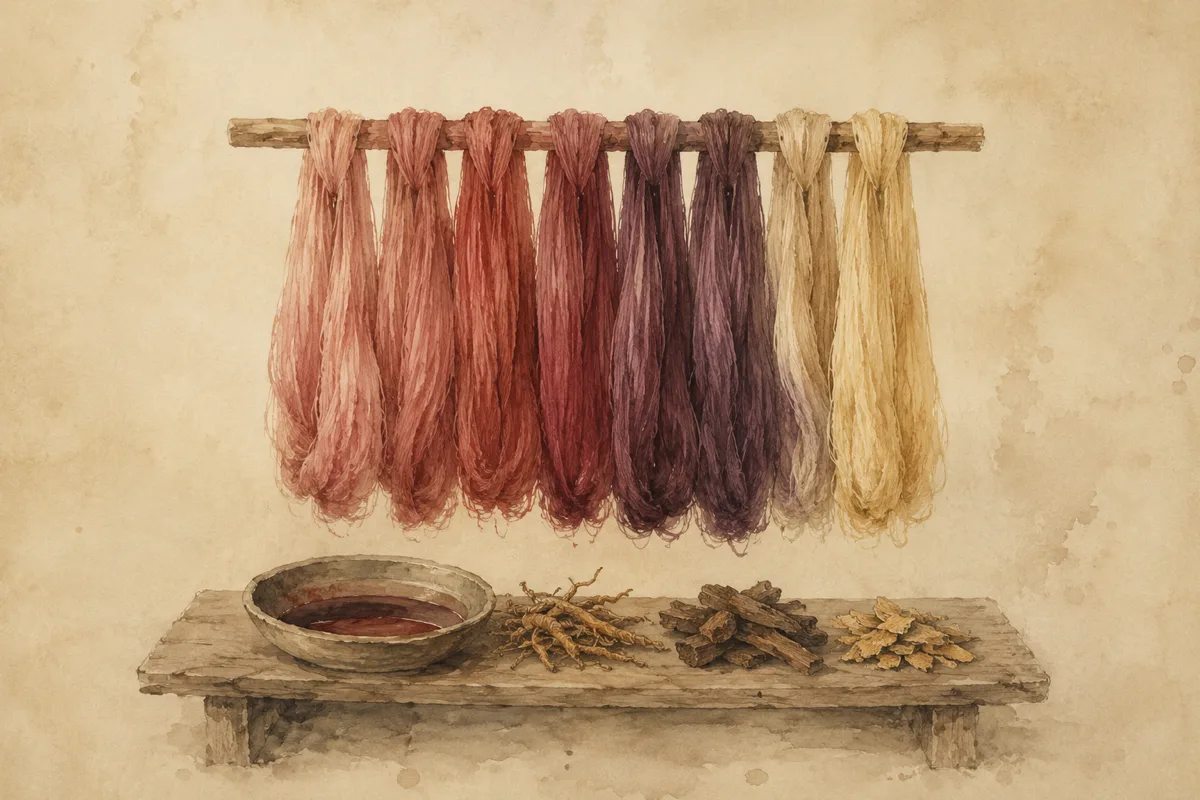
Most guides to Japanese plant dyeing are lists. Madder gives red. Gardenia gives yellow. Gromwell gives purple. What the list leaves out is what actually decides the color: the plant only sets a range, and a metal salt fixes which shade you get from it.
That metal is the mordant, and it is the real subject of kusaki-zome (草木染), Japan's name for dyeing cloth with plants.
The metal in the middle
A mordant is a metal salt, usually aluminum, iron, or copper, that you introduce to the fiber before, during, or after dyeing. The metal ion grabs the dye on one side and the fiber on the other, forming a coordination complex that bridges the two. Without it, most plant dyes rinse straight back out. With it, they lock in.
But fixing the dye is only half of what the mordant does. It also changes the color. The same dye bath over one metal and over another gives you two different results, which is why a color chart for natural dyes lists the mordant next to the plant.
Madder root, akane, is the clearest demonstration. Over an aluminum mordant it gives clear reds and pinks, the shades that run through The Tale of Genji and once signaled court rank. Take the same root, the same bath, and mordant with iron instead, and the reds collapse into purples and browns, though nothing about the plant changed.
Dyers have a vocabulary for this. Aluminum, usually as alum, is called a neutral mordant, because it more or less gives you the color of the dyebath itself. Iron is called a saddening mordant, because it darkens and dulls whatever it touches toward gray, olive, and brown. Iron is often held back and used as an afterbath, brushed or dipped on to shift a color that aluminum has already fixed. It is used carefully, because leftover iron can eventually rot the cloth it darkened.
Indigo breaks the rule
There is one Japanese dye that ignores all of this, and it happens to be the most famous one. Indigo needs no mordant at all. It is a vat dye: the pigment is coaxed into a soluble form in a living fermentation vat, soaks into the fiber colorless, and turns blue only when the cloth meets the air. It needs no metal, no bridge, and no color shift, the one Japanese dye the mordant rule does not touch.
A few plants come partway. Kihada, the inner bark of the Amur cork tree, gives a bright lemon yellow and holds to silk with little or no mordant. It also happens to be antibacterial and insect repelling, which is why it was used to dye paper for protecting documents and sutras, not just cloth. But these are the exceptions.
Colors that carried rank
Before it was a craft revival or a slow-fashion interest, plant dyeing was a system of status, and the hardest colors sat at the top.
The deepest of them was purple, from the root of murasaki, gromwell. The pigment is shikonin, and the traditional mordant was the ash of Camellia japonica wood, chosen for its high aluminum content. Purple was the highest color in the Asuka-period cap rank system of the early 600s, and for centuries it was a forbidden color, kinjiki, that commoners could not wear. It was also hard to keep. Gromwell purple fades in light, so the court needed a constant fresh supply, and the plant was harvested until, today, it is listed as endangered.
Red sat just below it. Safflower, benibana, was extracted with an alkaline straw-ash lye and then reddened with the acid of rice vinegar or unripe plum. A single roll of deeply dyed safflower red was said to be worth a nobleman's house. Yellows were the everyday colors, the workaday end of the palette: kariyasu grass, gardenia fruit, and the kihada bark already mentioned, cheap and abundant where purple and red were rationed by law and by cost.
Okinawa's bingata leans on mineral pigments rather than plant dyes partly because pigments hold up under a hard subtropical sun, which is exactly the weakness that made gromwell purple so precious and so fragile on the mainland.
The word is younger than the thing
The dyeing is ancient. Dyed goods from the Ashikaga region were recorded as gifts around 1250. But the word kusaki-zome is not ancient at all.
It was coined in 1930 by the novelist Yamazaki Akira, at an exhibition of revived hand-woven, plant-dyed textiles at the Shiseido Gallery in Ginza. Until then there was simply no single name for dyeing with plants, because there had been no need for one. The need appeared with synthetic dye. Once cheap aniline colors existed, "dyed with plants" became a thing worth naming and distinguishing.
And it was worth defending. After the exhibition drew attention, sellers began labeling synthetic-dyed cloth as kusaki-zome, so Yamazaki registered the term as a trademark in 1932 to protect the real thing from the imitation. The umbrella term for natural dye, in other words, appeared only after synthetic dye did, as a way to mark the difference. His son later let the trademark lapse, so that anyone doing the real work could use the word freely.
How to read a naturally dyed color
The plant a cloth was dyed with is only half the answer. The other half is the metal it met. A soft red and a muddy brown can come from the same root and the same vat, separated only by whether the dyer reached for alum or for iron.