
Pick up the cord tied around a kimono obi and try to work out how it was made. It is not woven, because there is no warp being crossed by a weft. It is not knitted, because there are no loops. Japanese reference works make the point in unusually flat language: braided cord is fundamentally different in composition from woven cord and from knitted cord. It is a third thing.
That third thing is kumihimo, and Japan built an industry on it, first for armour and swords, then, after those disappeared, for the sash cord you are holding.
Every strand does both jobs
In weaving there is a division of labour. The warp is stretched on the loom and stays put, the weft travels across it, and the two sets of threads meet at right angles. Knitting has no such division but works by pulling loops through loops.
A braid has neither. Several bundles of thread all travel obliquely, crossing over and under one another, and each of them is doing the work of warp and weft at the same time. Nothing in a braid is stationary and nothing is passive. That is the structural fact the whole craft is built on, and it is what the Japanese vocabulary is careful about: a braided cord, a woven cord and a knitted cord get three different words.
Braids sort into three families by their cross section: marugumi, round, kakugumi, squared, and hiragumi, flat. Within those, the number of possible structures is large. Kyoto Prefecture says that even the basic braiding patterns are reckoned at more than forty.
The stand decides the cord
The braider does not hold the work. It is held by a wooden stand, and each stand can make a particular class of braid, which is why a workshop owns several.
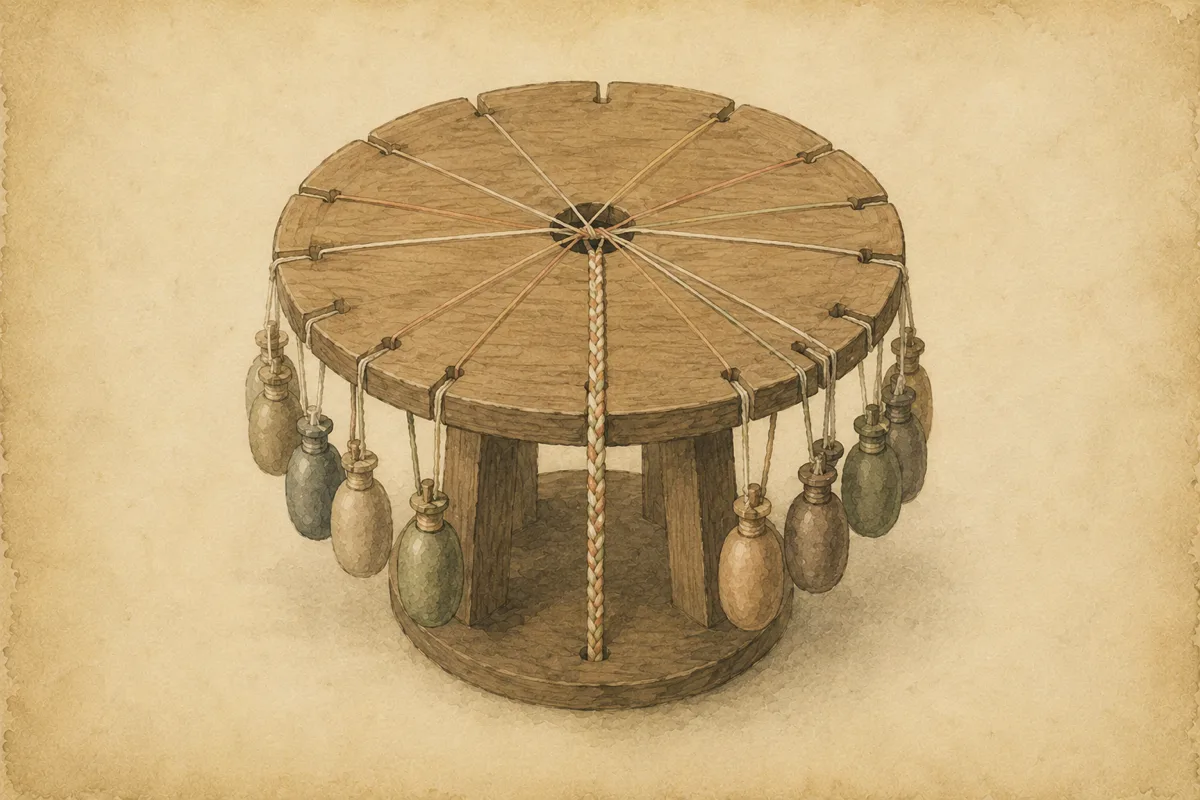
The marudai is the round one, the general-purpose stand, worked with the threads hanging down over a disc, tightening as they cross. It makes round and flat cord and takes as many strands as you want to manage.
The takadai is the serious one. It is roughly the size of half a tatami mat, the braider sits at the frame, and it carries a large number of bobbins, which is what allows a patterned flat braid. Takadai work is what goes into the best obijime. The ayatakedai makes flat cord with line patterns that stay tight and knot cleanly, and the kakudai covers both round and square braids, from simple four-strand cord upwards.
Two of these are not ancient. The takadai and the naikidai were invented in the Edo period, alongside rising demand for sword decoration. The tools arrived with the customers.
The customer was armed
Cord shows up early in Japan. There are impressions of three-strand and four-strand cord on Jomon pottery, and the lacing on a suit of armour recovered from a fifth-century tomb turns out to be an eight-strand braid. The Shosoin repository at Nara holds a hundred and twenty wide braids, by which point the technique had come in from the continent, by way of China and Korea, and was being used for Buddhist and Shinto implements.
Then it went to war. From the middle of the Heian period braided cord laced the plates of o-yoroi, the great armour of the mounted samurai, and the quantities were not small; figures of around 300 metres of cord for a single suit are cited. Court dress had its own version, the hirao, a broad band braided in a diamond structure to hang a sword at the waist, something over ten centimetres wide and four metres long. Later the tea ceremony took the technique somewhere quieter, for the drawstrings on utensil pouches and the fittings of hanging scrolls.
For most of its history, in other words, this was a supply trade. Somebody needed a length of something strong and beautiful to hold armour together or to carry a sword, and the braiders made it.
Then the sword was banned
The Meiji Restoration removed the customer. The samurai class was dissolved, and the government banned the wearing of swords, at which point the demand for sword cord collapsed. The same edict emptied the workshops that had been decorating the sword itself, including the inlay trade in Higo.
The braiders found two new markets. One was the military, which still needed cord. The other was the obijime, the cord that holds a woman's obi knot in place, and it is the one that lasted. The object that now stands for kumihimo is the craft's second career.
Two places carry the trade as a designated craft. Iga kumihimo, made around Iga and Nabari in Mie Prefecture, was designated a traditional craft by the minister of economy, trade and industry on 15 December 1976; the prefecture states that Iga produces most of the national output, especially of hand-braided cord, and describes the work as silk with gold and silver thread braided on square, round and high stands. Kyoto has its own designated line, Kyo-kumihimo, with a history running from ritual implements and armour through tea utensils to obijime.
Reading an obijime
If you are buying one, the vocabulary above is most of what you need.
The flat braid, hiragumi, is the most common kind, and versions carrying gold or silver thread are the ones worn with formal dress. A round marugumi cord has no front and no back, which makes it easier to tie without fussing, and plainer ones sit comfortably with casual kimono. Squared in section is kakugumi; one variety of it, kanmuri-gumi, is noted for having a bit of give, which makes it forgiving to pull tight. Then there is the outlier. Maruguke is not braided at all, but a tube of silk stuffed with wadding, the older form of the thing, worn now with bridal dress, furisode and antique kimono.
That is a lot of classification for a piece of string, and the vocabulary makes more sense once you know what the string used to be for. The armour came first, then the sword, and the obi came last.