
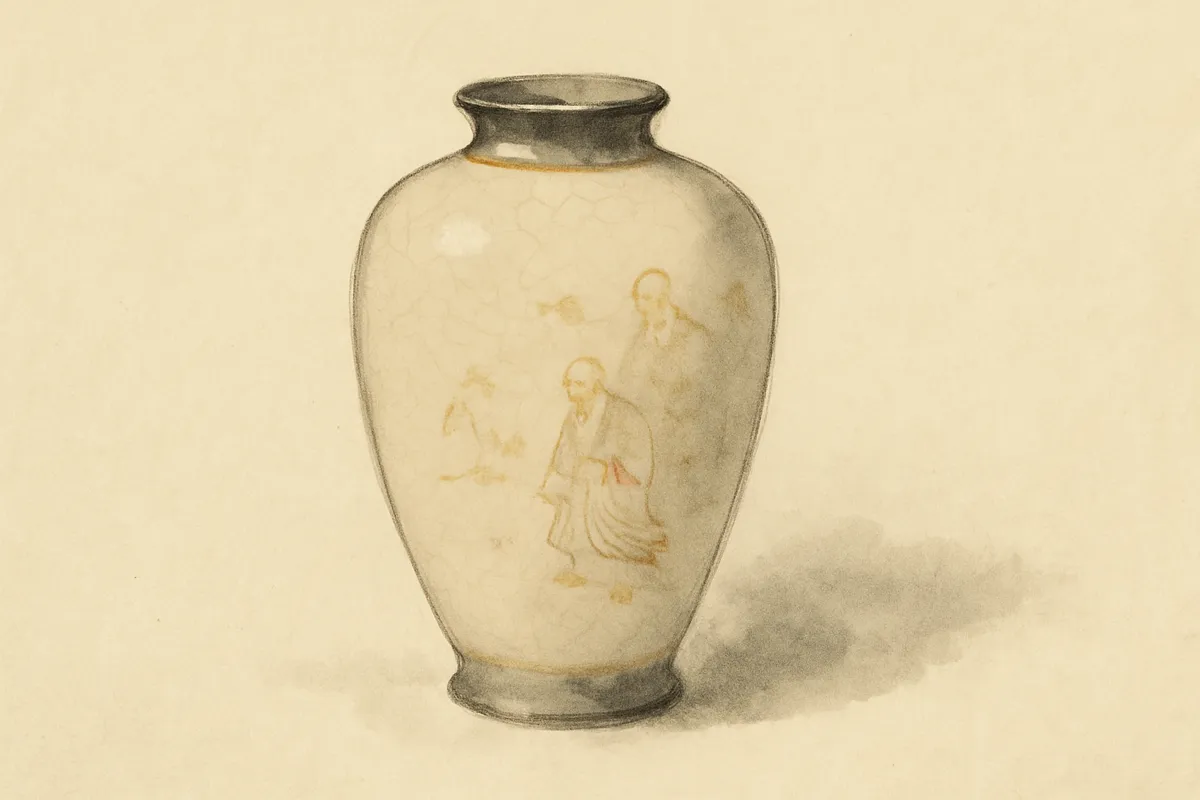
Somewhere in a grandparent's cabinet, or on an estate-sale table, sits a Japanese vase you can almost feel before you touch it: a warm ivory ground crazed all over with hair-fine cracks, painted with crowded figures (arhats, geishas, chrysanthemums) and gilded until it glints. The label, or the seller, says Satsuma. Two things about that name are usually wrong, and getting them right is how you read the piece. It is very likely not porcelain, and it was very likely not made in Satsuma.
First, it is earthenware, not porcelain
Most Japanese ceramics that reach Western collectors, like Arita and Imari blue-and-white and Kutani, are porcelain: hard, white, vitrified, translucent. Satsuma is a different material. It is earthenware, a soft faience: a warm cream-to-ivory clay under a clear glaze, fired far cooler than porcelain and never vitrified to glass.
You can check this without any expertise. Hold the piece to a lamp: porcelain glows faintly translucent at a thin edge, while Satsuma stays opaque. Tap it gently: porcelain rings with a clear, high note, while Satsuma gives a duller, lower thud. And look closely at the surface: that fine web of cracks, called crazing (kan'nyū), isn't damage. It happens because the glaze and the clay body shrink at slightly different rates as they cool, fracturing the glaze into a network of hairlines "like frost on glass." On Satsuma it is a feature, deliberately kept as the ware's signature texture. (For why the same clay can be pottery or porcelain, see stoneware vs porcelain.)
Where it really came from
The ware does begin in the Satsuma domain, modern Kagoshima, at the far south of Kyushu. Its origin is a piece of hard history: when the daimyō Shimazu Yoshihiro returned from Toyotomi Hideyoshi's invasions of Korea (1592 and 1597–98), he brought back roughly eighty Korean potters as captives and settled them in his domain, chiefly at the villages of Naeshirogawa and Tateno, which became the craft's heart. Around 1617, potters at Naeshirogawa are said to have found a white clay and produced Shiro-Satsuma ("white Satsuma"), the refined ivory body used for decoration. Alongside it ran Kuro-Satsuma ("black Satsuma"), a dark, iron-rich everyday ware, the humble cousin most collectors never meet.
The elaborate white-and-gold Satsuma is the descendant of that Shiro-Satsuma line, and its story turns on one date.
"Satsuma" is a style, not a place
At the 1867 Exposition Universelle in Paris, and again at the 1873 Vienna World's Fair, Satsuma dazzled European visitors, and the word became a fashionable label in the West. Demand exploded. To meet it, workshops outside Kagoshima began making the style. From the early 1870s it was produced in Kyoto (the Awata district, its output called Kyō-Satsuma), and in Yokohama, Osaka, Kobe, and Tokyo. Within a few years, mainland production outstripped Kagoshima's. So "Satsuma" stopped meaning a province and started meaning a look: crackled ivory ground, dense polychrome enamels, and gold.
Kyō-Satsuma from Kyoto is often the finest of all. The great name is Kinkōzan of Awata, the largest export producer, a workshop that by 1881 employed over 200 workmen and apprentices turning out some 30,000 pieces a year, and more than 700 craftsmen by 1907, before closing in 1927. In Osaka, Yabu Meizan built a reputation on miniature painting so fine the eye can barely follow it. These were, in effect, ateliers producing luxury goods for foreign buyers.
Reading the decoration
The decoration has a vocabulary worth knowing. Nishikide ("brocade") is the multicolored overglaze enamelling (iron-red, blue, green, purplish-black, yellow) painted onto the already-fired glaze and set in a second, cooler firing (the same two-fire logic behind how Japanese ceramics are made). Moriage ("heaped up") is enamel or slip piled into low relief, so dots and robes stand off the surface. For gold, older pieces used powdered gold with a soft, matte sheen; around the turn of the century workshops took up liquid "water gold" (suikin), a gilding technique of German (Meissen) origin, which was cheaper and glossier, and often gaudier. Late export pieces filled every gap with flowers and figures, a crowded horror vacui that Western taste of the day both bought eagerly and, later, called garish. The art historian Gisela Jahn put it bluntly: "in no other style of ceramics did the Japanese go to such extremes in attempting to appeal to Western tastes."
The marks, and why most of them lie
This is the point owners most want certainty on, and the one Satsuma most resists.
| Clue on the base | What it actually tells you |
|---|---|
| Shimazu crest (cross in a circle) | Almost nothing. It became a marketing convention stamped on pieces regardless of origin or age. The color it's painted in is meaningless too. |
| Hand-painted Japanese signature | A good sign of an art piece; a maker's name plus "Satsuma." Cross-check the name against known makers. |
| Stamped or printed mark | A sign of later, mass production rather than hand workshop output. |
| English lettering ("Royal Satsuma," "Hand-Painted") | Modern. Dealers note genuine old Satsuma has no English on it; such pieces are typically late-20th-century mass ware (often ~$30–40). |
| "Nippon" | Roughly 1891–1921. US law (the McKinley Tariff, 1891) required imports to be marked in English with their country of origin; "Nippon" was used until 1921. |
| "Japan" / "Made in Japan" | After 1921, when US customs ruled "Nippon" was not English. |
Two cautions keep you honest. First, an unmarked base does not mean old: artisanal earthenware like Satsuma often escaped the marking law, so absence of a mark proves little. Second, Jahn offers another rule of thumb: Japanese ceramics "were not generally signed or stamped unless made for export," which itself points to the Meiji era. So a signature is a hint about purpose and era, not a guarantee of value. As a texture note, fine even crazing tends to go with better Meiji–Taishō work, while coarse, greyish crazing suggests something later or cheaper.
The tap test stays the quickest check: a Satsuma piece is earthenware, not porcelain. Doubt the crest, distrust the English, and read "Nippon" and "Japan" as date stamps rather than pedigrees. None of this appraises the piece, which still needs an expert eye, but it tells you what you're holding, roughly when and for whom it was made, and turns a vague guess into a real question. For where Satsuma sits among Japan's other kilns, see the regional guide.