
The furnace is a box of clay, roughly 3 metres long by 1.35 wide by 1.2 high, and it sits on top of a large underground structure built to dry the ground beneath it and keep the damp out. It is charged with iron sand and charcoal, alternately, for three days and three nights without a break. Then it is broken open, the iron is dragged out, and the furnace itself is destroyed. The next run gets a new one.
Three days of that leaves a lump on the floor of the pit weighing two and a half tonnes, and at that point nobody yet knows how much of it is any good.
One run, one furnace
A single campaign is called an ichidai, and the Japanese sources are consistent that it cannot be paused, restarted or corrected halfway. Three days, continuous, with the charge going in around the clock.
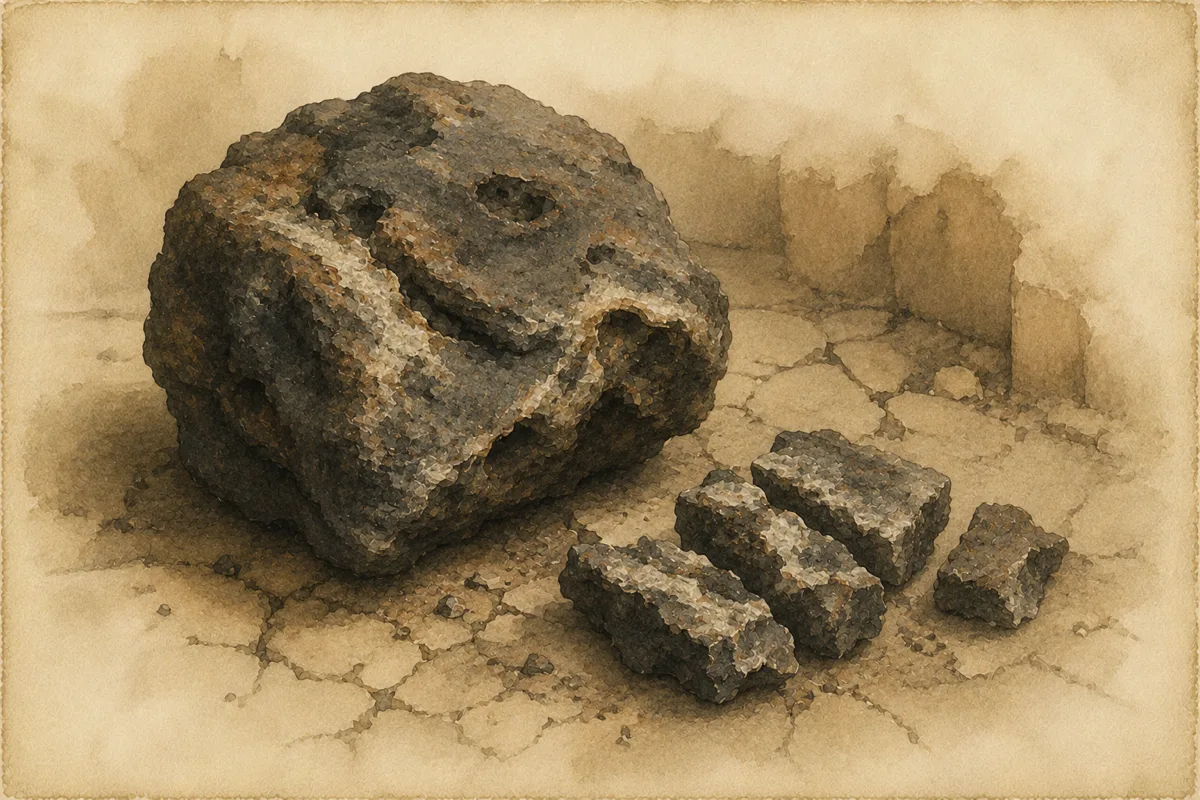
While it runs, a mass of iron gathers on the floor of the furnace and grows outward at a few millimetres an hour, eating into the clay walls as it spreads, until it is something like 1.2 metres across. That erosion is why the furnace is single-use. By the end of the run the walls have been consumed from the inside, and the only way to get the mass out is to take the furnace apart around it.
The lump is the kera. At the Sugaya works, a historical operation in the Izumo hills, about 12 tonnes of iron sand and 13 tonnes of charcoal produced a kera of roughly 3 tonnes, and the site ran 60 to 70 campaigns a year. The modern surviving operation, run in Shimane by the Society for the Preservation of Japanese Art Swords, works to the same shape at a smaller cadence: three campaigns each winter, mid-January to early February, chosen for the low humidity.
Nothing gets poured
A blast furnace melts iron and pours it, which is what makes a Nambu kettle possible: molten metal, a mould, one shape per pour. The tatara does not work that way. It holds 1,300 to 1,500 degrees and reduces the iron sand rather than melting a bath of it, slowly, across the length of the run, with the charcoal doing both the reducing and the carburising. Japanese metallurgical writing files the tatara under the direct processes.
You can see it in the product. Nakagawa Masashichi's account of the craft describes tamahagane as hanyōyū, semi-molten, a state in which the carbon has not evenly dissolved. That is what a slow reduction leaves behind rather than a fault in the workmanship.
Because the carbon is unevenly distributed, a single kera holds several materials at once. Parts of it took on very little. Parts took on a great deal: the pig iron a tatara also produced runs to around 4 percent carbon, which is what tea ceremony kettles were cast from and what no sword could be forged from. The whole spectrum comes out in one mass, mixed together.
The operators could bias the outcome. Running on masa iron sand, which has coarse grains and reduces slowly, favours steel, and the method is called kera-oshi. Running on akome sand, finer and quicker to reduce, favours pig iron, and that is zuku-oshi. But biasing is all it is. Neither method produces a single uniform output.
The craft is sorting
So the kera is broken up and graded by hand. Tamahagane is what survives that grading, and then it is graded again. The current operation sorts into three classes by carbon content: first grade at 1.0 to 1.5 percent, second at 0.5 to 1.2, third at 0.2 to 1.0. The wartime Yasukuni tatara used a prettier scheme with the same function, sorting into crane, pine, bamboo and plum.
Around 10 tonnes of iron sand and 12 tonnes of charcoal yield a kera of about 2.5 tonnes, and about 900 kilograms of that is tamahagane. At the modern furnace a run gives roughly a tonne of tamahagane, of which about 20 percent is first grade. Put those two figures alongside each other and a campaign ends with something on the order of 200 kilograms of top-grade steel for the 22 tonnes of raw material that went in.
Nor does the yield stay put. A 1943 run at the Yasukuni furnace consumed 12,825 kg of iron sand and produced 577 kg of steel. A 1978 run at the modern furnace consumed 7,840 kg and produced 1,194 kg. Two-thirds of the sand, twice the steel. A swing that size on the same process in the same region says the output is being judged rather than controlled, which is why the murage, who decides how much sand and how much air go in and when, is a named post with a documented line of succession behind it.
What the folding is for
The famous number is the folds. Fifteen or so, doubling each time, producing something on the order of thirty thousand layers in a sword billet.
It is repair work. Folding exists because the starting material is inconsistent. Larrin Thomas, testing tamahagane in 2025, cites a historical small blade whose carbon ran from 0.6 percent at one end to 2.0 percent at the other, and attributes the spread to a low number of folds. The bladesmith Tim Zowada, quoted in the same piece, puts it plainly: carbon is essentially homogeneous through a bar by about eight folds. Folding is how a bag of mixed carbon contents becomes one steel.
It does something to the slag too, though less than the folklore claims. Research cited in that study found fayalite inclusions dropping from 16 to 20 microns down to 8.2 microns over six folding cycles, but the volume fraction of inclusions was not significantly reduced. The slag does not leave. It gets smaller, rounder and more evenly spread.
Carbon burns off along the way. A billet starting around 1.2 percent arrives at the finished blade around 0.7. Folding costs you carbon, costs you material, and buys you consistency, which is the same bargain struck by pattern-welded Damascus cladding: the layer count is a manufacturing fact rather than a performance claim.
A metallurgist finally measured it
Until recently the question of whether tamahagane is metallurgically special was answered mostly by people with something to sell. In 2025 Thomas ran a piece of it through the same tests he applies to mill steels. The sample came from the swordsmith Yuya Nakanishi, was already forge-folded, and was hardened from 780°C in water and tempered twice at 180°C.
It measured 1.06 percent carbon and 0.001 percent sulphur, which as Thomas notes "puts it into a range similar to White #2," the Shirogami steel that Japanese blacksmiths use every day. Hardness came out at 64.6 Rc. Impact toughness was 5.8 ft-lbs, which he calls a relatively high value at that hardness, with the steel "behaving similarly to conventionally produced low alloy high carbon steels." Edge retention on the CATRA test was 370 mm, landing "on the same line as most of the other low alloy steels."
One number did stand out, and not in the direction the marketing would want. Inclusion content was about 0.1 percent by volume, lower than the figures reported in the journal literature and far below the 0.8 to 1.9 percent measured in swords around 600 years old. Modern tamahagane is a cleaner material than old tamahagane was.
Take that result with two cautions. It is a single sample, already forged by a smith, so the numbers describe modern tamahagane as delivered rather than the steel in a fifteenth-century blade, and a cleanliness gap that large means the antique material genuinely was a different substance. What the test does close off is the narrower claim that the traditional process yields a steel modern metallurgy cannot match on the bench.
Industry ran the experiment from the other end. Hitachi Metals developed an industrial substitute called shin-tamahagane, new tamahagane, and the attempt failed. The stated reason inverts the usual complaint about factories: machines could not reproduce the unevenness. A mill exists to eliminate the variation that a smith folding a tatara billet has spent a career learning to work with.
The hills went into the lake
The iron sand was never mined. It was rinsed out of the hills.
Kanna-nagashi meant cutting into a hillside, sluicing the spoil into channels, and letting density do the separation, iron sand sinking while the rest of the hill carried on downstream. In the Izumo basin, downstream meant the Hii River, which had once emptied into the Sea of Japan and which, during the Edo period, changed course into Lake Shinji. The regional heritage survey puts what settled in that lake at around 200 million cubic metres of sediment, up to 6 metres deep in places.
The river bed rose with it, into what Japanese hydrology calls a tenjōgawa, a river running higher than the plain beside it and correspondingly quick to flood, while irrigation channels downstream filled with sand. The response reads oddly modern: the washing was restricted to the winter months, and contracts were drawn up with the farming villages downstream setting out compensation for the damage.
Exhausted washing sites were then terraced into rice paddies, the Ōhara Shinden among them, reclaimed by the Itohara family of ironmasters, while further down the valley the silt was used to open new fields. The stepped hillsides of Okuizumo are what an extractive industry left behind when it had finished with the hill.
One furnace left
Commercial tatara smelting ended in 1923, beaten by blast furnaces on every metric a ledger records. The Yasukuni tatara, from 1933, kept the technique alive for sword steel alone.
The furnace working today was rebuilt on the Yasukuni site in 1976 and lit in November 1977, and it is run directly by the Society for the Preservation of Japanese Art Swords rather than by a company. Its output goes to around 200 swordsmiths nationwide.
That is where the scarcity actually comes from. Tamahagane is not rare because it is a better steel; the one neutral test on record has it performing like a good simple carbon steel. It is rare because getting any means washing a hillside into a river, burning 12 tonnes of charcoal and staying awake for three days, then knocking down the furnace and sorting the lump by eye to keep the best 200 kilograms of it.