
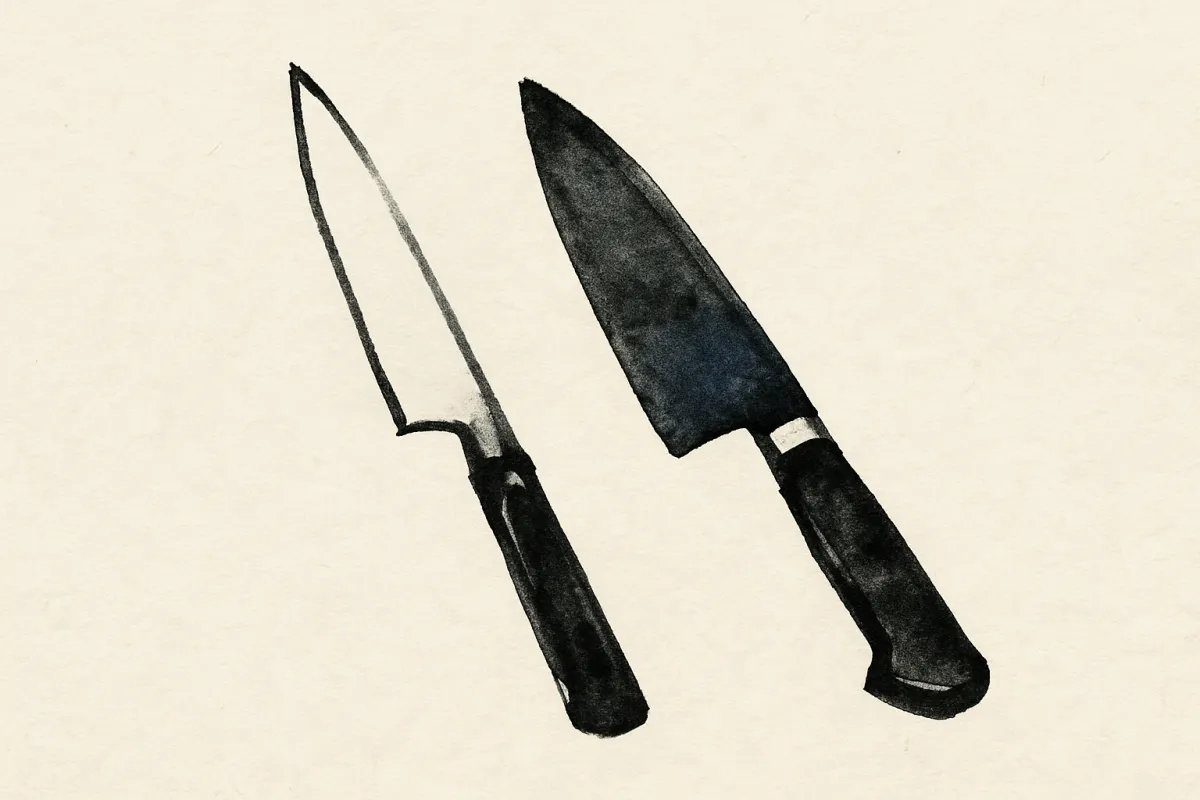
A dull German chef's knife and a thin Japanese blade that slides through a tomato under its own weight look like two versions of the same tool. They behave very differently. Before spending the money, the useful thing to settle is which one fits the way you actually cook. Most of the difference between them, from how they cut to how they break, is how hard the steel is.
Hardness sets the terms
Steel hardness is measured on the Rockwell C scale (HRC). German knives (Wüsthof, Zwilling/Henckels) run soft, 54–58 HRC. Japanese knives run hard, 58–67 HRC. Wüsthof hardens its Classic to 58; Shun runs its VG-MAX steel to 60–61 and its powdered SG2 to 61–62. That gap sounds small until you hear how Shun's own people describe it: "an increase of 1 degree Rockwell equates to an increase in hardness of about 10%." A jump from 58 to 61 is bigger than it looks.
Why harden steel at all? Because a hard blade holds a thin, acute edge. Sharpen a soft German knife to the same keenness and, in use, the very apex slowly bends over (it rolls) and the knife feels dull even though no metal is missing. Hard steel resists that deformation and keeps the acute shape, which is why a Japanese edge stays sharp longer.
That edge life has a real cost. As metallurgist Larrin Thomas puts it, "toughness and edge retention are generally opposing properties, and it is difficult to improve both at the same time." Push hardness up and you buy edge life by spending toughness. So the two camps fail in different ways. A soft German edge rolls, and you straighten it on a honing steel. A hard Japanese edge chips, and a chip only comes out on a whetstone. Both leave you with a knife that won't cut, but the repair is not the same.
Geometry and weight
Hardness decides what shape the steel can hold, and the shapes differ. Japanese edges are ground to roughly 10–15° per side, Western ones 15–20°. But the old "German = blunt wedge" picture is out of date: Wüsthof now grinds its standard edge to 14° per side, more acute than Shun's 16°. The real difference isn't only the angle. It's that the hard Japanese steel can keep a thin angle on a thinner blade, while soft steel needs a little more metal behind the edge to survive.
A thin, acute edge slips into food instead of wedging it apart. That clean glide through a tomato skin or a fish fillet is the payoff. The price is fragility. In Thomas's impact testing, the same 61 HRC steel was nearly undamaged at 25° per side but chipped clearly at 15°, under about a seventh of the force. Geometry drives chipping even more than hardness does.
Then there's weight. A Wüsthof Classic 8" is around 230–265g; a 210mm Japanese gyuto is often 150–180g. The German knife carries a full bolster and full tang (steel through the whole handle), so it's heavy and handle-balanced, which suits rocking the blade and powering through hard root vegetables. The lighter Japanese knife, with little or no bolster, sits balanced toward the blade and rewards a push-and-pull cutting motion; over a long prep session it's noticeably less tiring. The extra weight suits a different kind of work.
Rust is a separate question
The most common confusion is assuming hard means rust-prone. It doesn't: hardness and corrosion are independent axes. Plenty of Japanese knives use stainless steels like VG-10 or SG2 that are both very hard and rust-resistant; German steel (X50CrMoV15) is soft and stainless. The knives that genuinely need drying after every use are the traditional high-carbon Japanese blades (White and Blue paper steel), which are a further choice you make on purpose, not an unavoidable tax on switching. If rust anxiety is your dealbreaker, a stainless or stainless-clad Japanese knife gets you the thin hard edge with upkeep close to a German knife. (The whole fork is the job of the carbon-vs-stainless guide.)
Switch, keep, or both?
The right call depends on how you cook.
Switch if you do a lot of precise, thin slicing, want the sharpest edge you can get, or find a heavy knife tiring by the end of prep. The thin, light, hard blade pays off the first time you use it, and it holds that edge for weeks rather than needing a honing steel every session.
Keep the German knife if you cut through bone or joints, hack at frozen food, split hard winter squash, or are simply rough with your tools. A soft edge that rolls and comes back on a steel is exactly right there; a thin hard edge would chip, and it deserves better than a drawer and a glass cutting board.
Own both, where most people land. Let the German knife do the tough, careless work; reach for the Japanese one for the fine, deliberate cutting. The two split the work between them rather than competing.
Switching also doesn't mean spending more. A real Japanese gyuto lives in a $130–220 band, right where a mid-range German knife already sits, and because you'll sharpen it for decades, the price math is gentler than it looks.
If you do switch, two decisions come next: which shape (santoku, gyuto, nakiri or petty) and which steel (White, Blue, VG-10 or a powdered grade). Whichever you choose, plan to keep it sharp. A thin hard edge is only worth having if you keep it sharp. When you're ready to hold a few, the shop is the place to start.