
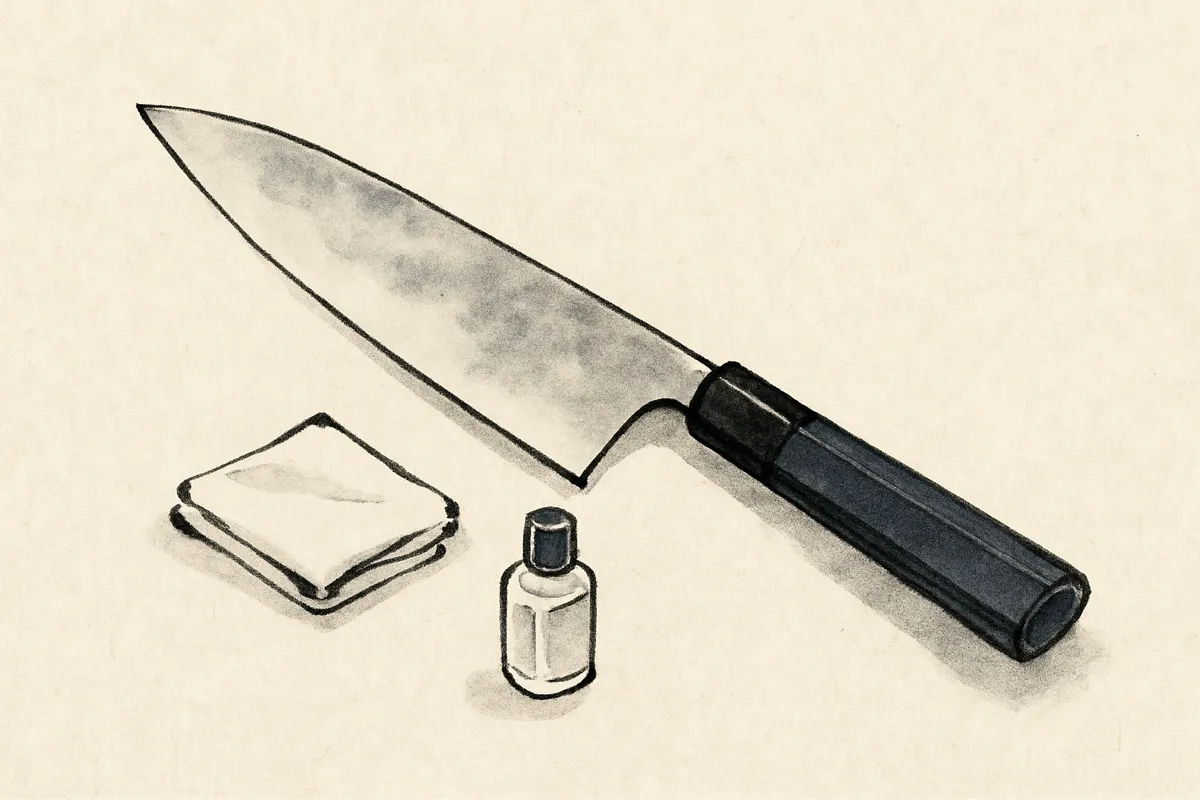
A day after your first proper Japanese knife arrives, orange pinpricks show up along the edge. Or you slice an apple and, where the flesh touched the steel, the blade goes a cloudy grey-black. Your old supermarket knives never did this, and both marks look like damage.
Usually neither is. But the two aren't the same thing, and telling them apart is most of knife care. One judgment axis sits under the washing, oiling and storage: patina is a friend, rust is the enemy. Get that distinction right and the wash-and-dry routine below follows.
Two kinds of oxidation, and only one is a problem
Both are iron reacting with air and water, but the reactions run opposite ways, with opposite outcomes.
The enemy is red rust: hydrated iron(III) oxide, Fe₂O₃·nH₂O. It forms a flaky, friable layer that doesn't stick, and its rough surface traps water and air against the steel, so it feeds itself. Corrosion engineers put it bluntly: rust begets rust. Left alone, it eats into the blade and leaves pits.
Patina is the other reaction: magnetite, Fe₃O₄, a dense, tightly-adherent grey-to-black film. Unlike red rust it doesn't shed; it seals the surface and slows further oxidation, a natural armour. That cloudy bloom the apple left is the friendly one. (Japan has used the same chemistry deliberately for centuries: nanbu ironware is fired to grow a permanent magnetite skin so the pot never rusts through.) On carbon steel a patina matures over the first few weeks of use from golden yellow through blue and purple to a settled grey.
Why does this only happen to your Japanese knife and never your stainless one? Chromium. Stainless steel carries 10.5% or more chromium, which forms its own invisible passive layer and blocks both patina and rust. Japanese carbon steels, especially Shirogami (White), have almost none, and that is exactly why they take a screaming edge and exactly why they react. It's the trade-off the steel guide covers: keenness is paid for in reactivity.
So which is on your blade? The reliable test is simple:
| Patina (leave it) | Rust (remove it) | |
|---|---|---|
| Chemistry | Magnetite, Fe₃O₄ | Iron(III) oxide, Fe₂O₃·nH₂O |
| Colour | Even grey, blue, black | Orange-red |
| Texture | Flat, part of the surface | Gritty, raised, spotty |
| Tissue test | Wipe with a white tissue: nothing transfers | Wipe: colour comes off |
| What it does | Slows further corrosion | Feeds itself, pits the steel |
One caveat: a patina slows rust, it doesn't grant immunity. You still wash and dry every time; it buys margin, not a pass.
The one rule, and the four things that break it
The core of knife care is one sentence: wash by hand and dry completely, immediately. Warm water, a drop of mild soap, then dry it, including the seam where the blade meets the handle, where water hides. That drying step is the one that actually prevents rust. A carbon blade left wet in a closed space can throw a rust spot in about fifteen minutes.
Four habits break the rule, and they're the ones that actually kill blades:
- The dishwasher: never. Several things go wrong at once: heat cracks the wooden handle, alkaline detergent and chlorine corrode the steel, and the blade rattles against other cutlery and chips. Chlorine is blamed for roughly 90% of rust even on stainless knives, so "it's stainless, it's fine" doesn't save you.
- Acidic and salty foods left sitting. Tomatoes, onions and citrus accelerate corrosion (and can discolour and flavour the food). Keep a damp cloth by the board and wipe the blade often as you work.
- The wrong cutting board. Glass, stone and metal are harder than your edge and chip it outright. Bamboo and hard plastic are rough on it too. End-grain wood is the standard: the blade sinks between fibres instead of splitting them.
- The honing rod. That steel rod that came with your Western knives will micro-chip a hard Japanese edge. Japanese blades are sharpened on water stones only, a skill you learn rather than a chore; the whetstone guide is where to start.
Sealing and storing so it can breathe
For a full-carbon knife, a thin film of oil before you put it away keeps the blade dry in storage. Use camellia (tsubaki) oil, the traditional blade oil smiths and even samurai kept on steel for centuries, or food-grade mineral oil, its cheaper equal; both are food-safe, non-drying and slow to go rancid. What you don't reach for is a kitchen cooking oil: olive, sunflower and coconut all oxidise into a sticky, smelly film. Wash, dry, a few drops on a cloth, wipe both faces thin, blot the excess.
Where the knife lives matters as much as how you dry it. The worst choice is also the commonest, the knife block: its slots trap dust and moisture, never ventilate, and scrape the edge each time you sheath. Better options let air reach the steel:
- A magnetic strip. Visible, ventilated, and it dries between uses. Set the blade spine-first and roll the edge down; never bang the cutting edge onto the magnet.
- A saya, a wooden sheath, traditionally of honoki (magnolia), which is light, mildly antibacterial and breathes moisture in and out. It's effectively required for single-bevel knives like the yanagiba (more on those in the single- vs double-bevel guide), and it must go on a bone-dry blade: you can't clean the inside of a saya, and a knife sheathed wet will rust in there, stainless included.
When rust wins anyway
It happens. Catch it early and work gentlest-first. A baking-soda paste left on for about an hour lifts light surface rust. A rust eraser (sabitori), a rubber block with fine abrasive, handles more; soak it, then rub along the grain of the steel to keep the finish even. For the stubborn rest, Bar Keepers Friend (the oxalic-acid scouring powder chemist George Hoffman first bottled in 1882) sprinkled on with a little water for about five minutes does the job. Rub along the grain, then wash and dry thoroughly so it doesn't return.
The one thing to accept: pitting is permanent. Once rust has bored deep black pits into the steel, no eraser or powder brings them back. That is why the fifteen-minute rule earns its keep.
None of this is precious or difficult. It's one habit, wash, dry, put away dry, built on one idea: the grey bloom is the blade protecting itself, the orange spot is the blade under attack. Kept dry, a good Japanese knife, the kind worth what you paid for it, stays sharp and sound for decades.