
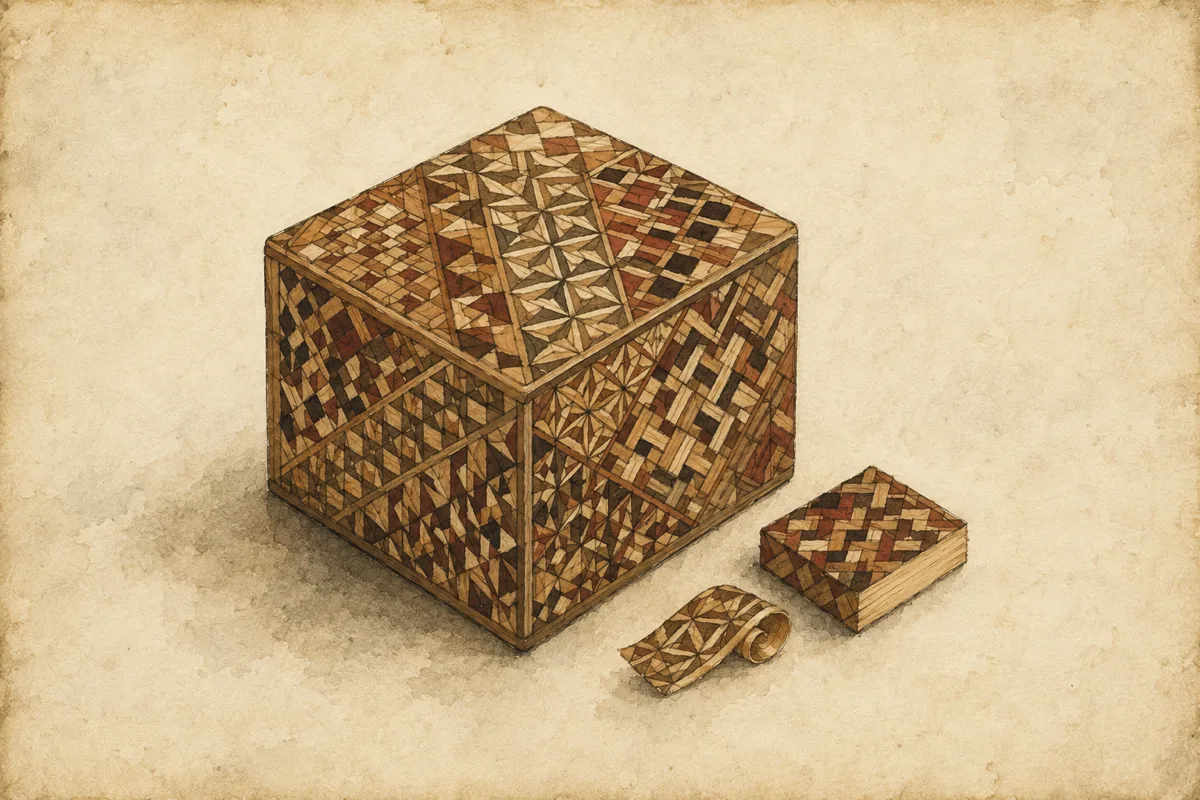
Pick up a small patterned box in Hakone and the first question is what the surface actually is. Most people guess inlay, or a very good print. It is wood: every colour in the pattern is a different tree, and on most boxes the entire design is a sheet about two-tenths of a millimetre thick that was planed off the end of a solid block.
The block comes first
Nobody draws a pattern onto a box in yosegi-zaiku (寄木細工). The pattern is built first, as a physical object in three dimensions, and the box only comes into it later.
A maker starts with strips of wood cut to shape, planes their faces true, and glues them together in the order the design requires. Those bundles become blocks. Blocks get sliced, rearranged, and glued again, and the pattern doubles in complexity each round. The result is a taneita, a patterned block, and the design carries through its full length, the way lettering carries through a stick of rock. Cut the block anywhere and the same pattern shows on the cut face.
No paint, stain, or dye is used at any stage. The colour is whatever the tree was.
Two things you can do with the block
Zuku-bari came first and remains the more common method. The block is clamped and shaved with a specialised hand plane into sheets of 0.15 to 0.2mm, thinner than a business card. These sheets, the zuku, are then glued onto boxes, trays and coasters. The sheets curl as they come off the block, so they have to be flattened again, either with an iron or by backing them with Japanese paper.
Muku-zukuri does the opposite. The patterned block is not sliced at all. It goes onto a lathe and is turned or hollowed into the finished object, so the pattern runs through the walls and appears on every face, including the inside of a bowl and the underside of a cup.
You would expect the solid method to be the old one and the veneer to be the shortcut. It is the other way round. Zuku-bari is the older technique and the origin of Hakone marquetry. Muku developed only after the war, once adhesives and finishes were good enough to hold a laminated block together under a cutting tool, and the Kanazashi workshop in Hatajuku credits Kanazashi Katsuyoshi with devising it.
So a zuku piece carries its pattern as a very thin sheet on the outside, and a muku piece is patterned all the way through.
The colours are species
Because nothing is coloured artificially, the palette is a list of trees. More than fifty species go into the craft.
White comes from aohada and mochinoki, and from mizuki dogwood. Black from ebony, black persimmon, and dark katsura and chestnut timbers. Red from padauk and rengas. Brown from Japanese pagoda tree, camphor, zelkova, and cherry. Greys, yellows, and pale straw tones each have their own woods again.
The one that surprises people is green, which comes from hōnoki, Japanese bigleaf magnolia. A maker who wants a new colour goes looking for a species that already has it.
Not all of those trees are Japanese. Padauk, rengas, and walnut are imported, so most boxes mix Hakone mountain species with tropical hardwoods.
Where it came from, and the disagreement about it
Everyone agrees the craft belongs to Hatajuku, which sat on the Tōkaidō between Odawara and Lake Ashi and lived on passing travellers buying something to carry home. They do not agree on where the technique started.
The Hakone Tourist Association tells it locally: Ishikawa Nihei of Hatajuku noticed how many tree species grew in the Hakone mountains, began assembling woods of different colours and grains into trays and boxes, and is said to have devised the method in the Kōka era, 1845 to 1848. The association marks that account as tradition rather than record.
The Kanazashi workshop, itself in Hatajuku, traces it elsewhere. On their account marquetry began in Sunpu, now Shizuoka, in the mid-17th century, among craftsmen assembled from around the country to build the Sengen Shrine, and it developed there for roughly two hundred years. Ishikawa, whom they date 1790 to 1850, brought the technique home to Hakone.
The two accounts have never been reconciled, and the Shizuoka lineage is simply absent from the association's telling.
What followed is well dated. A foreigner is recorded buying a piece in 1820. Sales widened after Shimoda opened in 1854, a Yokohama outlet followed in 1859, and work went to the St. Louis World's Fair in 1904. The famous puzzle box, the himitsu-bako, was devised in 1894, and some versions take more than a hundred moves to open.
Reading the patterns
Some sixty traditional patterns are recognised, and colour variants push the total past a hundred.
These patterns belong to Japanese design generally: seigaiha waves, ichimatsu checks, yabane fletched arrows, sayagata key fret, mimasu nested squares, yakko, nikuzushi, and asanoha, the hemp leaf that also runs through kumiko latticework. Here the same figure is glued up from end grain rather than assembled from lattice bars.
What happened to it
The industry declined from around 1937, and by the Tokyo Olympics of 1964 the number of marquetry craftsmen had fallen sharply. It was designated a traditional craft by the Minister of International Trade and Industry in 1984.
Tourism kept it going at the start and keeps it going now, which has held it alive and held it small. Turn a piece over before you buy it. On zuku the pattern stops at the surface; on muku the same pattern is on the base and inside the rim.