
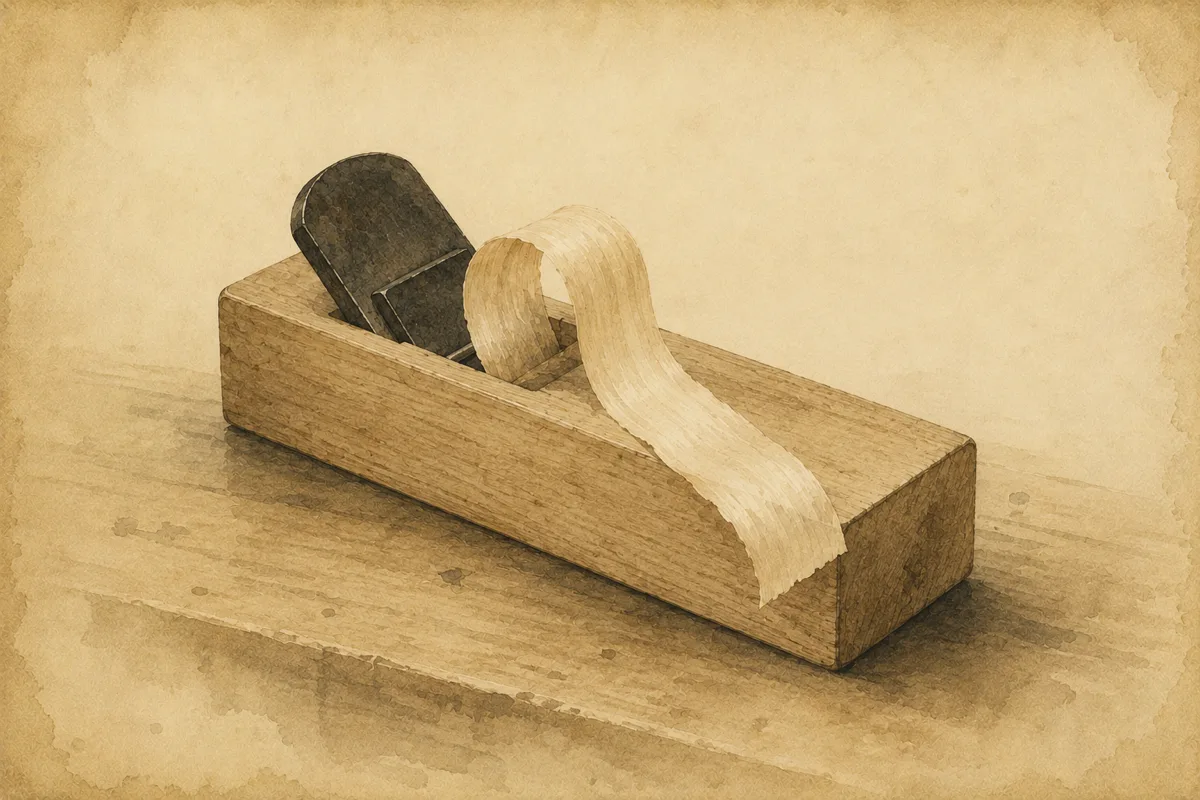
There are no screws on a kanna. No lever cap, no depth knob, no lateral adjuster. It is a blade jammed into a block of oak, and the only tool for adjusting it is a hammer.
What it is
A kanna (鉋) is a Japanese hand plane, and the first thing to know is the direction. It is pulled toward the user rather than pushed. The body is hardwood, typically Japanese white or red oak. The blade is laminated steel and iron, and it is stout compared with a Western plane blade.
The blade is tapered in both length and thickness, and it drops into a matching tapered mortice cut through the block. That taper is the whole fastening system. Push it deeper and it locks tighter. That is why nothing else holds it down: no wedge, no cap iron.
Set the depth by tapping the blade. Back it off by tapping the block itself.
The pull
Pulling changes how your body loads into the cut. The grip puts the dominant hand at the centre of the plane and the other hand near the head of the blade. Feet apart, one forward and one back, knees slightly bent. From there the stroke comes from the torso, with the arm held close to the body, not from the shoulder pushing outward. On a long board you walk backward through the cut, keeping the pressure even the whole way.
The rule has exceptions. Among the named plane types is the tsuki kanna, a push-style kanna.
Why the sole is shaped
Most people who buy a kanna try to true the sole up like a Western plane. The sole is not meant to be flat. It is shaped into a wave form. Wood is scraped away between the mouth and the toe, and again behind the mouth so that the heel sits slightly in the air. What remains is a small number of deliberate contact points. The plane rides on those, not on its whole length, and that is what lets it take a consistent fine cut without the sole dragging and chattering across the board.
The interior surfaces in the throat get the same treatment. They are shaped individually to fit that particular blade, tested by pencil transfer and scraped back, over and over, until the bedding matches the hollow on the back of the blade. A kanna body and its blade are fitted to each other, and cannot be swapped between planes.
This also means the block is consumable. It moves with humidity, it wears, and the relief has to be recut. The clearest evidence that this is routine is that a whole category of plane exists for it: the dainaoshi ganna, a plane whose job is planing the soles of other planes.
One known weak point: at full cutting depth, the blade tends to bulge the block directly behind the mouth, because the wood is thin there. That area needs watching.
Setup is the skill
Everything about conditioning a kanna is judged by hand, eye and ear, with no instrument involved at any stage.
Uradashi, tapping out, is the clearest case. The back of the blade is hollowed, and as sharpening eats into the edge that hollow has to be pushed back out by striking the hard steel with a hammer to move metal. Get the angle right and the blade sounds dead under the hammer, with no vibration through it. Get it wrong and it answers with a bright ping, which is the sound of a blade about to be damaged. The work leaves a pattern of dimples across the back, and reading that pattern is how you tell whether it was done well.
The rest follows the same logic. Scratch patterns tell you where the bedding touches. Reflected light tells you whether the chipbreaker is meeting the edge without a gap. Feel tells you what the stone is doing.
The chipbreaker has to sit very close to the edge and meet it in a light-tight fit to do anything at all. It is held by a simple nail set perpendicular to the blade, with bent ears pressing down. Practitioners are fairly blunt that for most work the plane runs perfectly well without one, and it is a late addition anyway, arriving only in the Meiji period.
Where the plane came from
The wooden-bodied plane is a late arrival in Japanese woodworking. Up to the sixteenth century, Japanese carpenters cleft and hewed timber with axes and adzes, and when a surface needed finishing they used the yariganna, a spear plane. It is a blade on a long shaft, drawn along the wood, and it leaves the faintly rippled surface you can still see on the oldest temple timbers.
It arrived through the seventeenth century, alongside a supply change: sawn timber replacing hewn timber. Sawn stock gives you flat-ish faces of a consistent thickness, which is exactly the situation a bench plane is good at and the situation a spear plane is not.
The yariganna then disappeared completely. None were made and nobody used one for 300 years. It came back in the twentieth century for an unusual reason: carpenters restoring old temples wanted to reproduce the exact toolmarks of the original work, and only the original tool leaves them.
The blade that took its place is the one that now cuts the joints holding those buildings together without nails, and the thin strips of the lattice panels set above their doors.
Microns, and what they actually measure
Since 1997, Japan has held a competition called Kezurou-kai where the object is to take the thinnest possible shaving with a kanna.
The format has barely changed. Shavings are measured under micrometers against three criteria: staying within the time limit, the width of the shaving, and its thickness. Only a complete shaving counts, with no gaps or defects, full length and full width. Competitors get three attempts a day, and the five thinnest go to a final.
The numbers, on hinoki with a 70mm plane: preliminary shavings run as thin as 5 microns, and a good competitor's three attempts might measure 10, 6 and 9. Finals are deliberately harder, planed on sugi, Japanese cedar, in three or four minutes per person. Winning final shavings have come in at 15 microns in one year and around 50 microns in another.
Past a point, thinness stops being about the carpenter. Grain evenness, density and above all moisture dominate. Competitors wrap their boards in plastic and lay damp towels on them to hold water in the wood, and wiping a board with a lightly damp rag right before the stroke changes the result completely.
A shaving is also a readout of the edge. A clean 10 micron shaving proves the blade carries no defect bigger than 10 microns along its entire width. No technique fakes it, and no inspection of the steel reveals it. An edge that clean leaves a planed surface that needs no sandpaper.
Reading a kanna
Pick one up and the useful questions differ from those you would ask of a Western plane.
The named types divide by the surface each one is meant to reach. Hira ganna, the flat smoothing plane, is the default; kiwa ganna is a shoulder plane for working into corners; mizo ganna cuts grooves; sori kanna has a convex sole for hollows and curves; nankin kanna is the spokeshave form. Three sit outside that scheme: dainaoshi ganna for the soles of other planes, yariganna for the old surfaces, and tsuki kanna for a push stroke.
These tools have also been collected as objects in their own right. The Takenaka Carpentry Tools Museum in Kobe, opened in 1984, holds more than 30,500 items, including some 20,000 tools, conserved as cultural heritage rather than as accessories to the buildings they made.
In every case the purchase is a blade and a body matched to each other, and the match will need remaking. The tool arrives unfinished, and stays that way for as long as it is in use.