
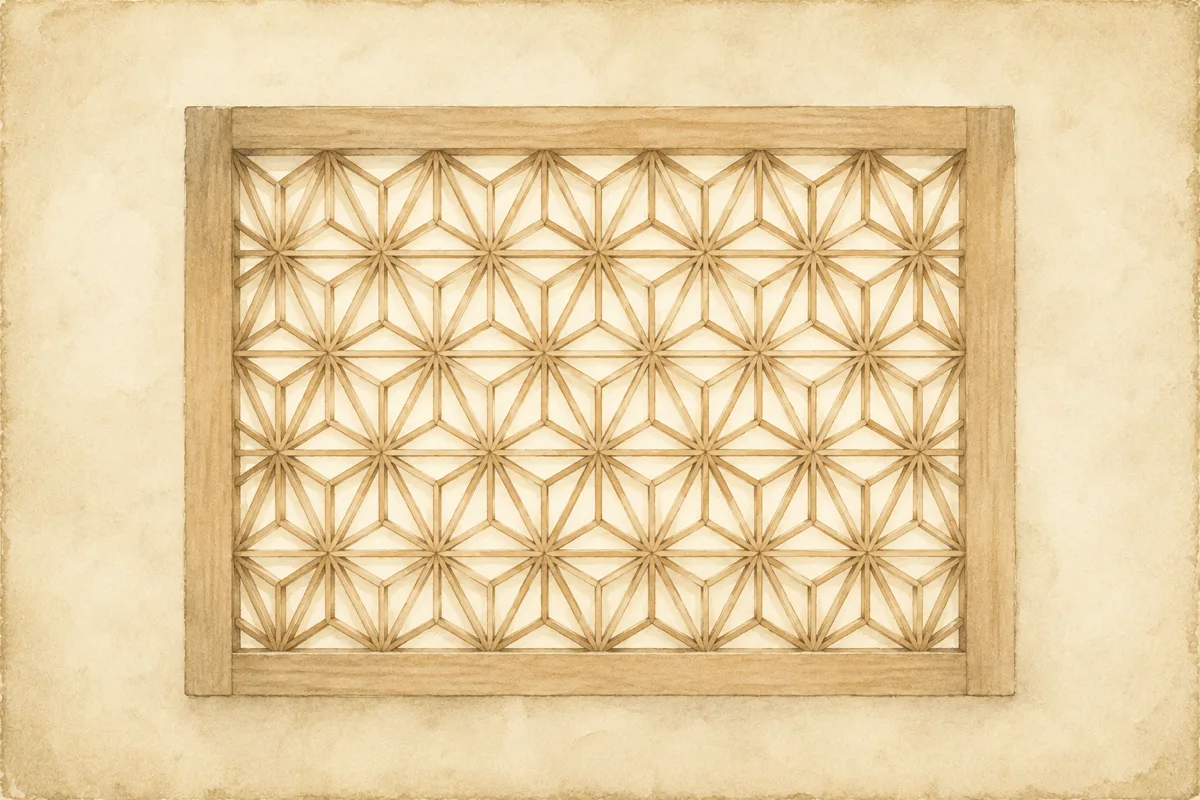
Hold a kumiko panel up to a window and the light comes through it broken into repeating shapes. The construction is the odd part. There are hundreds of separate pieces of wood in a panel the size of a book, and nothing holds them together. No nails, no screws, no glue. They are cut so precisely that they cannot fall apart.
What kumiko is
Kumiko (組子) is a technique of assembling many thin, slit strips of wood into geometric lattice. It is closer to a design practice than a joinery method. The joints are the means; the pattern is the object.
It lives in specific places in a Japanese building. Shoji screens, sliding doors, room dividers, and above all ranma, the transom panels set in the gap between the top of a sliding door and the ceiling. A ranma has a real job, moving air and light between rooms in a house with few solid interior walls, and kumiko is what fills that opening without closing it.
Why it stays together
The mechanism is pressure.
A maker builds a ground lattice first, a grid or diamond framework that fixes the geometry. Then the small infill pieces go in, each one notched and angled at its ends so it wedges between the members it lands on. Every piece is cut a hair oversized, so seating it takes a push. Multiply that by a few hundred pieces inside a rigid outer frame and the panel becomes a structure under continuous internal compression. Nothing can move because everything is pressing on everything else.
This only works at a tolerance most woodworking never needs. Skilled practitioners assemble to an accuracy of around 0.1mm. That is the whole margin. Cut a strip a fraction long and it splits its neighbour; a fraction short and the pattern goes slack and rattles. Properly made panels hold their shape for centuries, and nothing in them depends on an adhesive that can fail.
It is the same thinking as the nailless joinery used in furniture and temple frames, shrunk down until it becomes ornament.
Where it came from
The technique goes back to around the 7th century, the Asuka period, arriving alongside Buddhist temple architecture from the continent and then developing along its own line in Japan. What happened before that is murky. There is a persistent claim that the earliest lattices copied woven bamboo basketry in wood. Nobody can prove it, but one of the standard patterns, kagome, is openly named after a woven bamboo basket.
From the Heian into the Kamakura period, kumiko spread through temple architecture, filling transoms and lattices. The turn that mattered most came in the Muromachi period, when it became a decorative element of the tea room and of shoin residential architecture. That is the world of the formal tea gathering, where light in a small room was designed rather than left to chance. A lattice that breaks daylight into pattern belonged there.
The Edo period is when the pattern library exploded. Complex and elaborate designs proliferated, and by the end of it more than two hundred patterns were documented. Several hundred variations are recognised today.
Reading the patterns
Most kumiko patterns are not abstract. They are named motifs, and the majority carry an auspicious meaning, which is why they turn up on things given as gifts or built into family homes.
Asanoha (麻の葉), the hemp leaf, is the one nearly everyone meets first, and at a glance it barely looks like a leaf: it resolves into a repeating star-like hexagonal figure, six points radiating from each node. Its associations are growth, long life, and protection from evil.
Kikko (亀甲) is tortoiseshell, hexagons, and the meaning follows the animal: longevity.
Kagome, the woven-basket pattern, drives evil away.
Shippo links circles end to end without a break, and the unbroken chain is the point: family happiness, prosperity that keeps going.
Seigaiha repeats waves and carries a wish for financial and business success. Goma promises perpetual youth and long life. Shokko came from Chinese brocade, an octagonal design, and it means successful marriage and longevity.
A panel can therefore be read as a wish rather than a texture: asanoha for growth, shippo for a household that stays unbroken.
The two families
Two structural families sit underneath the variety, and nearly everything is a development of one or the other.
Hishi kumiko is built on the diamond. The ground lattice runs on the diagonal, and asanoha belongs to this family.
Koshi kumiko is built on the square grid, with members meeting at right angles, and it looks calmer, more architectural.
The family determines the angles a maker cuts and the jigs they need, which is why a beginner's kit almost always starts with one grid and one set of angles.
Wood, and what it costs
The woods are the fine-grained Japanese standbys: cypress (hinoki), cedar and cryptomeria (sugi), zelkova (keyaki). At these dimensions the notch is the structure, so grain that wanders, a knot or a run-out or a swirl, puts a fault line exactly where the load sits.
Ready-made panels give a sense of the economics. Tanihata sells standard kumiko panels at roughly ¥7,900 to ¥17,400 for a 300 × 300mm piece, varying by pattern and wood, with a standard frame member of 30 × 30mm and finer 16mm and 12mm options. The finer the frame, the more pieces the same area needs, and the price moves accordingly.
A craft with a supply problem
Demand has moved away from it. Japanese homes contain fewer traditional rooms than they did, fewer shoji, fewer ranma, and the number of practising craftspeople is falling. Kumiko has come off the wall in response: panels now show up as lighting, screens, inset furniture, and standalone art objects, which is also how most people outside Japan first encounter it.
The work continues in a building type that is disappearing, and the panels get sold as objects rather than fitted into rooms. The tolerance is the same 0.1mm either way.