
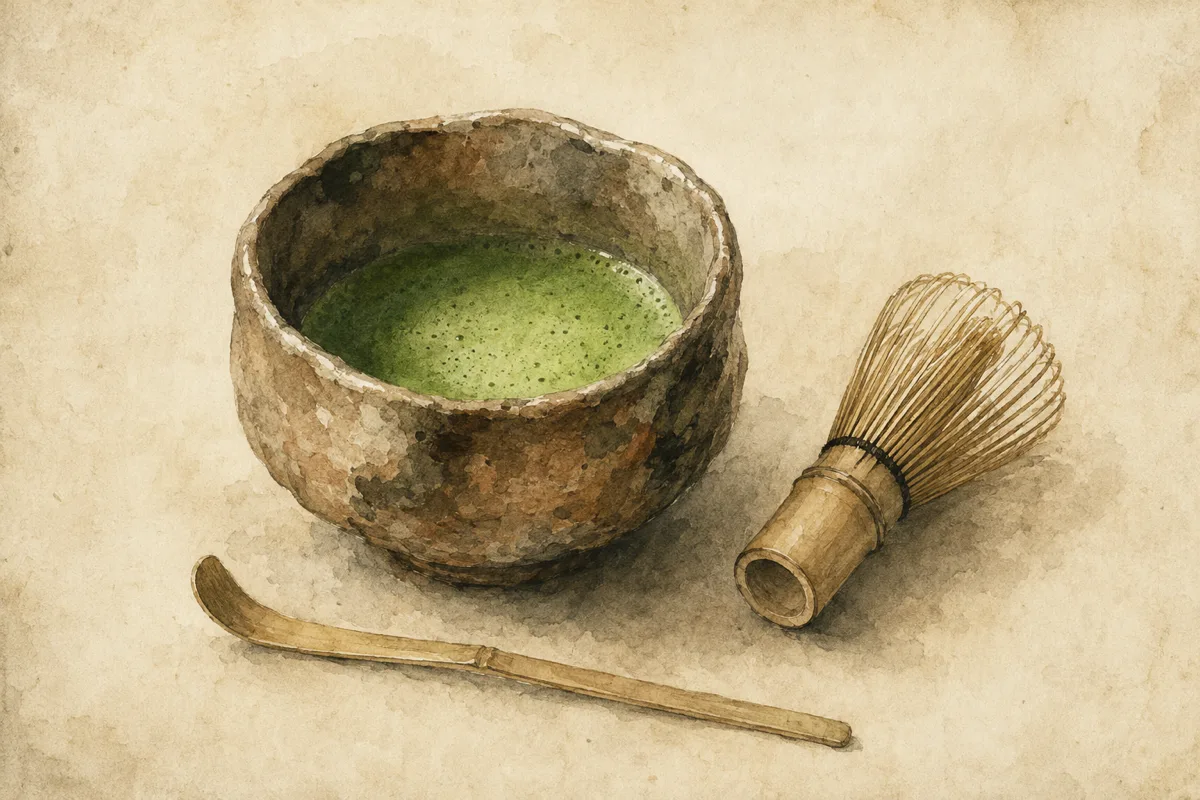
You bought a tin labeled ceremonial grade. A guide told you that's the good stuff, whisked on its own rather than buried in a latte. But nobody explains the word doing the work in that phrase. What ceremony? Whose? Why does anyone turn making a cup of tea into something with a name, a lineage, and four-hundred-year-old rules?
That ceremony is chanoyu, and it is a great deal more than whisking and serving matcha.
"Hot water for tea," and everything after
Chanoyu (茶の湯) translates as "hot water for tea." Pursued as a lifelong discipline it's called chadō or sadō (茶道), "the way of tea." The Met's Heilbrunn essay defines it as "a ritualized, secular practice in which tea is consumed in a specialized space with codified procedures." Secular here means it isn't a religious rite, though its manners grew straight out of Zen. Powdered tea came from China in the twelfth century with Buddhist priests; the monk Eisai is credited with bringing the practice, and in Zen monasteries tea earned its keep as an aid for staying alert through long meditation.
So the bowl is the center, but it isn't the point. The point is the meeting. In a gathering the host chooses the most beautiful face of the bowl, turns that front toward the guest, and the guest, out of respect, rotates it away before drinking, then studies the bowl once the tea is gone. Every gesture is an exchange, not a service. As Sen Genshitsu, the fifteenth-generation head of the Urasenke school, put it, the paradox of tea is "that we can find a lasting tranquility within our own selves in the company of others."
Rikyū, and the beauty of the plain
The man who fixed all of this in place was Sen no Rikyū (1522–1591), a merchant from the port of Sakai. He inherited a stripped-down style of tea from the monk Murata Jukō and the master Takeno Jōō, and pushed it to its limit, perfecting what's called wabi-cha: beauty found in the humble, the rustic, the imperfect. Where earlier hosts had shown off imported Chinese treasures, Rikyū shrank the room to two tatami mats (his tiny tea house Tai-an survives as a National Treasure), had guests stoop through a doorway so low that rank couldn't fit through it, and chose rough, hand-shaped raku bowls (originated with the tile-maker Chōjirō) over anything expensive. Here wabi-sabi becomes concrete, something you can hold rather than an abstraction. If you've ever wondered why a serious matcha bowl (chawan) can look deliberately uneven, this is the source.
Rikyū served the two most powerful men of his age (Oda Nobunaga, then Toyotomi Hideyoshi) as their tea master. And in 1591 Hideyoshi ordered him to commit seppuku. The reason has never been settled: a wooden statue of Rikyū placed over a temple gate the ruler then had to walk beneath, a quarrel over the trade in utensils, or, in the reading many historians prefer, a collision between Hideyoshi's gold-plated taste and Rikyū's insistence on the plain. It remains genuinely disputed.
Four characters: wa-kei-sei-jaku
The spirit of a tea gathering compresses into four characters, the four principles: wa (和, harmony), kei (敬, respect), sei (清, purity), jaku (寂, tranquility). The Urasenke school glosses them carefully: harmony as the give-and-take of host, guest, food, and utensils "with the flowing rhythms of nature"; respect as "the sincerity of heart" that recognizes the dignity of each person; purity as cleanliness of both the room and the mind. Jaku, tranquility, is not a fifth thing you do; it is the calm "that comes with constant practice of the first three." You don't aim at it; it arrives.
These are almost always credited to Rikyū, but Murata Jukō (1423–1502) had already stressed four values, kin (humble reverence), kei, sei, jaku, in a letter to a student around 1488, the Kokoro no fumi, the "Letter of the Heart." Rikyū's contribution was to swap Jukō's kin for wa and settle the set into the form we quote. Jukō planted it; Rikyū perfected it.
The one meeting, ichi-go ichi-e
If you see a single scroll hanging in a tea room, it may well read ichi-go ichi-e (一期一会), "one time, one meeting." Ichigo is a Buddhist word for an entire lifetime; ichie, one meeting. However often the same host and guest sit together, this gathering, this weather, this bowl, these people, this hour, can never recur, so both sides owe it their full sincerity. The sentiment traces to Rikyū, but the crisp four-character phrase was set down some 250 years later, in the mid-1800s, by the tea-practicing lord Ii Naosuke in his treatise Chanoyu Ichie Shū. It's the whole philosophy of impermanence, folded into a cup you can only drink once.
The three Sen houses (san-senke)
Rikyū's tea didn't die with him. One generation past his grandson Sen Sōtan, the family split into three head houses that still transmit his teaching today, the san-senke: Omotesenke, Urasenke, and Mushakōjisenke. The names are literal: omote means "front" and ura means "back," because the Urasenke teahouse, Konnichi-an, sat on the back street behind the Omotesenke residence. For an English-speaking reader, one house matters most in practice: Urasenke is the largest and the most active outside Japan, so the tea gathering you book in Kyoto or the lesson you find in your own city is most likely theirs.
None of this is required to enjoy a bowl at home. But it changes what the bowl is. The next time you sift a spoonful of ceremonial-grade matcha, reach for the chasen and chawan, and whisk, you're performing in thirty private seconds the last gesture of a four-hundred-year conversation about harmony, respect, and the fact that this cup will never come again. When you want the whole thing (the sweets served first, the lacquer tea caddy, the room), that's a tea gathering, and now you know what you're walking into. Start by getting the tea itself right; when you need a fresh tin, browse the shop.
Key facts
- Chanoyu (茶の湯), pursued as the discipline chadō/sadō (茶道), the way of tea, is a secular practice with Zen-rooted manners, where the gathering, not the drink, is the point.
- Sen no Rikyū (1522–1591) perfected wabi-cha (two-mat rooms, rough raku bowls, plainness over display) and was ordered to commit seppuku in 1591 for reasons that remain genuinely disputed.
- The four principles, wa-kei-sei-jaku (harmony, respect, purity, tranquility), are credited to Rikyū but were seeded a century earlier by Murata Jukō (as kin-kei-sei-jaku, c. 1488); jaku is the calm that results from practicing the first three.
- Ichi-go ichi-e, "one time, one meeting," captures the impermanence at the heart of tea; the phrase was fixed by Ii Naosuke in the 1800s, not coined whole by Rikyū.
- Rikyū's tea lives on through the san-senke (Omotesenke, Urasenke, Mushakōjisenke), of which Urasenke is the largest and most active abroad, and thus the usual entry point for students overseas.