
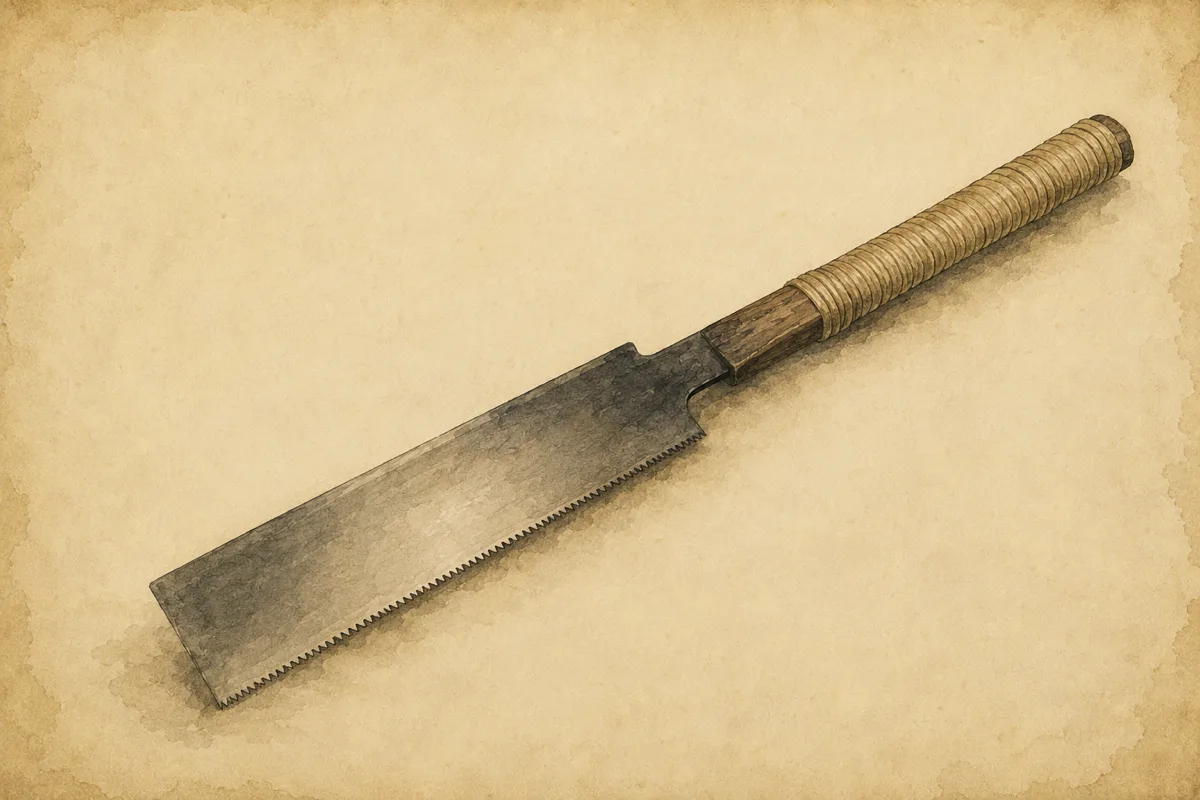
Pick up a Japanese saw and the teeth point at you. Pushed, it flexes and skates. Pulled, it drops into the wood at once, cutting a slot so narrow you can barely see daylight through it.
Every explanation of the tool stops at that reversal. The Japanese saw is not one ancient tool but a stack of fixes, and the two features people most associate with it are barely a century old.
Why pulling works
A push saw has to survive compression. Force the blade forward and the steel wants to buckle sideways out of the cut, so it has to be thick enough to resist that, and thick steel means a wide kerf and a lot of wood turned into dust. Pull instead and the blade is stretched straight by the force that cuts. It cannot buckle. It can be made much thinner without wandering. Dozuki blades sell in thicknesses of 0.38, 0.4, 0.5 and 0.6mm, with kerfs from about 0.4mm, and tooth pitch running down to 0.9mm, roughly 28 teeth to the inch.
A saw that removes four tenths of a millimetre per cut is not doing a lighter version of the same job as one that removes two.
There is also a body reason, and the Japan Woodcraft Association gives it plainly: Japanese woodworking is done seated, on the floor, with the work held by foot and knee rather than a bench vice. From that position you can pull with far more force and control than you can push. The tool suits the posture, and the posture suits the joinery.
Pull saws are not a Japanese peculiarity. They turn up in China, Korea, Iran, Iraq, Nepal and Turkey. The claim that pulling cuts more efficiently is asserted more often than demonstrated. The kerf can be measured.
The saw was designed around soft wood
The design also had a material to answer to. Japanese saws were made for cypress, cedar and pine. European saws were made for oak and maple. Thin blades and fine teeth work beautifully in a straight-grained softwood and struggle in a dense hardwood, and the original Japanese saws were less suitable for hardwoods than push saws. Modern versions with a reinforced steel spine handle hardwood without complaint, but the ancestry shows. Hinoki and sugi are what the country had in quantity, and the tools grew to fit them.
The tool Japan did not have
Saws reached Japan early. Serrated stone and fish bone were used for cutting in the Jomon and Yayoi eras, metal saws appear around the fourth century in the early Kofun period, and the oldest documented form dates to the fifth. But those early saws functioned closer to rasps than cutting tools. And every ancient Japanese saw was a yokobiki, a crosscut saw.
Nothing could rip.
So for something like a thousand years, a board was not sawn out of a log. It was split out of one, by driving in wedges, a technique called yawari. Splitting follows the grain wherever the grain goes, so you cannot decide a thickness, take two boards off the same face, or use a log whose fibres twist.
The rip saw arrived in the middle of the Muromachi period. Ripsawing in Japan begins from the mid-fifteenth century, with a large two-person saw called the oga. That single import is upstream of most of what people now think of as Japanese woodworking. Sawn stock makes flat, even, dimensioned boards ordinary rather than lucky. The bench plane spread in the seventeenth century: a plane is good at a flat-ish sawn face and useless against a hewn one. Nailless sashimono cabinetry and shoji frames need parts of consistent thickness before the joints are worth cutting.
The whaleback
The two-person oga did not last. During the Edo period it gave way to one-person rip saws, the kagari and the maebiki oga, whose name reads as "front pull large saw." It is the wide, curved, whale-shaped blade that turns up in museum collections and in Hokusai's print of sawyers at work.
Everything about it is built for a person hauling against a log all day. The handles run 7 to 8cm in diameter and 15 to 20cm long, giving two hands a large bearing surface, and paulownia was preferred because it stays comfortable and does not get slippery when wet with sweat. The teeth get progressively smaller toward the handle so the cut starts easily, with generous taper and heavy set. The blade itself is two metals: a strip of hardened high-carbon tamahagane forge-welded along the toothed edge, with the whole body behind it made of soft, unhardened low-carbon iron. Hard where it cuts, tough where it must not crack. By around the seventeenth century the saw had subdivided by purpose, and most of the types still in use were in place.
What each type is for
Two families sit at the top: kataba, single-edged, and ryoba, double-edged. Most of the specialised saws below are kataba, with the small azebiki a double-edged exception.
Ryoba carries crosscut teeth along one edge and rip teeth along the other, which makes it the general carpentry saw. Blades run 20 to 36cm, and carpenters describe them by that length: 240mm for ordinary work, 270mm and up for timber-frame joinery.
Dozuki takes the joinery cuts. Its very thin blade is stiffened by a folded steel or brass back, which fixes it dead straight at the cost of how deep it can go. Blades 20 to 28cm.
Azebiki has a short blade with curved edges on a long neck, so it can be started in the middle of a panel rather than at an edge. Useful for sliding dovetails and mortise work.
Anahiki, at 31 to 46cm, is the long rough-work saw for logs and beams.
Kugihiki is the flush-cut saw, and it has no set to the teeth at all. Set is what stops a blade binding, but it also scratches. Remove it and the saw can lie flat against a finished surface, trimming a dowel or a plug without marking the wood around it.
Mawashibiki is the keyhole saw, narrow and long for curves.
Maebiki, the whaleback, runs 40 to 60cm and beyond.
Where they are made
Saw making in Japan concentrates around Miki, in Hyogo. Forging there is said to go back some 1,500 years, an origin story crediting Korean smiths from ancient Paekche, though that is traditional account rather than documented record. The Edo commercial history is dated. Wide-bladed ripsaws went into production in 1763, and the industry took off. Miki lost its Osaka distribution rights in 1792. Demand fell around 1885 as Western manufacturing arrived.
The forging itself runs nine steps with a temperature at almost every one: iron and carbon steel forge-welded at about 1,200°C, edge and centre forging, shaping at 950 to 1,000°C, annealing near 750°C, grinding, quenching at 700 to 800°C, tempering in oil and salt at only 150°C, then final polishing.
The two young features
The ryoba, the double-edged blade that is the emblem of the Japanese saw abroad, is a Meiji-period invention. It spread from the late Meiji period onward.
The replaceable blade is younger still. Hand-forged saws gave way to replaceable-blade construction during the Showa era, and that is why your saw cannot be sharpened. Modern teeth are impulse or laser hardened, which keeps them sharp far longer than a Western handsaw's teeth, and too hard to file. A replacement blade is cheaper than the labour of sharpening.
The traditional alternative has not disappeared. Cutting and setting teeth is its own trade, metate, and metate-shokunin still work. But the current practice among most craftsmen is to buy a new blade.
What the tool actually is
A saw sold today as unbroken tradition has a fifteenth-century import at its root. The types were fixed in the seventeenth century, the double edge in Meiji, the throwaway blade in Showa.
Each of those answered a problem that was live at the time. The most recent one was that the sharpening trade had begun shrinking faster than saws wear out, and the answer was to stop sharpening them.