
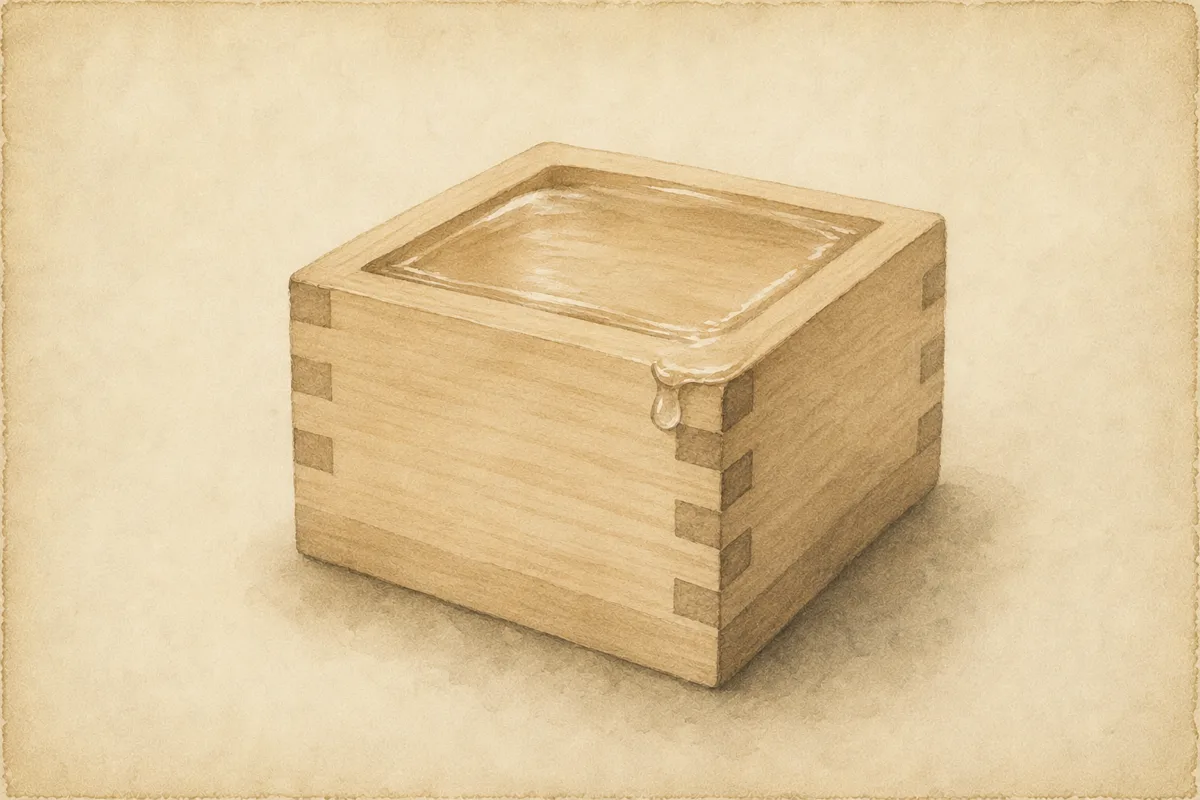
The small square box your sake arrives in, the pale one that smells faintly of a forest, is a masu (枡): a measuring vessel that only later became a cup. That 1-go box holds about 180 millilitres because a go is a unit of volume worth 180 millilitres, and the box is simply what a go looks like when you make it out of wood. What sits in your hand is a measure you happen to be drinking from.
Why a measure has to be a box
To measure a volume by eye you need a shape that holds exactly one amount and no more, and can be checked. A box does this in the simplest possible way. You pour grain or liquid in until it stands above the rim, then draw a straight stick across the top to shear off the heap, and whatever is left is level with the rim: always the same quantity. The Japanese had a name for the stick, the tokaki, and the act of scraping level, suri-kiri, is the whole reason the vessel is a rigid box with a flat mouth rather than a bowl. A bowl can be heaped high or filled shallow, and no one can prove which. Scrape a box level and the amount is fixed.
That flat rim is a working surface, and it left a mark on the design. Larger dry-goods masu, the ones for rice, often had an iron bar set across the mouth, because the leveling stick scraped hard against the top edge and the metal kept the wood from wearing; a box built that way was called a tsurukake-masu. The masu for liquids carried no metal at all, and was called a kiji-masu, a plain-wood box. The vessel you sip sake from is the metal-free kind, and it is bare wood for a reason: nothing should touch the drink but cypress.
The box the government owned
Rice was the tax, and rice was counted by the boxful, so whoever set the size of the box set the size of the tax. That made the masu an instrument of the state rather than just a tool of the kitchen.
The units are ancient. The Taihō Code of 701 already set out a system of measures built on the shō, the character that gives masu its name. But a unit written in law is not the same as a box everyone agrees on, and for centuries different regions used different masu. The great consolidation came with Toyotomi Hideyoshi's land survey in the late sixteenth century, which adopted the Kyō-masu, the Kyoto box, as the standard for assessing yield, and for the first time defined the volume of one shō nationwide. Its size was fixed precisely: a square of four sun nine bu on a side, two sun seven bu deep. This was the ruler by which a domain's wealth, its kokudaka, was reckoned in rice.
Standardising it was not the end of the argument. When Tokugawa Ieyasu set up in the east he brought the Edo-masu, a different box, five sun square and two sun five bu deep, and for decades the country ran on two official measures at once. The shogunate finished the job by force. It surveyed the masu in use across the provinces in 1668, and in 1669 banned the rest in favour of a single new Kyoto standard, granting a licensed guild, the masu-za, in Kyoto and Edo the sole right to make, sell, and certify them. A masu was now a licensed instrument, and faking one meant counterfeiting the state's own measure, which the law treated accordingly.
Cypress, and four walls that lock
For all that history the object itself is a modest piece of joinery. It is built from hinoki, the Japanese cypress prized for its clean scent and fine straight grain, traditionally the mountain hinoki of the Kiso valley. The four side walls are not butted and nailed. Their ends are cut into interlocking slots and tenons, comb-like fingers that mesh at each corner, and set with glue so the box draws up tight and square, the same instinct for holding wood together by shaping it rather than piercing it that runs through Japanese woodwork. The last step is done one corner at a time: the maker bevels each edge by hand, softening it so the rim sits kindly against a lip.
The craft has collected almost entirely in one town. Ogaki, in Gifu Prefecture, turns out around 80 percent of all the wooden masu made in Japan. It landed there by accident of the timber trade. Nagoya had been the center, as the distribution point for Kiso cypress, and in the latter half of the nineteenth century masu craftsmen who had worked in Nagoya moved home to Ogaki and began making the boxes themselves.
How it stopped being a measure and became a cup
The masu lost its official job all at once. When Japan went over to the metric system in the 1880s, the box was no longer a legal measure of anything, and a tool that had ruled taxation for three centuries had nothing left to weigh.
It survived because of a pun. Masu (枡) sounds exactly like masu (増す), the verb meaning to increase or multiply, and that homophone made the box a small emblem of growth and abundance. So it stayed in Japanese life as a lucky object, filled at weddings and New Year and cracked open at kagami-biraki ceremonies, wishing increase on whoever drinks. Serving sake in it followed naturally, and the theatrical version, sosogi-koboshi, deliberately overflowing the box so the sake spills into a saucer beneath, spread from working-class bars in the postwar years into a general custom. There is no strict rule for drinking it; people sip from a flat edge or a corner as they like, and let the cypress do what a proper cup never would, which is to season the drink with the smell of the wood.
The box was engineered to be exact, its dimensions argued over by warlords and policed by a guild, so that no one could add or subtract a single drop. Now its only job is to be full, and to smell of the forest while you empty it.