
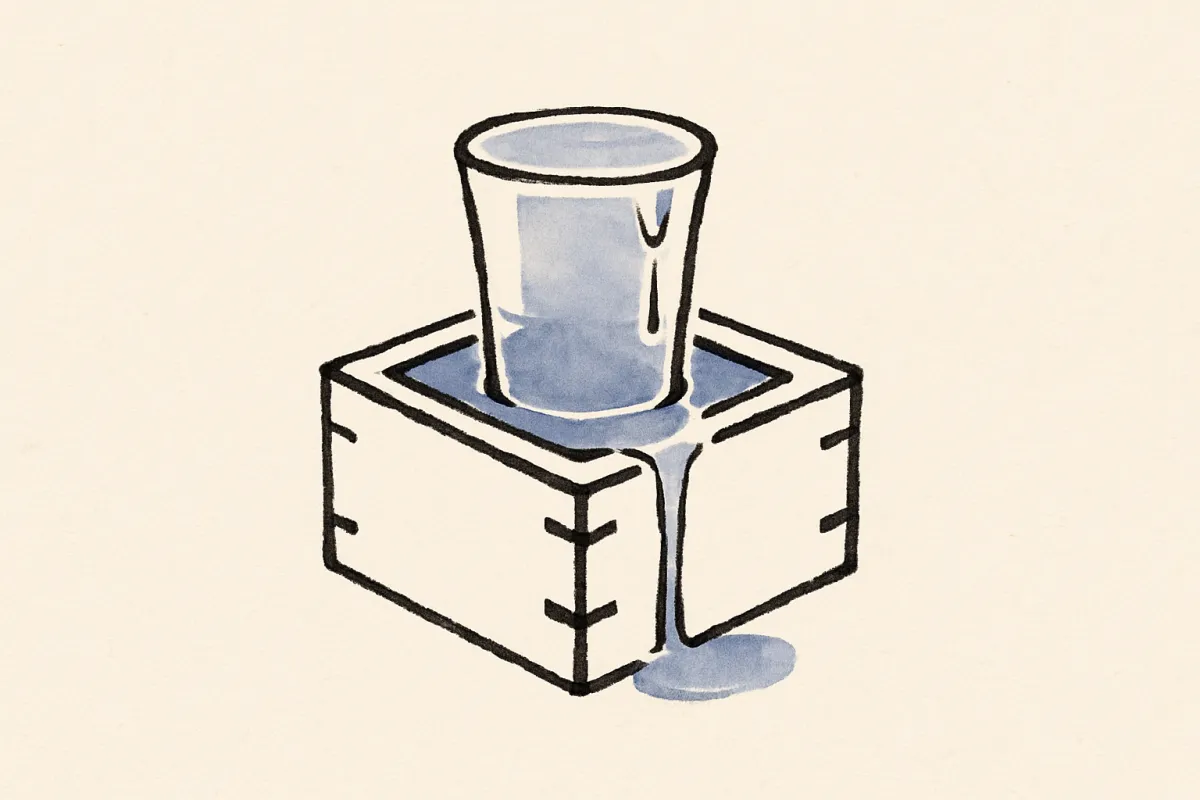
A sake set lands on the table and, for a beat, nobody moves. There's a little flask, a couple of cups barely bigger than a thumb, and sometimes a glass sitting inside a wooden box with sake pooled around it. The instinct is to treat it like wine: pour your own, fill it up, take a swig. Almost every one of those instincts is slightly wrong. But sake's table manners aren't a thicket of fussy rules; they rest on a single courtesy.
First, name what's on the table
Japanese lumps all of this under shuki (酒器), sake vessels, and splits them into cups you drink from and servers you pour from.
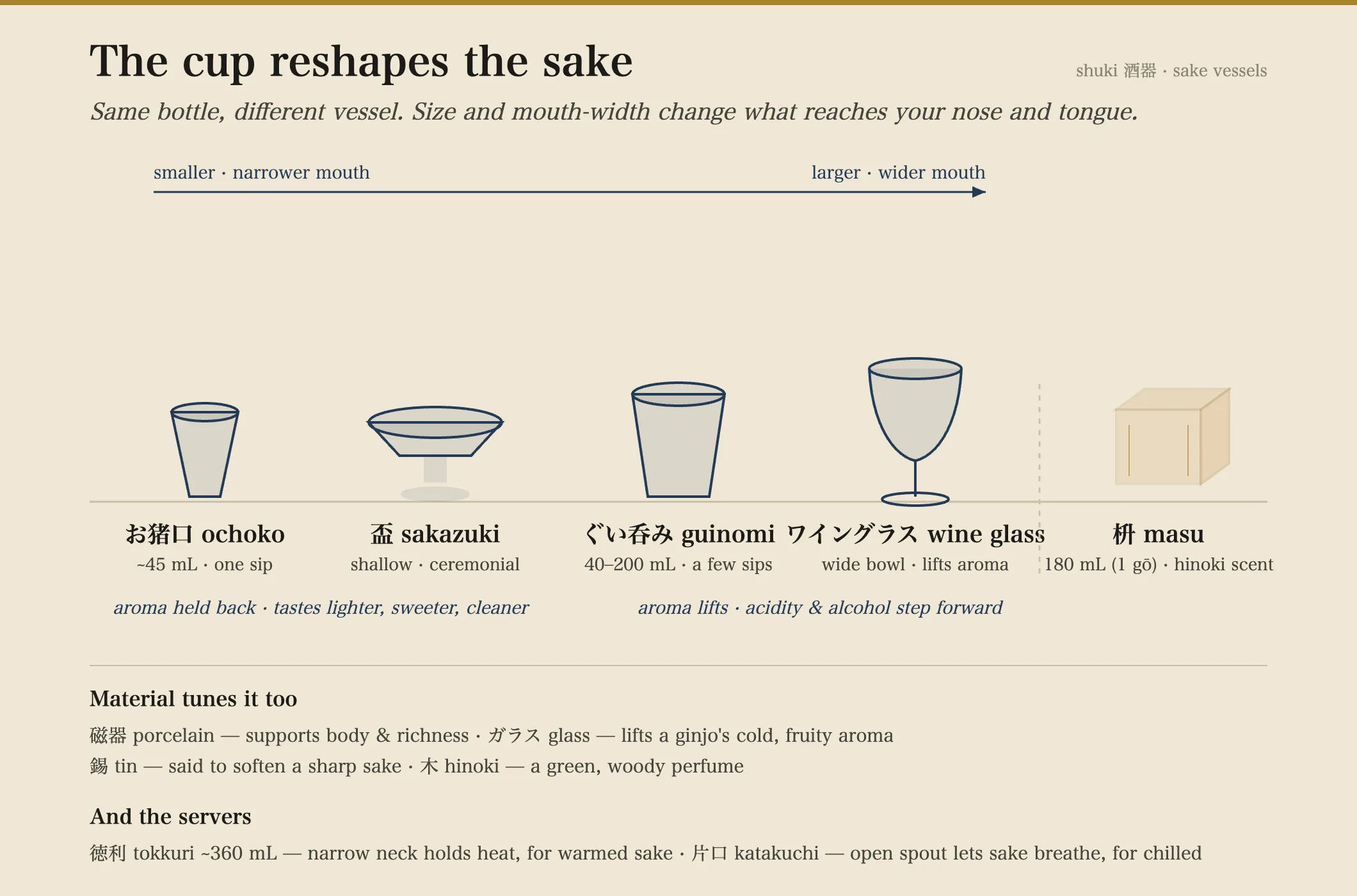
The ochoko (お猪口) is the classic thimble cup, usually about 45 mL: a single mouthful. Its bigger cousin the guinomi (ぐい呑み) runs 40 to 200 mL; the rough test is that an ochoko empties in one sip while a guinomi takes a couple. Then there is the sakazuki (盃), a shallow, wide, saucer-like cup that mostly turns up at weddings, shrine rites, and formal toasts. And the masu (枡), that wooden box, which began life as a measuring vessel and most often holds one go, 180 mL.
On the pouring side, the tokkuri (徳利) is the familiar narrow-necked flask, typically around 360 mL; that pinched neck holds heat, just what you want when the sake has been warmed. The katakuchi (片口) is a squat, open-spouted pitcher; its wide mouth lets the sake breathe and show its color, so it tends to appear with chilled sake. (You may also spot a small white cup with a blue double-ring painted in the bottom: that's a kikichoko, the tasting cup judges use to read a sake's clarity.)
The cup is not neutral
The surprising part: pour the same bottle into two different cups and it tastes like two different sakes. Size and shape do most of the work. The smaller and narrower the cup, the lighter, sweeter and cleaner the sake reads, and the more its aroma stays tucked away. Go the other direction, to a wide, in-curving bowl like a wine glass, and the aromatics lift off while acidity and alcohol step forward. It's the same reason wine has glass shapes: a wide bowl gathers scent, a narrow opening concentrates it toward your nose. That's why a fragrant ginjo or daiginjo, all about aroma, often does best in a glass, while an everyday cup flatters a rounder, mellower sake.
Material tilts it further. Smooth, neutral porcelain supports a rich junmai's body. Glass shows off the cold, fruity top notes of a ginjo. A tin cup is said to round off a sharp or rough sake, softening its edges. And hinoki (the cypress of the masu) lends a green, faintly citrusy wood scent that can either lift a sake or mask it, depending on who you ask.
This is also where sake quietly meets another craft. Those ochoko, guinomi and sakazuki are, overwhelmingly, pottery. The cup in your hand may be Bizen, Mino, or Hagi ware, chosen as deliberately as the bottle. If a good guinomi becomes yours to keep, learn how to care for it.
The one rule that explains the rest
Now the etiquette, which really is a single principle: you pour for others, and you don't pour for yourself. The custom is called oshaku (お酌), and filling your own cup (tejaku) is frowned on, described in some places as the height of rudeness.
That sounds like a constraint until you notice what it does. If nobody pours their own, everyone has to watch out for everyone else. The tiny ochoko isn't a shot glass; it's an excuse. It empties fast, so someone is always reaching for the flask, always making a small gesture of I've got you. The rules are a machine for turning a drink into attention.
- Pouring: hold the tokkuri with both hands at a formal table, your dominant hand on the neck and the other supporting the base, and don't tuck your right hand underneath, which comes across as disrespect. Fill the cup to about eight or nine tenths, never to the brim. If there's a label, keep it facing up.
- Receiving: lift your cup off the table; don't let someone pour into a cup still sitting there. Hold it in one hand, steady it underneath with the other, and take a small sip before setting it down.
- The silent signals: a cup left full means "I've had enough"; an empty cup invites a refill. Top up a neighbor when theirs drops to about a third.
- The toast: wait for the eldest or the host to say kanpai before you drink. The word literally means "dry the cup," but you're not obliged to drain it; a sip is fine. Clinking with someone senior, hold your cup a touch lower than theirs.
Among close friends, all of this loosens: one-handed pours, less ceremony. The formality scales with the occasion, not with some fixed rulebook.
Mokkiri: when overflowing is the point
Back to that glass brimming inside a box. This is mokkiri (盛りこぼし), and the overflow is deliberate: a little theater of generosity, a nod to the old days when sake was measured out and sold by the masu. Nothing has gone wrong; you're meant to have been given more than the glass can hold.
To drink it without wearing it: don't pick it up first. Bend down and sip from the rim of the glass until it's no longer threatening to spill, then lift it and drink normally. When the glass is done, tip the sake caught in the box into it, or drink straight from a corner of the masu. Hold the box from below, four fingers under it and a thumb on the rim. Grabbing it from the top is the clumsy move. If a pinch of salt sits on one corner, that's an invitation to alternate salt and sake, the way salt makes watermelon taste sweeter; it sharpens the other flavors. It's optional, a connoisseur's touch, not a requirement.
The cup that seals a marriage
One vessel earns a mention beyond the dinner table. The sakazuki, that shallow ceremonial cup, is the heart of san-san-kudo (三三九度), the sake ritual at a Shinto wedding. Bride and groom drink from three cups of increasing size, three sips from each, nine in all. The threes and nines carry meaning: three stands for balance and completeness (heaven, earth and humanity; past, present and future; the couple and their families, depending on who tells it), and nine, an "unfolding" number, for something meant to last. Sharing sake to seal a bond is ancient in Japan, once used to fix alliances and promises long before it was folded into the wedding. When you drink sake, you're using the same gesture — scaled down to a Tuesday, but the same gesture.
That's really the payoff of learning the cups and the rules: none of it is about getting it "right." It's about seeing that a sake set is built for company. From here, the natural next question is what to pour into which cup and how warm, which is where our serving-temperature guide picks up, matching the vessel to the bottle and the bottle to the heat.