
Most guides to sake open by calling it "rice wine," and that's the first thing to unlearn. Sake isn't wine, and it isn't beer either. It's made by a process that neither of them uses, and that single process is the reason an undistilled drink can reach nearly 20% alcohol, higher than any common brewed beverage. Grasp that one process and the rest of the brewing line makes sense.
The one trick: two jobs in one tank
Every alcoholic drink has to solve the same problem: yeast eats sugar and makes alcohol, so you need sugar. Grapes already have it, so wine ferments in a single step. Grain doesn't: barley and rice store their energy as starch, which yeast can't touch, so it has to be broken down into sugar first. Beer does this in two stages, one after the other: malt enzymes saccharify the starch into a sugary wort, and then yeast ferments it.
Sake does both at the same time, in the same vessel. In the main mash, the enzymes from koji dissolve rice starch into sugar while the yeast is already fermenting that sugar into alcohol, saccharification and fermentation running in parallel. The Japanese term is heikō fukuhakkō (並行複発酵), "multiple parallel fermentation," and it's sake's one genuinely unique move.
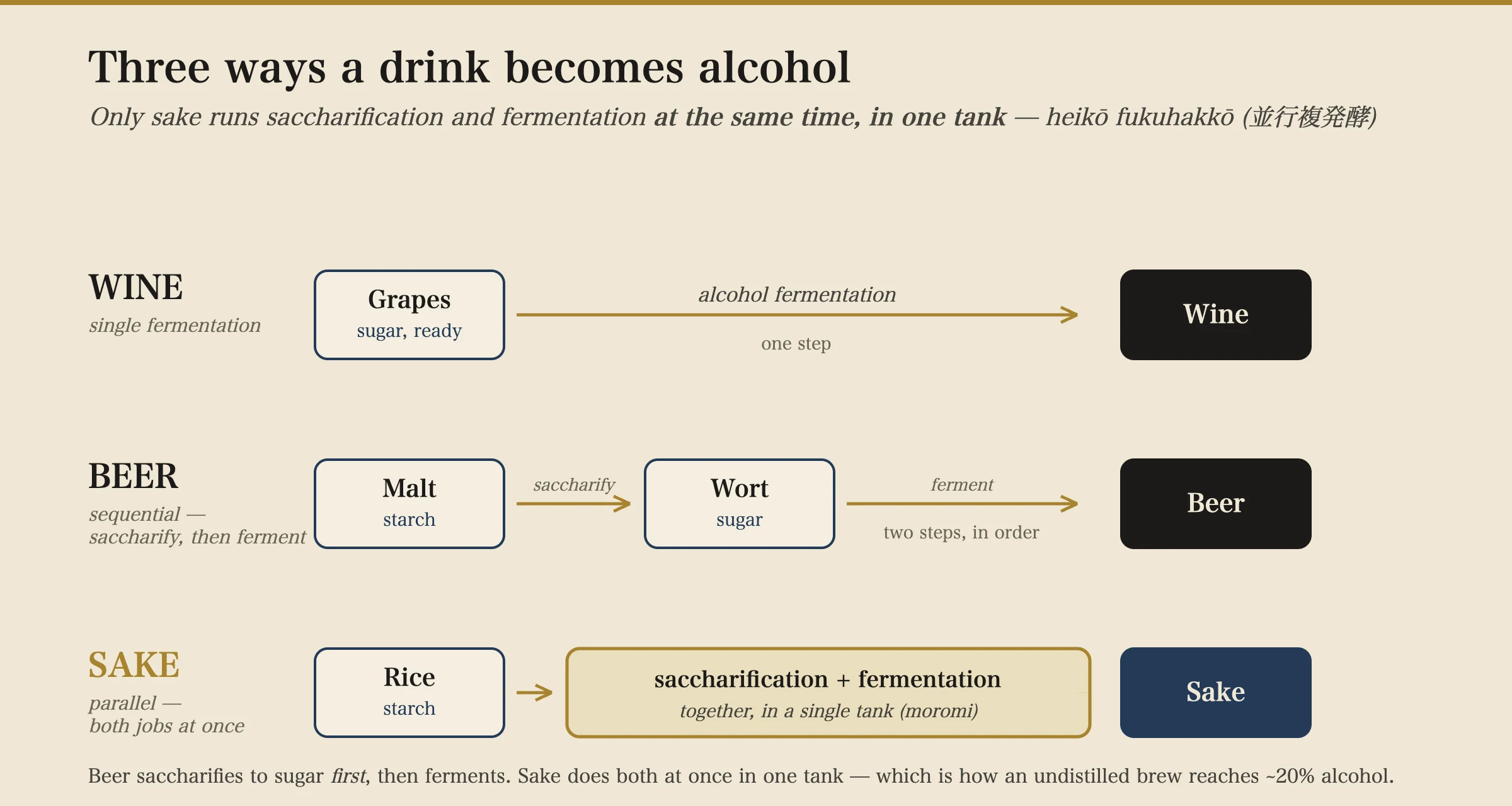
More sugar would actually mean less alcohol, not more. A high sugar concentration stresses and inhibits yeast, and wine and beer both start with all their sugar present, which caps how far the yeast can push. Sake sidesteps the ceiling: the koji doles glucose out gradually, the yeast consumes it the moment it appears, and the sugar level never climbs high enough to stall things. So the fermentation just keeps going, past where a wine or beer would quit. Keeping the sugar low lets the alcohol run high.
That's the spine. Everything else in the brewery (the polishing, the steaming, the koji room, the strange three-part mash) exists to feed and control that one tank.
Walking the line, rice to bottle
1. Polishing (seimai). It starts by grinding rice away. The center of each grain is nearly pure starch; the outer layers hold proteins and fats that throw heavy, off flavors and mute the aromatics. So the outside is milled off: at least 30% for ordinary sake, 40% or more for ginjo grades. The polishing ratio you see on a label is what remains.
2. Washing and steeping (senmai / shinseki). The milled rice is washed and then soaked until it has absorbed about 30% of its weight in water, a step timed so precisely that for top grades it's counted in seconds.
3. Steaming (mushi). The soaked rice is steamed for roughly an hour, not boiled. Steaming leaves the grain firm on the outside and soft within, the texture the mold and the mash need to work on.
4. Making koji (seigiku). A portion of the steamed rice is carried into a warm, humid cedar room (the kōji-muro, kept around 30°C) and dusted with spores of Aspergillus oryzae. Over about two days the mold threads through the grains and loads them with the amylase enzymes that will later cut starch into sugar. Only 15–25% of the total rice needs this treatment. Koji is the whole reason sake can ferment at all: it's the enzyme engine that replaces beer's malt. (It's also the same mold behind miso and soy sauce.)
5. The yeast starter (shubo or moto). In a small tank, a dense, deliberately acidic population of sake yeast is grown up. The acid matters: unlike grapes, rice contains none, and a low pH keeps spoilage microbes at bay while the yeast builds strength. That acidity comes either from naturally cultivated lactic-acid bacteria (the slow, traditional kimoto and yamahai methods) or from a modern dose of brewing lactic acid.
6. The three-stage mash (sandan-jikomi → moromi). Now the starter is scaled up into the main mash, but not all at once. Rice, koji and water are added in three steps over four days: about a sixth on day one, a rest day for the yeast to multiply, then a third, then the final half, with the temperature stepped down from around 12°C to 8°C. The reason is defensive. As the NRIB puts it, dumping everything in at once would leave "the yeast … too diluted," slowing it and "allowing microbes to multiply, which could abort the fermentation process and spoil the mixture." Once fully built, the mash (this is the tank where parallel fermentation happens) ferments cold, at 8–18°C, for three to four weeks (longer for ginjo), reaching 17–20% alcohol. Fermenting cold keeps saccharification and fermentation in step and protects the delicate aromas. By volume it is mostly water: a typical tank runs roughly 80 parts steamed rice to 20 koji to 130 water, which is why a region's water shapes its sake so much.
7. Pressing (jōsō). The finished mash is pressed through cloth to separate clear sake from the solids, by machine, or for competition bottles by simply hanging the mash in bags and letting gravity do it. The leftover cake, sakekasu, still holds about 8% alcohol and gets used for pickling, cooking, or distilling into shochu. Pressing is also the legal line: this is the moment the liquid officially becomes "sake."
8. Pasteurizing and finishing (hiire). Most sake is then gently pasteurized at 60–65°C, usually twice (once before storage, once at bottling) to kill microbes and switch off the enzymes before they shift the flavor. Skip one or both passes and you get the fresh, zippy nama family. Finally, since the sake comes off the press at a hot 17–20% (genshu), most is cut with a little water (warimizu) down to a food-friendly 15% or so before it's bottled.
One idea, eight steps
That is the whole line: one idea wearing eight steps. Polishing cleans the starch; steaming and koji prepare it to be dissolved; the starter and the staged mash protect the yeast; and all of it converges on a single cold tank where sugar is made and drunk in the same breath. It is slower and more hands-on than wine or beer, which is why a glass of sake can carry a fortified wine's strength on a clean grain character. Once you can see the tank, every label term you meet next, whether the grades, nama, kimoto, or the contrast with whisky, is just a note about one point on this line. When you're ready to taste your way along it, our beginner bottles are a good place to start.