
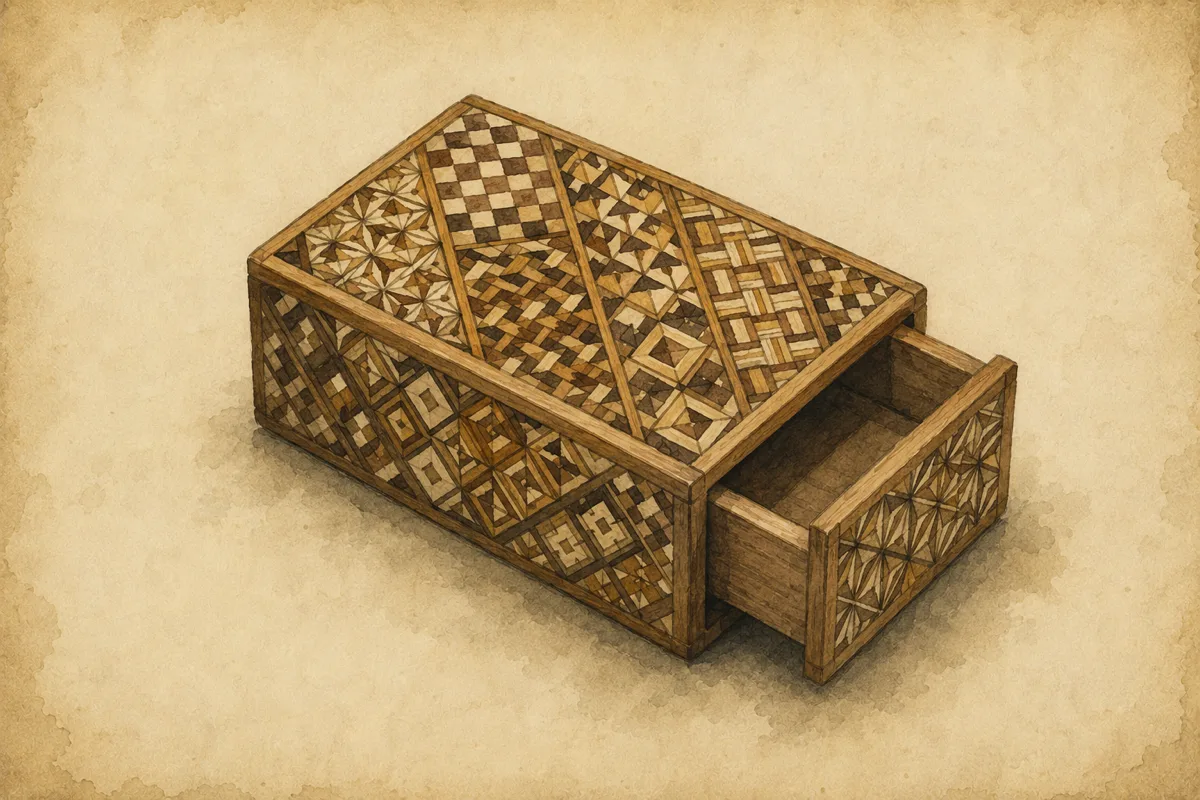
There is no lock on a himitsu-bako. Open one up and look: no keyhole, no clasp, no metal at all. And yet it stays shut against anyone who does not know it, which makes it one of the stranger objects in Japanese woodwork, a container secured by a sequence instead of a key.
How it holds shut
The box is a piece of sashimono, the tradition of building furniture and boxes by cutting the wood to interlock, with no nails and no glue holding the structure. A himitsu-bako takes that idea and turns it into a trap.
Some of its panels, usually the thin ones at the ends and sides, are cut so they can slide a short way rather than sitting fixed. In the closed box each of these is blocked by another. You slide the one that happens to be free, which uncovers a channel that lets the next one move, which frees a third, and so on down a set order until a final slide releases the lid or, on many boxes, the base. Nothing clamps it shut in between. What holds a himitsu-bako closed is only the friction and spring of well-fitted wood, and the fact that you do not yet know which panel moves first.
That is why it can have no metal in it. There is nothing to lock, because the locking is done by the order of the moves. Lose the sequence and a solid, seamless-looking box simply will not open, short of breaking it.
The pattern is camouflage
What everyone notices first is the surface, a tight geometric mosaic of pale and dark woods. This is yosegi-zaiku, the Hakone marquetry sliced as a thin veneer off a glued-up block of coloured timber, and it is beautiful in its own right. But on a secret box it is also doing a job.
A sliding panel has to have a gap around it, a seam where it meets the rest of the box. On a plain wooden box those seams would be obvious, and they would hand you the answer, because you would simply push on every visible edge until something gave. The mechanism also tends to force those seams into unnatural places. A moving panel's edge can land in the middle of a face rather than tidily at a corner. The Japanese account of the box is blunt about the consequence: the yosegi veneer is applied partly to hide those joints. The busier the pattern, the harder it is for the eye to pick out the one line that is a moving edge from the thousand lines that are only the mosaic.
So the decoration and the difficulty are the same feature seen twice. The surface that makes a Hakone box a souvenir is also what stops you cheating your way into it.
Sun and moves
Two numbers describe a box, and they measure different things.
The first is size, given in sun (寸), an old Japanese unit of about 3 centimetres. A 5-sun box is roughly 15 centimetres along its longest side; a small 2-sun box sits in the palm. The second number is the move count, the number of separate slides needed to open it, and that is the difficulty. A box is named by both at once, so a listing for a "2-sun, 10-move" box is telling you it is small and moderately tricky.
Classic Hakone boxes are graded up a ladder of move counts, through boxes of four, seven, ten, fourteen, twenty-one, twenty-seven moves and higher, up to the traditional maximum of seventy-two. Seventy-two deliberate slides, in one correct order, to reach whatever is inside. The move count is not padding; each additional move is another panel that has to be freed before the next will give.
Souvenirs, and where they came from
The secret box is not ancient. Yosegi marquetry came first, established in Hakone in the late Edo period, and the box that wears it is a much later idea. It is credited to Ōkawa Ryūgorō, a sashimono joiner of Hakone-Yumoto, in the late nineteenth century, with the year usually given as 1894.
The setting matters. Hakone sits on the old road between Edo and Kyoto, a mountain waypoint full of travellers and hot springs, and the secret box was made for exactly that traffic: a clever, portable keepsake to carry home from the mountains, decorative on a shelf and quietly baffling to guests. Hakone's yosegi work, the box included, was designated a National Traditional Handicraft in 1984, and a small community around Hakone and Odawara still makes it.
Where the idea went next
The classic himitsu-bako is a rectangle that opens by sliding panels, and for a long time that was the whole form. Ōkawa's successors did not leave it there. They broke away from the plain box, inventing new shapes and, with them, new ways in.
The wider modern name for this is the karakuri box, the trick box, which keeps the secret box's spirit but drops its rules. A karakuri box may hide a drawer, may take a shape that is not a box at all, and may demand an opening sequence far past the old ceiling of seventy-two. The Japanese makers' group points to a box that takes 1,536 moves to open, which is less a souvenir than an endurance test, and closer to a lock whose only key is patience.
Set beside a tansu chest, which announces its drawers and simply asks you to pull them, the himitsu-bako is the opposite kind of Japanese box. One is built so that anyone can open it and the contents stay dry and safe. The other is built so that only you can, and its whole craft, the joinery and the mosaic alike, is bent toward keeping everyone else out without ever showing a lock.