Look closely at a yūzen kimono and you will find, running between every colour, a fine pale line. It threads around each petal and leaf and holds the reds off the blues. It looks like a drawn outline, and in a sense it is, but it was never inked. It is the ghost of a wall.
The line is a wall of paste
Yūzen is dyeing that behaves like painting, and the thing that makes that possible is rice paste.
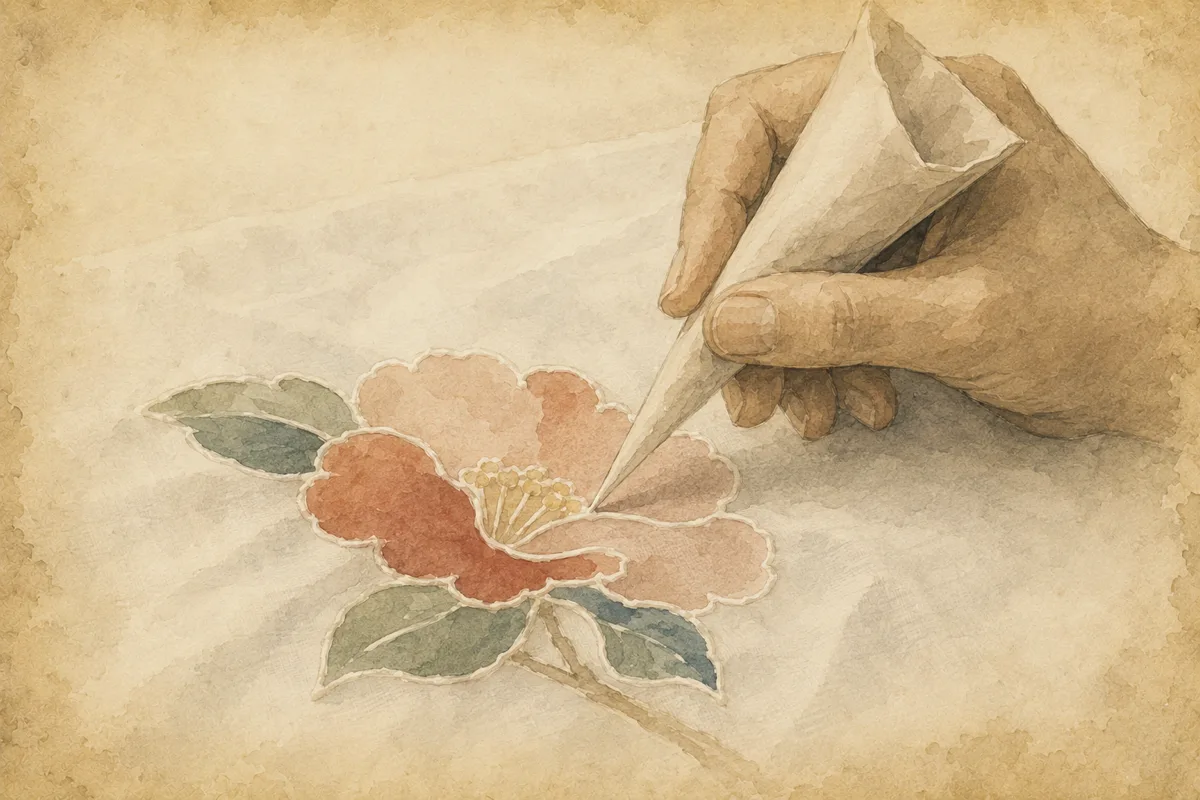
Before any colour touches the silk, an artisan traces the entire design in a thin line of paste, called itome-nori, squeezed from a cone with a metal tip much as you would pipe icing. That line of paste is a barrier. Where it sits, dye cannot reach the cloth. So once the outlines are laid and dried, the whole design becomes a set of walled compartments, and the dyer can brush colour into each one freehand, wet and full, without any of it creeping across the border into its neighbour. The paste holds the line the way the metal ridges hold the enamel apart in cloisonné.
At the end, the paste is washed away. What it leaves behind is its own path: a thread of silk that never took any colour, the pale outline you saw. The white line in a yūzen design is not something added. It is the record of the wall that made the painting possible.
That single trick, a freehand piped resist, is what separates yūzen from the rest of Japanese dyeing. Where kasuri fixes its pattern into the threads before the cloth is even woven, yūzen does the opposite: it takes a finished bolt of plain white silk and paints the picture on last. It is the mirror image of Nishijin weaving, where the design is complete before the cloth exists. In yūzen the cloth exists first, blank, and waits for its picture.
A way to be rich against the rules
That the picture could be so free, so detailed, so multicoloured, mattered for a reason beyond beauty.
The technique took hold in the Genroku years of the late seventeenth century, when Japan's merchant class had money and appetite for display, and when the shogunate kept passing sumptuary laws to stop exactly that: rules restricting embroidery, gold, and the most expensive woven and dyed fabrics on the backs of commoners. Yūzen was a way around them. It could conjure a lavish, painterly, many-coloured kimono out of nothing but dye and a line of paste, without the banned embroidery or gold thread. You got the effect of extravagant dress while technically staying inside the law. The loophole was part of the appeal, and it is one reason the style spread as fast as it did.
The name comes from Miyazaki Yūzen, a fan painter working in Kyoto in those same decades. His pictorial manner, flowers and scenes composed for the round of a fan, is what got carried onto cloth, and a book of his patterns, the yūzen-hiinagata, appeared in 1688. Whether he personally worked out the paste-resist method or simply lent it his eye and his name is a traditional attribution rather than a documented one. Either way the name stuck to the technique and never came off.
Kyoto and Kanazawa part ways
Yūzen did not stay one thing. It split into two great traditions with opposite temperaments, and once you can tell them apart the whole craft comes into focus.
Kyō-yūzen, the Kyoto line, is a relay. No single person makes the kimono; it passes down a chain of specialists, sketcher to paste-layer to dyer to the hands that finish it, each doing one part with high skill. And Kyoto does not stop at dye. After the colours are set, a Kyō-yūzen piece is often loaded further, with embroidery and with gold and silver leaf laid onto the silk, so the final cloth glitters as much as it pictures. Its shading tends to run from the centre of a motif outward, brightest at the heart.
Kaga-yūzen, from Kanazawa in the old Kaga domain, is nearly its opposite. It is largely carried by one artist from design to finish, and it refuses the embroidery and the gold entirely. It works instead in a set palette known as the five Kaga colours, a deep, sober range of indigo, crimson, ochre, grass green, and an old purple, and it aims not at glitter but at realism. Kaga painters render nature closely, and the signature of the style is that they will paint a leaf with the holes and browning of insect damage in it, the mushikui or worm-eaten motif, because a real leaf on a real plant is not perfect. Its shading is also reversed: a Kaga motif is graded from its outer edge inward, dark at the rim and lightening toward the middle, the mirror of the Kyoto habit.
So the fork is clean. Kyoto adds, and dazzles, and divides the labour. Kanazawa subtracts, and observes, and keeps the work in one pair of hands. Both are yūzen; both start from the same piped white line.
From dayflower to river
The making, in outline, runs the same way in both cities, and it begins with a blue that is designed to disappear.
The artist first sketches the composition directly on the white silk using aobana, an ink drawn from the dayflower, chosen because it is fugitive and will rinse out completely later, leaving no trace under the finished colours. Over those guide lines goes the itome-nori paste, walling the design. A soybean liquid, gojiru, is often brushed on to help the dyes take and spread evenly, and then comes the painting proper, dye laid into each compartment by hand. The cloth is steamed, at around 80°C for a matter of minutes, to fix the dye into the fibre. The background is dyed. And finally the paste is washed out.
That last step was once a public spectacle. In Kyoto the washing, yūzen-nagashi, was done in the running water of the city's rivers, the Kamo and the Horikawa, long bolts of painted silk streaming in the current while the paste and loose dye rinsed away. It was enough of a sight that ordinary townspeople turned out to watch it, which is a fitting end for a craft whose whole point was to put a painting where everyone could see it, and get away with it.