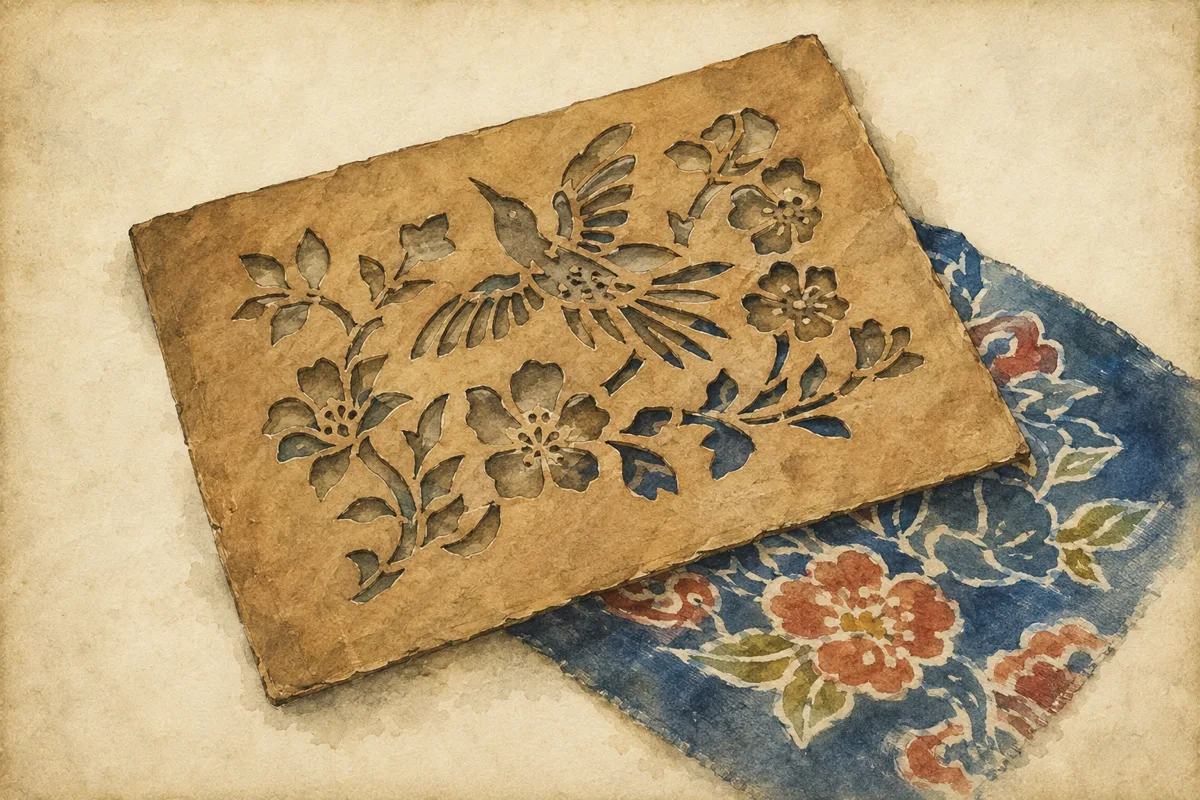
After 1945 there was no stencil paper in Okinawa, so bingata's dyers cut their stencils from Japanese army maps, drawing the designs from memory.
Colour that sits on the cloth
In most Japanese dyeing the colour goes into the fibre. In bingata much of it is brushed onto the surface.
A stencil of laminated mulberry paper carries the design, and a rice-paste resist goes down through it, the paste made from glutinous rice flour, rice bran and salt. The cloth is not then dunked in a vat. The dyer brushes colour into the open areas by hand, working with two brushes, one pointed and one shorter and stiffer for rubbing the colour in. The colour is set with steam, the process repeated several times, and the paste finally washed off. Soybean juice is used to help the colour take.
Mainland katazome, which shares the stencil and the paste, uses dyes. Bingata uses pigments alongside them, and as many as eighteen colours may end up on a single piece.
The name is younger than the craft
The two characters are read bin and gata. The first refers to colours in general rather than to red specifically, and the second to patterns of various kinds, so the word amounts to something like coloured pattern. The written form is credited to Kamakura Yoshitaro, who is said to have used it first in 1924, which puts the name several centuries behind the thing it names.
How many centuries is not settled. Japanese Wikipedia works backwards from a surviving fourteenth-century fragment, allows time for a technique to establish itself, and estimates an origin around the thirteenth century. English Wikipedia places the craft in the fourteenth-century Ryukyu Kingdom, when foreign goods and manufacturing techniques were arriving through the islands' sea trade, and dates the oldest known surviving piece to the late fifteenth century, from Kumejima. A Japanese textile dictionary puts the origin in the fifteenth century without qualification. The honest answer is a range of two hundred years, and the disagreement is about how much lead time to allow between a technique arriving and a surviving example of it.
Why pigments
The reason is chemistry rather than taste. Nakagawa Masashichi puts it plainly: plant dyes are weak against strong sunlight and high temperature, while pigments stand up to both. In Okinawa's climate that makes pigment the practical choice.
The brightness follows from that. Cochineal, cinnabar, orpiment, sumi ink and gofun are on the pigment side. Ryukyu indigo, fukugi, sappan and yamamomo supply the plant dyes that remain.
Stencils are carved on a bed of dried tofu, called rukujuu, firm enough to support the paper and soft enough to take a blade. After the flat colours are laid, the dyer goes back in with kumadui, a darker tone worked into the centre or the edge of a motif and blended outward, with prescribed colours for the job. Kumadui is also what separates hand-worked bingata from a print, which is covered below.
Who was allowed to wear what
Under the Ryukyu Kingdom, colour and pattern size were regulated by rank.
Yellow was the highest ranking colour and belonged to the royal family. Nobility wore pale blue. Commoners wore simple dark patterns in indigo or black and were permitted certain colours only on special occasions. For royal formal dress the ground was gold or yellow, on silk. The third class was held to indigo-only bingata in medium patterns or smaller.
Pattern size was the second axis. Nobles wore larger patterns and samurai wore smaller ones, so pattern size marked rank independently of colour. Japanese Wikipedia adds that the cloth was made for women of the royal and shizoku classes and for boys before adulthood, and that the patterns were understood to carry protection for the person wearing them.
Eegata, the indigo-only version, sat at the bottom of that scale. It was what the third class was restricted to, rather than a quieter palette anyone chose.
Three families held permission to produce for the court, each with its own designs handed down. English Wikipedia names them as Takushi, Gusukuma, now Shiroma, and Chinen; only Shiroma and Chinen appear in the Japanese sources consulted here. The arrangement lasted until the kingdom fell in the 1870s.
1879, and then 1945
Production dropped away sharply after 1879, when the Ryukyu dynasty ended and the court that set the dress rules went with it. Bingata had already travelled to mainland Japan, exported between 1688 and 1704, but the customers at home were the ranked classes, and those had just been abolished.
The Battle of Okinawa destroyed the shops and stopped production, and a great deal of surviving bingata was lost. The stencils had gone earlier, and not in the fighting: they had been taken to mainland Japan over the years by collectors and by Japanese soldiers. Eiki Shiroma went to the mainland to look for them, and found some.
The rest he and Sekko Chinen improvised, and Japanese Wikipedia records what they used. They drew designs onto picked-up Japanese army maps and cut them as stencils. They used broken gramophone records as spatulas for laying the paste. They used lipstick in place of pigment. They used spent cartridge cases as the nozzles of the paste bags. Nakagawa Masashichi's account adds that the designs they cut into those maps were ones they still remembered.
The craft was designated a national traditional craft under the name Ryukyu bingata on 31 May 1984. Shiroma Eijun works as the fifteenth generation of the family.
What to look at
Kumadui is worked into individual motifs, so the darker tone sits at the centre or the edge of a flower and softens outward, and the shading varies from flower to flower. A print reproduces the same gradient everywhere it appears.
The other difference is how the colour meets the fibre. Pigment work sits slightly on the surface, with a density the immersion dyeing of aizome indigo never produces, because indigo colours the thread itself. The three techniques differ in when the colour goes on. Kasuri dyes the yarn before the cloth exists, aizome dyes the finished cloth in a vat, and bingata paints the colour on and steams it in. The pigments are the part that holds up under Okinawan sun.