
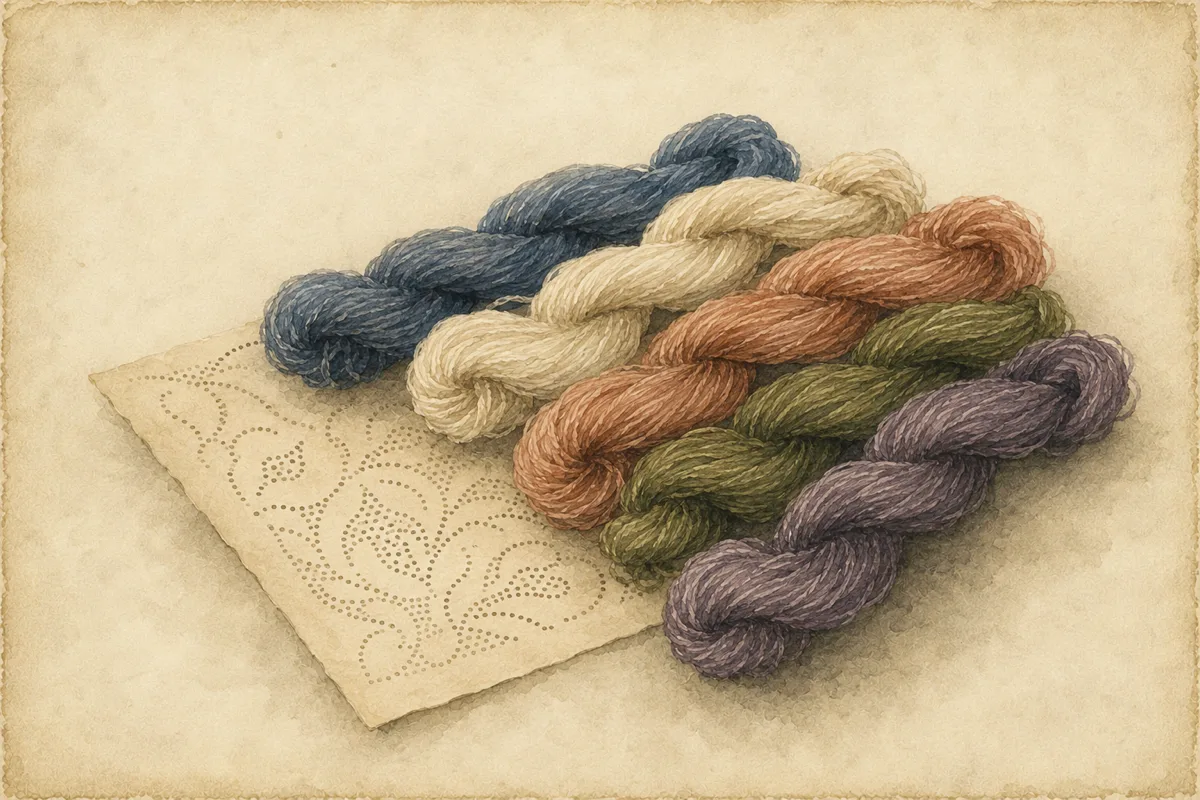
The dye goes onto the thread. The pattern is built as the fabric is built. There is no stage at which a Nishijin weaver has blank cloth in front of them and decides what to put on it.
Dyeing the thread
Silk is reeled from cocoons, dyed, and only then wound as warp and weft. The colour is in the strand, all the way through, and the picture is assembled out of coloured threads crossing each other.
Yarn-dyed cloth is tougher and more wrinkle resistant than cloth woven first and dyed afterwards.
This puts Nishijin on the opposite side of a line from most of the Japanese textiles known abroad. Shibori is tied and dipped, indigo is fermented and dipped, bingata is stencilled and pasted, and all of them work on cloth that already exists. The nearest relative is kasuri, where sections of thread are bound off and dyed so the pattern emerges as the weaving progresses. In both kasuri and Nishijin, a mistake in the thread cannot be corrected later.
Punching the pattern
The official process runs to nine stages: designing, design mapping, pattern paper punching, twisting, dyeing, reeling, warping and weft winding, heddling, hand looming.
Third in that sequence comes the punching. Before any silk has been twisted, before any dye has been mixed, the entire design has been converted into perforated pattern paper that the loom will read. Every crossing of every thread in the finished obi is decided at that point, by a pattern designer rather than a weaver, working on graph paper ruled to match the specifications of the particular loom the cloth will be made on.
Computers extended that chain rather than breaking it. The template is scanned, the pattern data projected on screen, the texture of the weave and the movement of the weft added, and the result entered to a pattern data standard called CGS. Punched paper became a file.
The division of labour
The work is divided among separate businesses and freelance specialists, each doing one thing.
A textile store draws up the proposal, a designer works it up, a pattern designer converts it to a template, a dyer colours warp and weft, a warping specialist dresses the loom, and a weaver, last, weaves. These are different companies and different households, and an obi is the output of a supply chain rather than a workshop.
In depth this pays: each firm does one operation for generations and gets extremely good at it. The city's own guide to the craft states the other half of the arrangement plainly, that if one step is missing the product cannot be completed. Both the city and the national craft body note the shortage of successors as fewer people wear kimono.
Named after a war camp
The district is in Kamigyō-ku, in the northwest of the city, and its name means western encampment. Rendered in full, Nishijin-ori is western-military-encampment brocade.
The Ōnin War ran from 1467 to 1477 and much of the fighting took place in Kyoto, driving the weavers out of the city. When they came back, in the 1480s, they set up on the ground that had been occupied by the army of Yamana Sōzen, commander of the western side. Silk itself had been in the city far longer. Sericulture arrived with migrants from Korea and China in the fifth and sixth centuries, before the capital moved to Heian-kyō in 794. By the Heian period silk weaving was an official occupation of the court city, which is the arrangement the war interrupted and the returning weavers rebuilt.
Collapse and Lyon
Crop failures halted production in 1837. Then in 1869 the capital moved to Tokyo, taking the court and much of the customer base with it, and the move was widely expected to finish the Nishijin trade.
Nishijin sent weavers to Lyon. They studied the Jacquard loom and the flying shuttle, brought the technology back, and production resumed in 1872. The punched pattern paper that now defines the craft's working method came back from Lyon with them.
With the Jacquard mechanism the economics changed too. Nishijin moved toward many designs in small quantities, and that is still how the district operates. Hand looms remain in use next to power looms with Jacquard heads, rapier looms and air-jet looms.
Twelve kinds
Under the regulations, twelve varieties of Nishijin textile are currently designated. They include tsumugi, woven from thin silk threads, honshibo-ori with its crepe texture, and futsu, which is double-sided. Kasuri, velvet, damask and brocade are all produced there. So are the open watermark weaves, sha and ra.
What holds the list together is a sequence, not a look: decide everything, encode it, colour the thread, and only then weave.