In most dyed cloth, the pattern is put onto a surface. In kasuri, the pattern exists before the surface does.
The sequence
Kasuri is the Japanese term for cloth woven from fibres dyed beforehand to create a pattern, and it belongs to the family the rest of the world calls ikat.
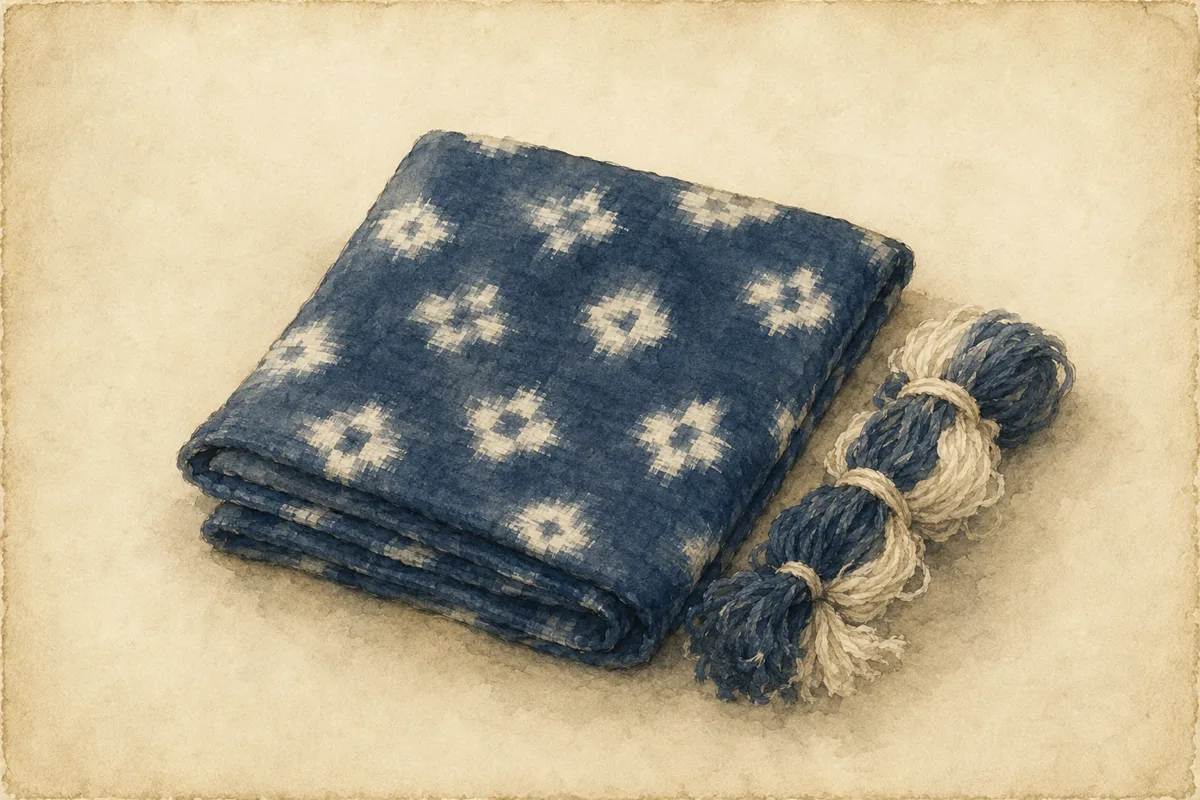
Sections of the warp and weft yarn are wrapped tightly with binding thread so that dye cannot penetrate them. The yarn goes into the dye, usually indigo. The bindings come off, leaving each thread with its own sequence of dyed and undyed stretches. Only then does anyone weave.
The loom does not make the pattern. It aims one that already exists. Every thread already carries its share of the design, and the weaver's job is to bring thousands of pre-committed marks into alignment so the intended motif appears.
Why the edges look brushed
The sources agree on the look and do not agree on where it comes from. English and Japanese references describe the motifs as blurred or brushed without naming a cause. Kurume City traces the soft outline back to the binding and dyeing, the stage at which a resist edge is never perfectly sharp.
The loom plausibly adds its own share, since thousands of pre-committed marks have to be brought into alignment and none of them can be nudged once dyed. No source here says so, so treat that as reasoning rather than as record. What is not in dispute is that each thread carries a fragment of the motif, and the finished edge records how closely those fragments landed.
Three kinds, by which threads carry the design
Tate gasuri puts the resist-dyed yarn in the warp, the threads running the length of the cloth. Yoko gasuri puts it in the weft, running across. Tate-yoko gasuri uses both, and English classifies this as double ikat.
The third is the hard one. With one patterned direction, the weaver aligns a dyed set against a plain set. With two, two independently dyed sets have to meet each other correctly, and an error in either shows up in the finished motif.
How the technique got to Japan
It came by sea, from the west.
The technique is thought to have originated in India and to have spread through Southeast Asia, reaching Japan by way of the Ryukyus. Ikat was being practised in the Ryukyu Kingdom in the twelfth or thirteenth century. It entered southern Japan after the Satsuma invasion of the Ryukyu Kingdom in 1609, reached the Nara area of Honshu by 1750, and by 1850 was in production at Kurume, Iyo, Bingo and in the San-in region.
Those became the recognised centres. Japanese sources name Iyo, Kurume and Bingo as the three great kasuri, with Omi, Kurayoshi and Yumihama among the other known producers.
The girl in the story
Almost every account of kasuri reaches Inoue Den within two paragraphs, usually as the child who invented it.
Den was born in 1788 and died in 1869. Around 1800, aged twelve or thirteen, she noticed that a much-worn indigo garment had faded into white speckling. Pulling the cloth apart, she found the warp threads had lost colour unevenly. She reasoned that binding white threads before dyeing them would reproduce the effect deliberately, and it did.
She was not working alone for long. In 1813 she consulted Tanaka Hisashige, later the founder of what became Toshiba, on techniques for pictorial patterns. By 1827, when she was forty, roughly a thousand apprentices had trained with her, and about four hundred of them dispersed across the country.
Two things complicate the invention framing. The first is chronology: ikat had been worked in the Ryukyus for centuries and had been in southern Japan since the seventeenth century, so the technique was not new to the country. The second is that in Iyo, Kagiya Kana developed that region's kasuri independently. English Wikipedia writes only that "some sources claim" kasuri was invented by Den Inoue.
What the record supports is that she originated Kurume kasuri and built the industry around it.
What the designation actually requires
Kurume kasuri carries two separate government recognitions.
Kurume City gives 25 April 1957 as the date it was designated an Important Intangible Cultural Property. The cooperative describes the protected technique as hand-tied threads, dyeing in good natural indigo, and hand-weaving on a throw-shuttle loom. Separately, on 2 June 1976, it was designated a traditional craft by the national government.
Each condition marks a step where the process could be industrialised without changing how the cloth looks at a glance.
The full sequence runs to thirty steps. The indigo comes from Tokushima and is fermented for seven to ten days, and the dyeing uses somewhere between eight and twelve indigo vats. The cooperative describes the dyeing as repeated around fifty to sixty times, which is a count of immersions rather than of vats. The cloth itself is a plain weave, in cotton only.
Reading a piece of kasuri
Look at the edge of a motif. A crisp edge rules kasuri out. A feathered edge does not rule it in, because printed cloth is made to imitate exactly that softness. The more reliable check is the reverse face, where a woven pattern is present in the structure of the cloth and a printed one is not.
Warp-only and weft-only kasuri soften along different axes, and double kasuri softens on both, though separating them by eye takes practice rather than a rule.
Kurume kasuri is cotton and plain-woven, and was for most of its history ordinary clothing. It developed in the cotton-growing districts along the Chikugo River, and its breathability and durability made it everyday and work wear rather than finery. The postwar shift in how people dressed, and the arrival of synthetic fibre, hit it hard.
Set beside the other Japanese indigo traditions, kasuri sits at the opposite end of the process from most of them. Shibori binds and dyes cloth that already exists. Kasuri binds and dyes what the cloth will later be made of, drawing on the same fermented indigo vat but committing to the design several steps earlier.