
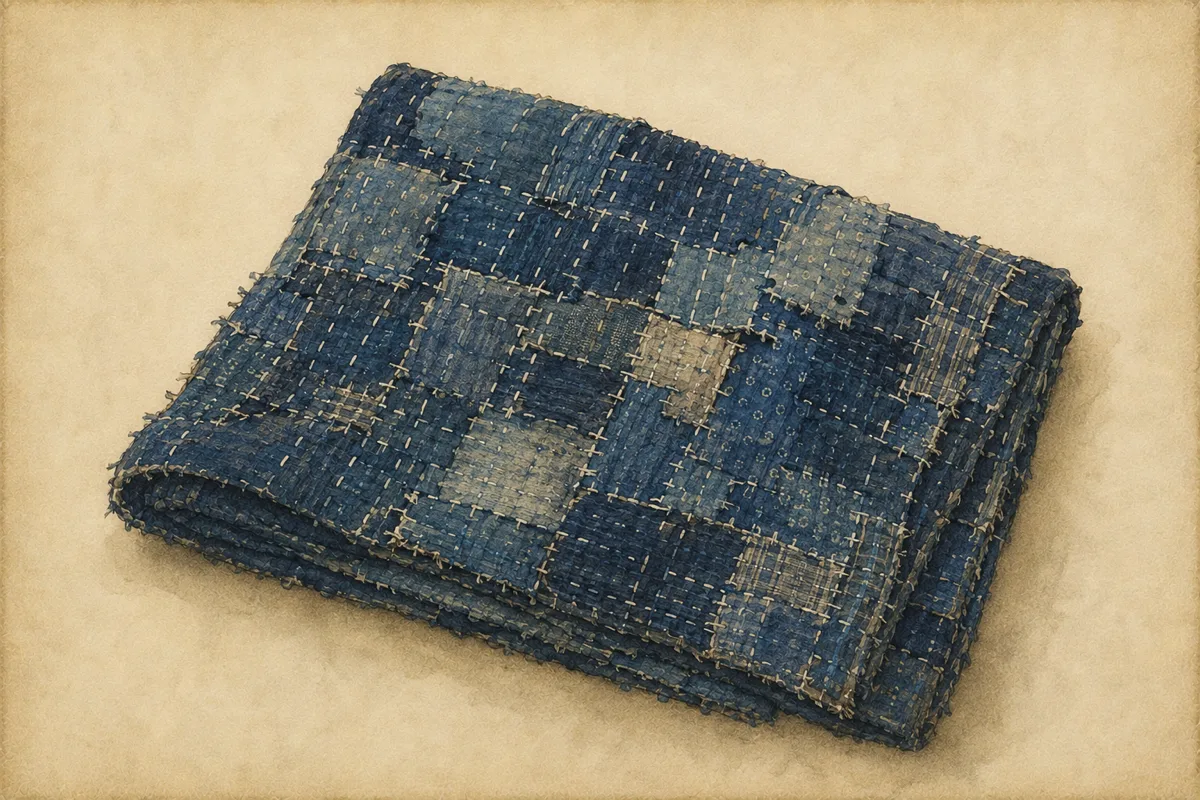
In Aomori the cotton often arrived second-hand, already worn out by someone else, and a family slept under the same patched night robe. Boro was never preserved because anyone valued it. It was kept because it could not be replaced, used until it was more patch than cloth, and thrown out in embarrassment as soon as anyone could afford to.
What boro is
Boro (ぼろ, 襤褸) is a class of Japanese textiles that have been mended or patched together. The word comes from boroboro, an onomatopoeic term for something tattered or repaired, and originally it just meant rag or scrap. The material is cotton, linen and hemp, mostly hand-woven by farming families and then repaired, again and again, over a working life and often several. Patches sit on patches, layer over layer.
This is the distinction that trips people up: boro is not a technique. It is what an object becomes. The stitching that holds it together is sashiko, a running stitch used to reinforce and quilt cloth. Sashiko is the method; boro is the result of applying it for thirty years to something that keeps failing. Most boro contains sashiko, but sashiko is also used on cloth that is not boro.
The cotton problem
Boro is a northern phenomenon for agricultural reasons. Cotton will not grow in the cold of rural northern Japan. In Tohoku, and in Aomori Prefecture especially, the local fibre was hemp, asa, which before cotton techniques were adopted was effectively the only material in general use for the lower classes. Farmers and fishermen wore hemp. Silk was unavailable to anyone outside the privileged classes, and the sumptuary order of the time made that explicit: the upper classes wore silk and cotton dyed with expensive red, and the lower classes were prevented from wearing such things and wove their own cloth instead. Layering was how they stayed warm.
The north did get cotton, through a trade in which used cotton from western Japan was sold on to poorer northern villages. The cotton arriving in Aomori was frequently already second-hand, so a household was often mending cloth that someone else had worn out first.
How a piece accumulated
Worn clothes were patched with small pieces of fabric using sashiko stitching. Old futon covers and other garments were unstitched, re-dyed to freshen their colour, and sewn into work clothes, so the indigo that gives boro its range of blues was doing practical work. Pieces then passed between family members, and each one added more mending, so a single garment could carry the repairs of several people across decades.
The objects themselves were ordinary household things: bodoko mats, donja night robes that a family slept under, tabi split-toed socks, kotatsu blankets. Also boro donza quilted working coats, kaimaki, dotera and tanzen, all variations on padded or patched kimono. None of it was ceremonial. These were bedding and work clothes.
Thrown away
Rising living standards ended the practice; shame is why so little of it survives. As living standards rose after the Meiji period, most boro was discarded and replaced with new clothing. These garments were, to many working-class Japanese people, an embarrassing reminder of former poverty, and no institution was collecting them. The association with poverty and struggle intensified again after Japan's defeat in the Second World War. Across the whole period the direction was the same: this was cloth people wanted to stop owning. Almost nothing was preserved deliberately, and what survives is largely the work of one collector.
The collector
Chuzaburo Tanaka, a folklorist and ethnographer, collected over 20,000 pieces of boro. Of those, 786 items are now designated Important Tangible Cultural Properties. The Amuse Museum in Asakusa, Tokyo, which opened in 2008, exhibited 1,500 of them alongside a wider collection of over 30,000 pieces of Japanese folk art. Tanaka was gathering these things while their owners still regarded them as rags. The designation came afterward, and the exhibitions came after that.
From rag to gallery wall
Boro was eventually read through wabi-sabi, the aesthetic in which marks of wear and use are treated as beautiful rather than as damage. Tanaka's collection appeared in a Japan Society exhibition in 2008, and in 2020 Japan Society in New York mounted Boro Textiles: Sustainable Aesthetics, showing bodoko, donja, tabi and kotatsu blankets from garments dated between 1800 and the 1950s. Fashion houses including Kapital, Dior and Loewe have since drawn on the boro look.
The exhibition's curator, Yukie Kamiya, described the objects this way: "This is a kind of creation for and from survival. They have to pile and patch."
Kamiya is describing something that was never designed. The composition of a boro panel, the drifting rectangles of different blues, the visible stitching, the asymmetry, was not composed. Every decision in it was made for a reason that had nothing to do with how it would look on a wall.
What the panel records
A single object holds repairs made years apart, by different hands, for different failures. The drifting blues are the residue of whatever cloth happened to be available on the day each repair became necessary. It is a record of decisions made under constraint, by people who did not sign their work and did not expect it to be kept.