
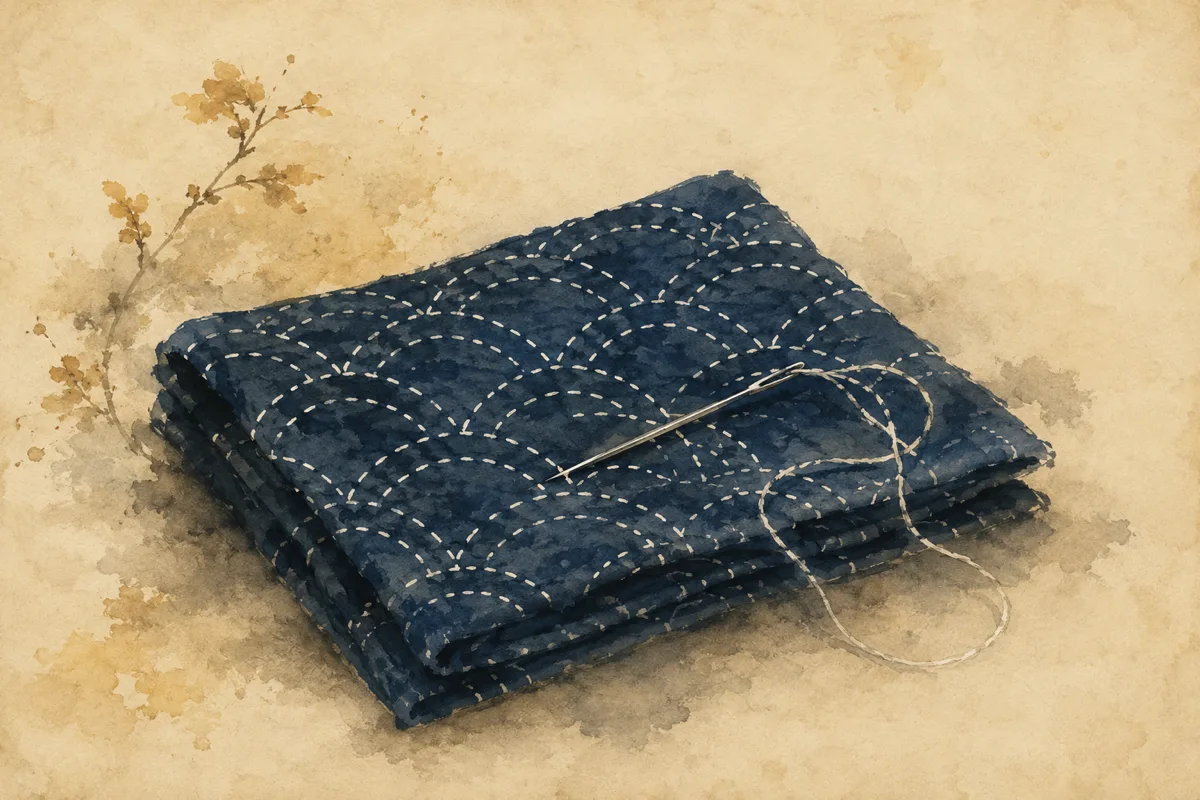
The word is sashiko (刺し子), and it means something close to "little stabs." It comes from sasu, to pierce. It is a blunt name, and an accurate one: the technique is named for the action, not the result.
What you have probably seen is white cotton thread worked in geometric lines across indigo-blue cloth. That combination is real and historical, but the pattern was not the original point.
What sashiko was for
Sashiko is a running stitch. The simplest stitch there is, in and out through the cloth, worked in repeated parallel lines.
Rural households used it for three jobs. It reinforced worn cloth and held patches on. It quilted layers together, stacking thin, exhausted fabric into something with body. And it added warmth, which mattered enormously: sashiko is found across Japan but concentrated in the colder north.
Whether that counts as embroidery is genuinely disputed. The Textile Research Centre in Leiden notes that some scholars file sashiko as structural stitching rather than embroidery, on account of those practical origins. Embroidery decorates a surface; this holds a garment together. The geometry that people now buy kits to reproduce started out as the visible trace of a repair.
The technique first appears in the Edo period (1603–1867), and by the Meiji era (1868–1912) it was established as winter work in northern farming communities, done in the slack months when there was no field work. Where it began before that is unclear.
Why white on blue
The color is a constraint, not a taste. Edo-period sumptuary rules restricted textiles and garments by social class, and fine fabrics and bright colors were not for farming families, so rural dress stayed with indigo-dyed cotton and hemp, the cheap and abundant cloth, and undyed white thread was what was left to stitch it with. Real indigo has to ferment before it ever touches cloth, which is its own long story.
Not everything is white on blue. Some decorative pieces use red thread. There is also kakurezashi, where the stitching is dyed over with indigo afterward so it nearly vanishes into the cloth.
Two ways to stitch it
Most sashiko sorts into two families.
Moyozashi builds its patterns from long, continuous lines of running stitch. The lines curve and cross and the design emerges from their paths. This is the style most people imagine.
Hitomezashi works on a grid. The name is usually translated "one stitch," which misleads. According to the Japanese sashiko practitioner Atsushi Futatsuya, hitome refers to how long each stitch is, set by the grid chosen at the start of the work, not to each mark being a single isolated stitch. Every stitch is one grid unit long. The pattern appears from how thousands of these uniform stitches align across rows, and makers commonly plan it on graph paper. The stitches themselves are relatively large, and combining them at that fixed size is what separates the method from ordinary running stitch.
Neither is more advanced than the other. They developed in different places under different conditions.
Regional traditions
Sashiko's regional names track what each place had to stitch with and what it had to survive.
Kogin-zashi comes from the Tsugaru region of Aomori, in the far north. It is worked as counted-thread stitching that produces dense diamond patterns in horizontal rows, originally to strengthen and warm hemp garments. The surface it makes is noticeably ridged and textural, unlike the flatter look of common sashiko.
Shonai sashiko, from the Shonai area of Yamagata, is the best-known hitomezashi tradition, geometric and grid-based.
Farther out, the ground cloth follows local supply. Nanbu sashiko is stitched on a light blue ramie ground. Shimokita sashiko uses a notably heavy amount of thread, which fits a fishing community that needed hard-wearing cloth.
Edo-period firefighters wore hikeshi sashiko hanten, coats of many layers stitched densely together and soaked with water before the wearer went in.
Sashiko and boro are not the same thing
These two words get used interchangeably in English, and they name different things.
Boro is cloth that has been patched and layered and repatched over a long time, sometimes across generations, until it becomes a record of its own repair. Sashiko is the stitching that commonly holds it that way: a condition of the textile versus a method of working it.
So a clean, single-layer piece of indigo cloth covered in careful white geometry is sashiko without being boro. A garment built from twenty scraps of different fabric is boro, and it is almost certainly held together with sashiko. The confusion is understandable, since the most photographed boro pieces are dense with sashiko stitching.
The patterns
The named patterns are numerous, and many are shared with the wider vocabulary of Japanese design rather than being unique to needlework: seigaiha (blue ocean waves), uroko (fish scales), shippo (linked circles, the Buddhist seven treasures), kagome (the woven basket), amime (netting), toridasuki (interlaced bird circles), hishi-moyo (diamonds), plus grid and stripe patterns like koshi, tate-jima, and yoko-jima. Hokusai's 1824 pattern book New Forms for Design is said to have fed designs into the tradition.
You will meet the same motifs in resist-dyed cloth, on ceramics, and in woodwork lattice. These are Japanese design motifs generally, not needlework ones, and sashiko borrowed them like everything else did.
Why it came back
Visible mending, slow fashion, and a general suspicion of disposable clothing all point at a technique whose entire premise is that worn cloth is worth saving. The Japanese word usually attached to this is mottainai, a sense that waste is a shame in itself.
Sashiko exists because rural families could not afford to replace cloth and were legally discouraged from wearing anything better. The revival runs the other way: it is largely taught from kits of new cotton, pre-printed with a grid, and practiced by people mending out of preference rather than necessity.