
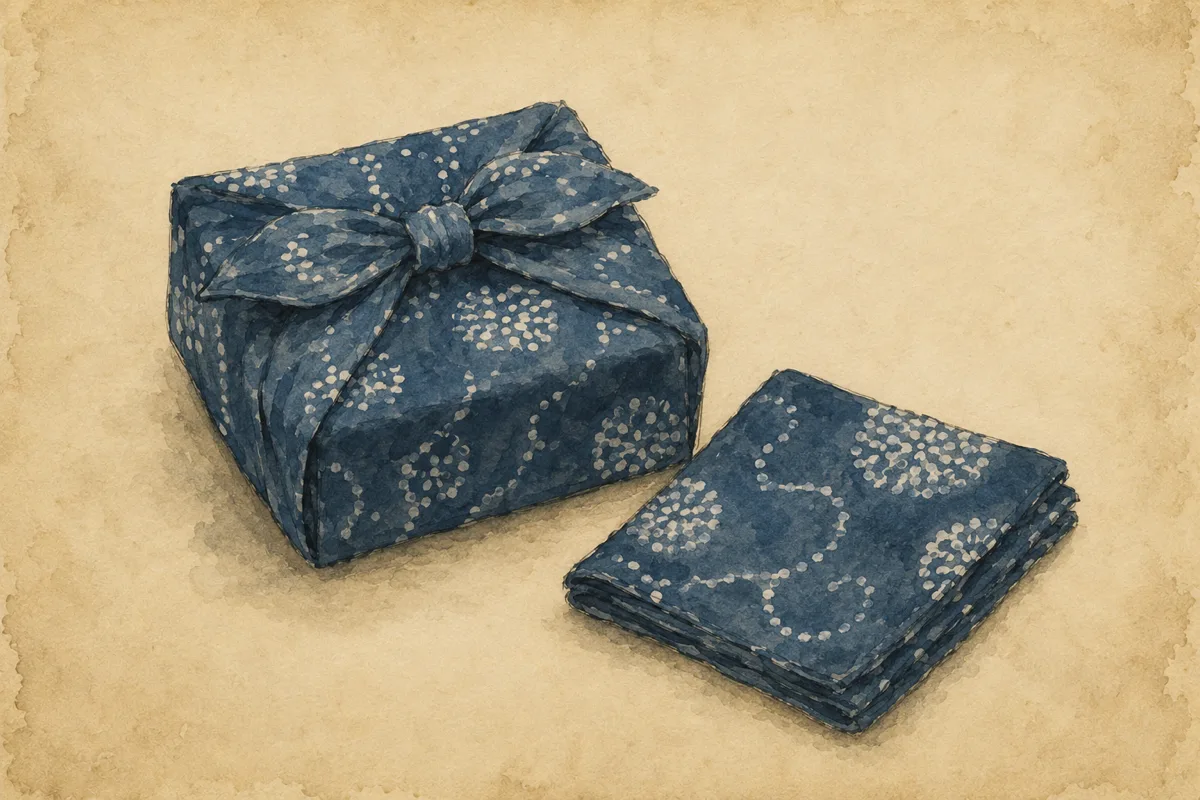
Every English furoshiki tutorial shows the same thing: a pair of hands, a square of cloth, a box, four folds. None of them says which square of cloth. Buy the wrong size and no amount of correct folding will save the parcel, and the size system is not in inches, or in centimetres either. It is counted in loom widths.
What the cloth is
A furoshiki is a squarish cloth for wrapping and carrying things. The name means bath spread, from furo, bath, and shiki, spread, which is an odd name for a shopping accessory and points at where it comes from.
In the Muromachi period, bathers of rank at a large bathhouse would spread a cloth to stand on and bundle their clothes into it, marked with a family crest so that nobody went home in someone else's robes. One Kyoto account attaches this to the bathhouse built by the shogun Ashikaga Yoshimitsu. Before that the cloth had other names, koromo-zutsumi and hira-zutsumi, clothes-wrap and flat-wrap, and in the Nara period a wrapping cloth was simply a tsutsumi, used around temple treasures. The word furoshiki only became the general term for a wrapping cloth in the 18th century, once public bathhouses had made the object ordinary.
Then it went out of use. Production peaked around 1970 by one Kyoto seller's account, and paper and plastic bags took the rest. In 2006 the Japanese environment minister Yuriko Koike launched a mottainai furoshiki to push it back, and that campaign, more than any tradition, is why the cloth reached English-speaking shoppers as an environmental object.
Sizes are counted in loom widths
Furoshiki sizes have names, and the names count haba: the width of a bolt of kimono cloth, which Kyoto sellers put at about 34cm. Two widths, futa-haba, is about 68cm, and that is the size you will meet most often.
The everyday range runs roughly like this. Use about 45cm for a money envelope, a lunchbox or a tissue box, and 50cm for a roomier version of the same things. 68cm is the standard, sized for a boxed gift or a single wine bottle, and 75cm does that job with more slack. Use 90cm for a large bottle, a shopping bag or a door curtain, and 105cm for a bundle of clothes or to cover a table.
Above that the sizes stop being about carrying and start being about bedding: roughly 128cm, 175cm, 200cm, and about 230cm for moving futons. Different sellers quote these a few centimetres apart, so treat every figure as approximate. The arithmetic is approximate too. Two widths really is twice 34cm, but four widths lands nearer 128 than 136, and the naming has outlived its own maths.
One more quirk: the cloths are not quite square. Wikipedia's article notes that the height slightly exceeds the width, which is part of why every size here is quoted as one approximate number.
Choosing the size, properly
Musubi, the Kyoto specialist, puts the object's longest dimension at about a third of the cloth's diagonal. Not a third of its side. The diagonal is what does the wrapping, because the corners are what you tie.
For an exact answer there is a formula, which one Japanese furoshiki seller sets out as a sum: the length across the bottom of the object, plus the length across the top, plus twice the side, plus about 15cm for the knot itself. That total is the diagonal you need. Divide it by 1.414 and you have the side length of the cloth.
Their worked example: a diagonal of 125cm divided by 1.414 gives 88cm, so a 90cm cloth is very close to right.
Run a box you own through that before buying, and the arithmetic will often send you a size up from the cloth you were about to choose.
The square knot, and the granny knot that looks like it
Two knots do nearly all the work: the square knot, ma-musubi, and a simple single knot.
The square knot is where beginners come unstuck, because the wrong version of it looks almost identical. Tied correctly, the finished knot lies flat: a bar. Tied the other way you get tate-musubi, a granny knot, and it sits crosswise, a small upright cross where the bar should be. That is the whole test, and you can apply it to a knot somebody else tied.
The difference is not cosmetic. Japanese guides say the granny knot loosens under load, which is exactly when you are carrying something, and then jams solid when you try to open it. None of them explains the mechanism, but they agree on the behaviour. It is also considered plain wrong, so a gift arriving under one is a small visible error.
Musubi's own sequence labels the two corners a and b. Hold one in each hand and cross them with b behind a, then wind b around a and pull. Now lay the tail of a over to the left, bring b across on top of it, and pass b up through the loop that crossing has just made, from underneath. Take both corners again and pull them apart left and right.
Untying is where it tells. A correct square knot opens in a single move. Take the end lying on top of the knot, fold it back across the knot and pull it straight, and the knot stops being a knot; grip it and slide it off the other end.
Wraps and their sizes
The Kyoto guides pair each wrap with a size.
Hira-tsutsumi, the flat wrap, is the formal one, done at about 45 or 68cm and used for presenting gifts on a tray. The bottle wrap needs 68 to 70cm for one bottle and 90 to 100cm for two. The bag conversions need 90 to 100cm. For a tissue box, use about 50cm and leave the knot loose enough to keep the dispensing opening clear.
Cloth to buy
Cotton does most of the work. It is strong, it knots securely, and it softens with use, which is the same argument that runs through Japanese cotton textiles that were mended rather than replaced. Traditional cottons come dyed in indigo.
Silk, chirimen crepe especially, is the formal choice and needs dry cleaning. Polyester is slippery, which ties and unties easily and folds down to nothing in a pocket. Nylon goes smaller still, shrugs off water and dries fast. Rayon is the exception, because it shrinks when wet.
One cloth: 68cm. Three: 45, 68, and 90. Either way, run the object through the arithmetic first.