
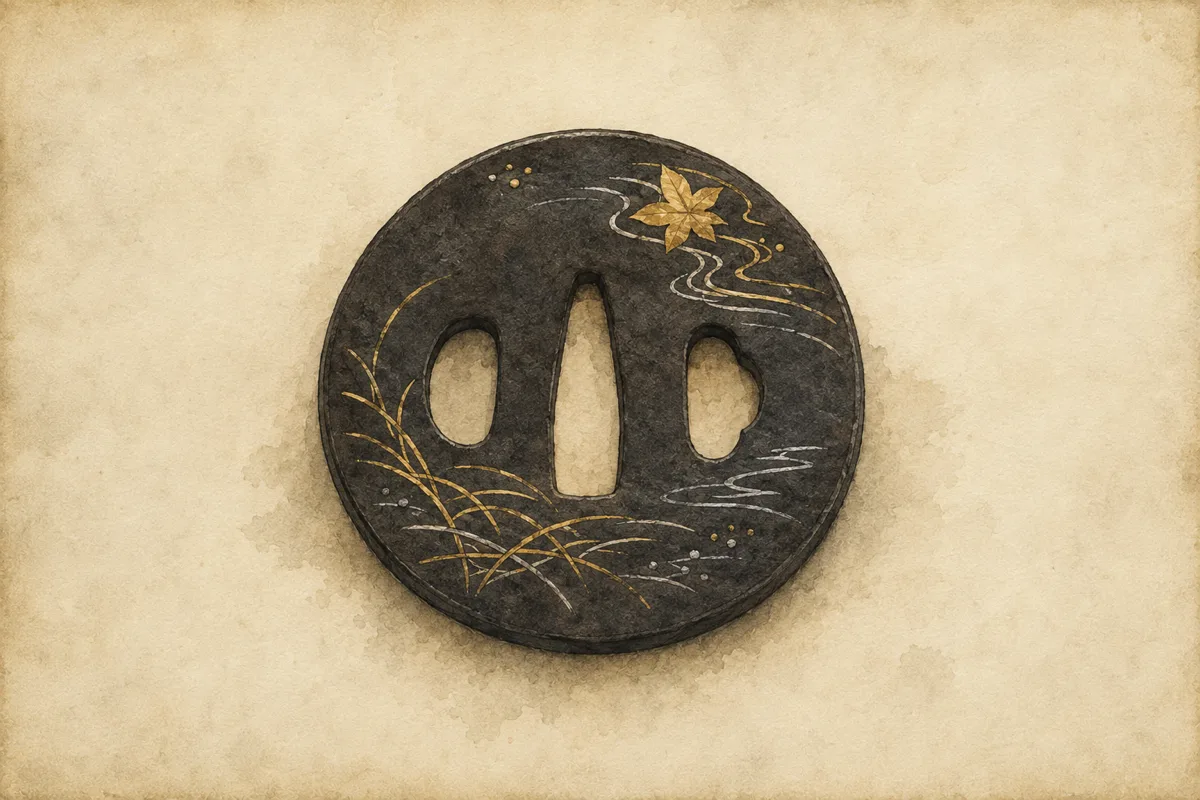
The black on a piece of Higo zogan is rust. Real corrosion, raised on the iron deliberately and then stopped before it could eat any further.
Raising the rust, then stopping it
The last stages of the process are the ones that sound wrong to anyone who has spent time around ironware. The sources describe the agent only as a rusting liquid: it is brushed onto the finished piece, which is heated, and the two are repeated until rust has come up evenly across the whole ground. Only then is the corrosion halted, by boiling the piece in tea for roughly thirty minutes. Tannin converts the surface into a stable black iron oxide film that resists further rusting, and it leaves the gold and silver alone.
Nothing is painted. The colour is the metal's own, and both the Kumamoto craft centre and KOGEI JAPAN describe the ground in terms of iron rather than of coating.
The last step is camellia oil, mixed with soot, brushed on, heated in, and then polished back with more oil. Wearers get much the same instruction afterwards, which is why pieces are sold with a small bottle of it.
Set that against the tetsubin, where rust is the enemy and every care instruction exists to keep it out. Higo zogan invites the same chemistry in, lets it take the whole surface, and then converts it into the finish.
Sixteen cuts in a millimetre
Before any precious metal appears, the craftsman covers the design area in nunome, a crosshatch cut into the iron with a chisel in four directions. KOGEI JAPAN gives the density: around sixteen lines fit inside a square millimetre. Under magnification the surface stops looking like metal and starts looking like woven cloth, which is what the name says.
Gold or silver is cut to shape, warmed, laid onto that texture and hammered down with a tool of deer antler. The soft metal spreads into the raised grid and locks there. No solder, no adhesive. Excess is trimmed, the piece is beaten smooth, and then the exposed crosshatch outside the design has to be scraped off with an iron rod and the ground polished back to plain iron.
The full sequence runs to seventeen stages in KOGEI JAPAN's account, and the inlay is only the middle of it. The stages before it are cutting and filing the plate, polishing out impurities, fixing it into a work stand and transferring the design; the ones after are hairline engraving to bring up the details, a bath of dilute nitric acid followed by ammonia, and then the rust, the tea and the oil.
There is a second method, horikomi, in which the design is carved into the base metal and the inlay set into the recess. Sources differ on how much of each is used now. Most descriptions of contemporary Higo work put nunome in front.
The 1876 collapse
The craft was born decorating weapons. In the early Edo period the work went onto gun barrels, sword guards and smoking pipes, and it was made for the samurai class specifically. Kumamoto's tsuba acquired their own name, Higo tsuba, and the patronage of the Hosokawa house kept the workshops fed for two and a half centuries.
Then in 1876 the Meiji government banned the wearing of swords, and the customer base did not shrink so much as vanish. Artisans went to whatever iron object could still carry decoration: boxes, paperweights, tobacco pipes. Kamiyoshi Rakuju is the name attached to the survival, a craftsman rated so highly that BECOS records the contemporary verdict on him as Matashichi reborn, and the shift he pushed was towards accessories and tea utensils.
Who started it depends on who you ask
Most accounts name Hayashi Matashichi. He was a gunsmith working for Kato Kiyomasa, moved into the service of the Hosokawa house after 1632 when the Kato were dispossessed, went to Kyoto to learn nunome inlay, and brought it back to decorate barrels. The sword guards he went on to make are the ones that gave Higo tsuba their reputation.
The Japan Tourism Agency tells it differently, crediting Hosokawa Tadaoki, who lived from 1563 to 1646, with bringing a smith named Hirata Hikozo to Kumamoto from Omi province. The two stories are not reconcilable as they stand, though both put the craft in Kumamoto in the early seventeenth century, under Hosokawa patronage, with the technique arriving from outside rather than growing up locally.
Fifteen craftsmen, and what they make
The Japan Tourism Agency counts roughly fifteen craftsmen still working in Kumamoto. What they produce has drifted a long way from a gun barrel: cufflinks, tie pins, pendants, pens. The Kosuke workshop, run by a fourth-generation owner, has added eyeglass frames and even a golf marker in the local Kumamon character, and describes its direction as small things for everyday use.
Raising rust evenly depends on temperature and humidity, and it used to be at the mercy of the weather. Kosuke installed constant temperature and humidity equipment to stabilise the stage. The chisel work stays exactly as it was; the corrosion got an air-conditioned room.
The craft's public profile now comes largely from official gifts. Higo inlay fountain pens went to G7 leaders in 2016, and the medals for the 2019 IHF women's handball world championship in Kumamoto carried the work. Designation as a national traditional craft came only in 2003, four centuries after the first Hosokawa commissions.
Reading a piece in the hand
Look at the edge of the gold under a loupe. Nunome inlay sits on the surface and its outline sits slightly proud; carved horikomi inlay sits flush in a recess. Neither is better, but they are different techniques at different prices, so it is fair to ask which one you are holding.
Then look at the black itself, in raking light. It should have depth: an oxide layer sits in the metal and shifts as you tilt it, where a coating stays flat on top. Hammered Tsubame copper takes its colour the same way, from a chemical bath rather than a pigment.
Then ask about care, and expect to be handed camellia oil. The finish is arrested corrosion, and the wipe is what keeps it arrested.