
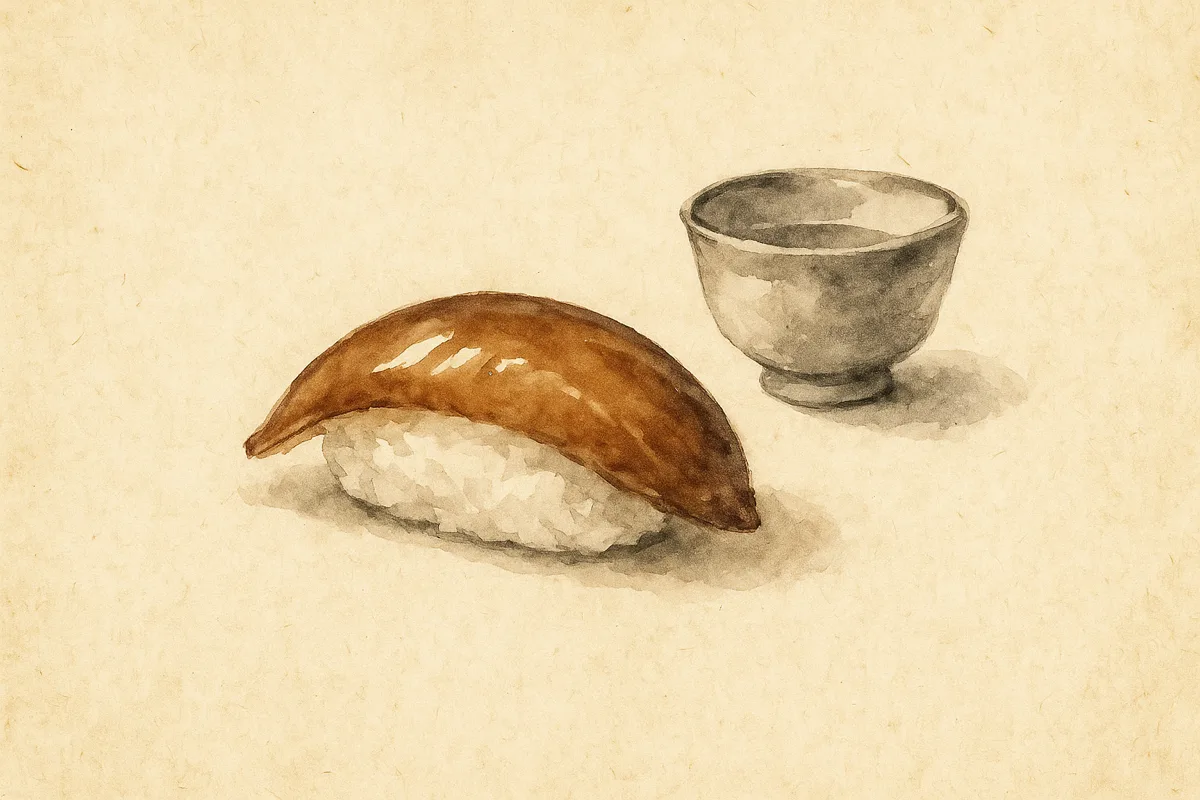
At a sushi counter, the sake list raises a practical question: which bottle will stay out of the way of the fish? A flat table of pairings (junmai with salmon, ginjo with tuna) only helps until the piece in front of you isn't listed. What carries over to any fish is the reasoning behind the match.
This guide covers one reason sake belongs with raw fish, two moves you can apply to anything, and a grid you can read by the piece.
Why Sake Beats Wine With Raw Fish
Red wine with sashimi often leaves a metallic, faintly rotten aftertaste. For a long time this was folklore, captured in "white with fish, red with meat." In 2009 a team of Japanese researchers pinned down the cause and published it in the Journal of Agricultural and Food Chemistry. Tasting panels ate scallops alongside 38 red and 26 white wines, and the intensity of that fishy aftertaste tracked one thing: the iron in the wine. Spike a wine with ferrous ion and the aftertaste got worse; strip the iron out and it vanished. The iron oxidizes the fish's delicate omega-3 fats into a set of volatile compounds (hexanal, heptanal, nonanal and others) that smell exactly like old fish.
Sake is brewed with almost no iron on purpose. Iron reacts with a compound from the koji mold to form a reddish-brown stain and off aromas, so brewers insist on water with iron at or below 0.02 ppm (against roughly 0.3 ppm in ordinary tap water) and actively strip it out. The quality control that keeps sake clear and clean happens to remove the one thing that makes a drink clash with raw fish. Sake can't produce the iron-driven fishy aftertaste, because the iron was never there.
There is a positive side too. Raw fish is rich in inosinate; sake is rich in glutamate. Those are the two halves of umami synergy: combine them near a one-to-one ratio and the savoriness jumps to seven or eight times what either delivers alone. It's the exact mechanism behind dashi, where kombu (glutamate) meets bonito flakes (inosinate). Pour sake over a piece of tuna and the sake is playing the kombu; the fish is the bonito. Sake also carries zero tannin, so nothing grips or dries the fragile protein, and its low acidity leans on succinic acid, the same savory acid found in shellfish.
Two Moves: Complement or Contrast
The choice is between two moves.
- Complement (重ねる): for lean, umami-rich fish, stack flavor on flavor. The sake adds its glutamate to the fish's inosinate and the synergy above does the work.
- Contrast (対比する): for fatty, oily fish, go the other way. A dry, cool sake cuts the fat and resets your palate for the next bite.
Lean fish, lean into it. Fatty fish, push back against it. That single instinct will carry you through a whole omakase.
The Grid, by the Piece
Read light to bold, the traditional order of a sushi meal, from delicate white fish to rich uni and eel.
| Neta | Character | Move | Sake style |
|---|---|---|---|
| Shiromi — white fish (tai, hirame) | delicate, clean, faint sweetness | complement, gently | light junmai or crisp junmai ginjo, well chilled, low aroma |
| Akami — lean tuna (maguro) | clean, mineral, very umami-rich | complement | a clean ginjo; the textbook match |
| Hikarimono — silver-blue (aji, saba) | oily, assertive, often vinegar-cured | contrast, stand up | junmai with body and acidity; earthy kimoto or yamahai; can go warm |
| Toro — fatty tuna | rich, buttery fat | contrast | dry junmai to scrub the fat; or gently warmed |
| Uni — sea urchin | creamy, briny, glutamate-rich | complement but light | a lighter, fruitier ginjo; the exception (see below) |
| Ikura — salmon roe | briny pop, bold | contrast | a bolder sake later in the meal, or sparkling for lift |
| Anago / unagi — eel in sweet sauce | strong sweet-savory glaze | complement, richer | a fuller junmai or daiginjo, or warm — the one place a bold sake earns it |
| Tamago — egg custard | sweet, meal's end | contrast | a rounder or sparkling sake to close |
Two exceptions: Uni and shellfish are already glutamate-rich, not inosinate-rich like fish, so piling a heavy umami sake on them stacks rather than synergizes. Reach instead for a lighter, cleaner sake for lift. (There's a lovely regional habit here: Hokkaido uni with a Hokkaido sake, "what grows together goes together.") And eel in its sweet tsume sauce is the rare piece robust enough to meet a fuller, richer sake head-on.
Skip the Showy Daiginjo
The instinct at a good sushi bar is to order the most expensive bottle for the best fish. Resist it. Sushi specialists are blunt about this: a sake high in ethyl caproate (the apple-and-melon "ginjo aroma" that defines flashy ginjo and daiginjo) "generally does not go well with sushi." The floral top notes climb over the fish instead of serving it. The fish should lead. The sake's job is to stay subtle and let the umami synergy happen underneath.
The single safest order is a crisp, dry junmai ginjo with little aroma, considered by chefs the best all-round fit for sushi and sashimi. If you want one bottle for the whole meal, that's it. Two schools exist on how to run a meal. One keeps a subtle junmai ginjo pouring throughout so nothing distracts from the fish; the other progresses light-to-bold with the neta. Both are defensible; pick by mood.
The Condiments Are Part of the Pairing
The fish rarely arrives plain. Soy sauce adds salt and its own glutamate, so a slightly rounder sake balances it where a razor-dry one can read sharp against a heavy dip; dip fish-side, lightly. Wasabi is volatile heat, not chili burn; sake's tannin-free gentleness won't amplify it, so keep the sake subtle enough not to fight its aroma. Gari, the pickled ginger, is eaten between pieces, not with them, a palate reset so the next fish-and-sake pairing lands clean, work the sake's own quiet acidity is already doing between sips.
On temperature, the rule of thumb is simple: chill for delicate raw fish to keep it fresh and quiet; warm gently (nurukan, around 40°C) for fatty tuna and sweet-sauced eel, where heat broadens the sake's umami to meet the richness. The full ladder is in our serving-temperature guide.
What to Buy
For the one-bottle answer, a clean junmai ginjo like Shimane's Rihaku "Wandering Poet" or Akita's Taiheizan "Chogetsu" pours happily across a whole tray. For oily mackerel or aji, an earthy kimoto (Fukui's Hanagaki, say) has the acid and depth to stand up. For toro, a bone-dry junmai such as Oze no Yukidoke "Ex Dry" scrubs the fat. And for uni, a Hokkaido bottle like Otokoyama's unpasteurized nama junmai keeps things light and honors the regional match.
All of these live in our sake shop, sorted by exactly the styles this guide leans on: crisp junmai ginjo, dry junmai, earthy kimoto and yamahai, fresh nama. If you want to understand the grade words behind the picks, start with junmai, ginjo and daiginjo explained; to read a label for sweet-or-dry before you buy, see the SMV guide. And once you've done sushi, the same logic runs the other way at sake with Western food.