
Somewhere along the way, the wider world decided sake is a hot drink: a little ceramic flask, a thimble cup, steam rising. It's a stubborn image, and it's mostly wrong. Heating is one option among many, and for a lot of good bottles it's the fastest way to throw away what you paid for. The truth is more interesting. Japanese has ten different names for serving temperatures, spaced in tidy 5°C steps, and the temperature you choose doesn't just make the sake warmer or cooler; it redesigns the flavor.
Three zones, and a word that trips everyone up
The whole range falls into three bands. Reishu (冷酒), chilled sake, runs up to about 15°C. Jō-on or hiya, room temperature, runs around 20°C. And kanzake (燗酒), warmed sake, climbs from roughly 30°C all the way to 55°C and beyond.
The trap sits in that middle band. Hiya (冷や) sounds like it should mean "cold," and menus often translate it that way, but it originally means room temperature: sake that simply hasn't been warmed. In the era before refrigeration, everything that didn't go over the fire was "hiya." Chilled-in-the-fridge sake is a newer idea with its own word, reishu. So if a bar offers you hiya, don't expect ice; expect the bottle as the room left it.
The ladder: ten names in 5°C steps
Within those bands, each 5°C step carries its own poetic name, standardized by the Japan Sake and Shochu Makers Association. They range from yuki-bie, "snow-chilled," up to tobikiri-kan, "extra-hot."
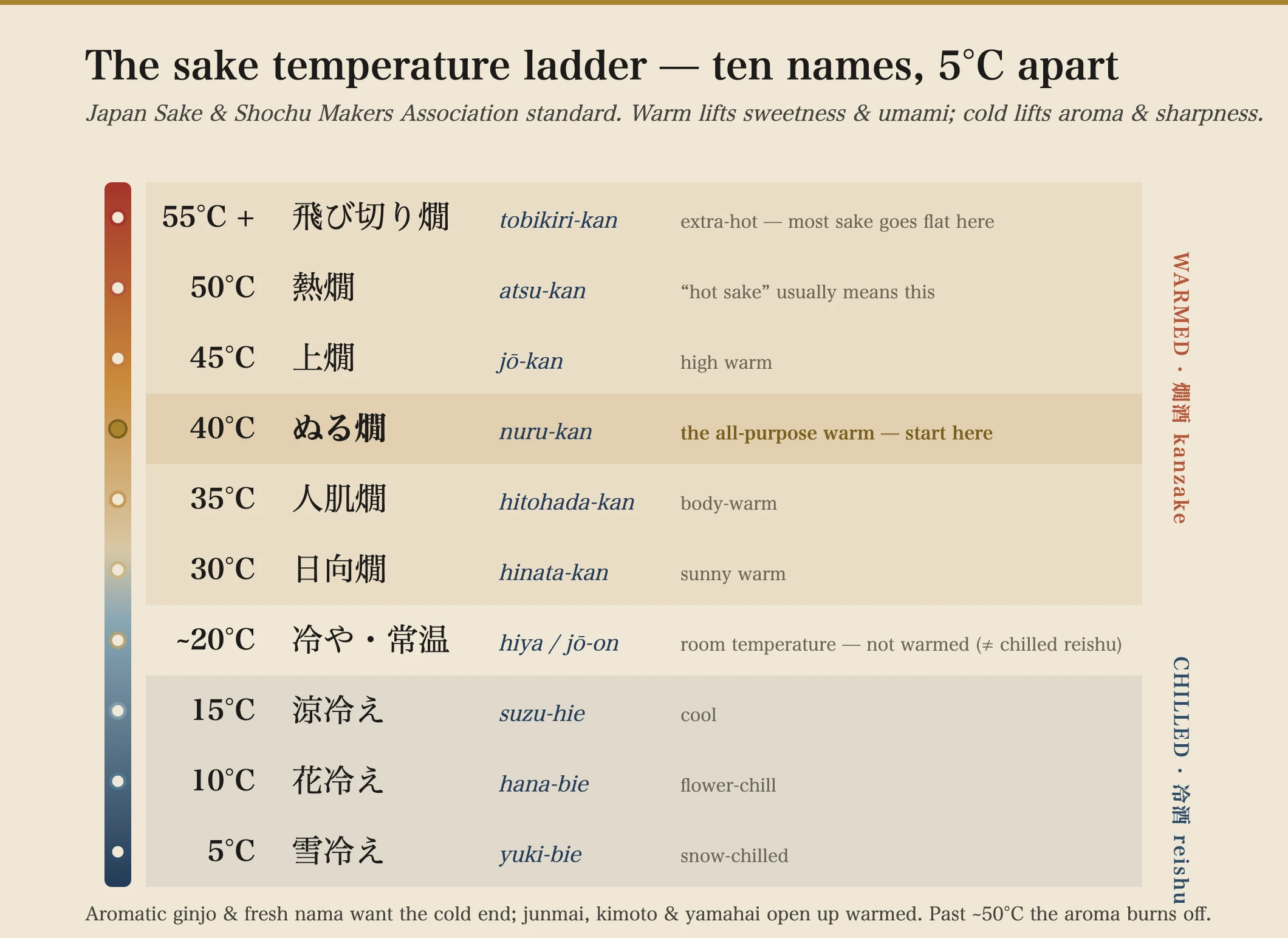
The names aren't trivia; they're the vocabulary a good sake list actually uses. The two most useful landmarks: atsukan (熱燗) at 50°C is what most people mean by "hot sake," and nuru-kan (ぬる燗) at 40°C is the gentle, forgiving warm temperature that suits the widest range of bottles. When in doubt about warming, start at nuru-kan.
What temperature does to the flavor
Temperature isn't a volume knob; it's an equalizer. Warm the same bottle and its sweetness, umami and sense of alcohol push forward, while acidity and bitterness soften and the body turns rounder and fuller, with sweetness reading most strongly near body temperature. Chill it and the showy, fruity aromatics lift off the surface while the flavor tightens and turns crisp and sharp.
That split is why no single temperature fits every bottle. A fragrant sake's whole appeal lives in aromatics that heat drives off; a rice-forward sake's appeal lives in umami that heat wakes up. Push both to the same temperature and you flatter one and flatten the other.
Matching temperature to the bottle
This is how it connects to what's on the label. The Sake Service Institute sorts sake into four flavor types, and the type points straight at a temperature:
| Type | What it is | Serve at | Why |
|---|---|---|---|
| Kun-shu 薫酒 | Aromatic ginjo / daiginjo | 8–15°C (chilled) | Heat drives off the delicate fruity aroma — don't warm it |
| Sō-shu 爽酒 | Light, fresh, nama (unpasteurized) | 5–10°C (well chilled) | Cold keeps it crisp; nama and sparkling need to stay cold |
| Jun-shu 醇酒 | Rice-driven junmai, kimoto, yamahai | 40–55°C (warmed) | Warmth amplifies umami; the lactic depth of kimoto/yamahai loves higher heat |
| Juku-shu 熟酒 | Aged sake (koshu) | 15–40°C | Chill to hold freshness, or warm to open the aroma — your call |
You can read this straight off the grade system: a junmai daiginjo is deeply polished and built on aroma, so it belongs in the cold end; a plain junmai or honjozo, or anything labeled kimoto or yamahai, rewards gentle warming. And the styles born of how sake is actually brewed, a fresh nama straight off the press, stay cold, always, because they're never pasteurized. (These are tendencies, not laws; a light, crisp junmai can drink cold perfectly well.)
Warming sake without wrecking it
The traditional method, yusen, is a water bath, and it's still the best. Pour sake into a tokkuri flask to about 80–90% full (sake expands as it warms, so leave headroom), then stand it in water heated to 70–80°C. Nuru-kan (40°C) takes about 2–3 minutes; atsukan (50°C) about 4–5. Don't let the water boil, and taste as you go.
The microwave, the modern shortcut, is the reliable way to make bad hot sake: it heats unevenly, so one mouthful scalds and bitters while another stays cold. If you're stuck with one, go low (50%) in 30-second bursts, stir between them, and rest it a minute before pouring.
Whatever you use, mind the over-heat line. Push past roughly 50°C for the wrong bottle and the aroma flies off, the flavor goes flat and papery, and only the alcohol stands out. For an aromatic ginjo, warming at all means paying for a fragrance you then boil away. And there's a lovely no-thermometer test from the days before them: watch the neck of the flask, and when a bead of condensation forms and then vanishes, the sake is ready.
One last thing: the "right" temperature has always drifted. The Hakushika sake museum notes that the nuru-kan praised in old advertisements meant about 55°C, what we'd now call tobikiri-kan, "extra-hot." Yesterday's just-right is today's scalding. There's no single correct temperature for sake, only the one that suits the bottle in your hand. When you're picking that bottle, our five sake for beginners span this whole ladder, from a chill-and-sip ginjo to a junmai made for gentle warming.