
The words on a sake label look like a code. Junmai, ginjo, daiginjo, honjozo aren't brand names or vague quality stars a marketer sprinkled on. They're a legal classification set by Japan's National Tax Agency, built on two rules that sort all eight of the so-called tokutei meishoshu ("special designation") grades onto a single grid.
Every premium sake grade is fixed by two levers: how far the rice was polished, and whether a small, capped dose of distilled alcohol was added. The two levers below cover every grade.
The two levers
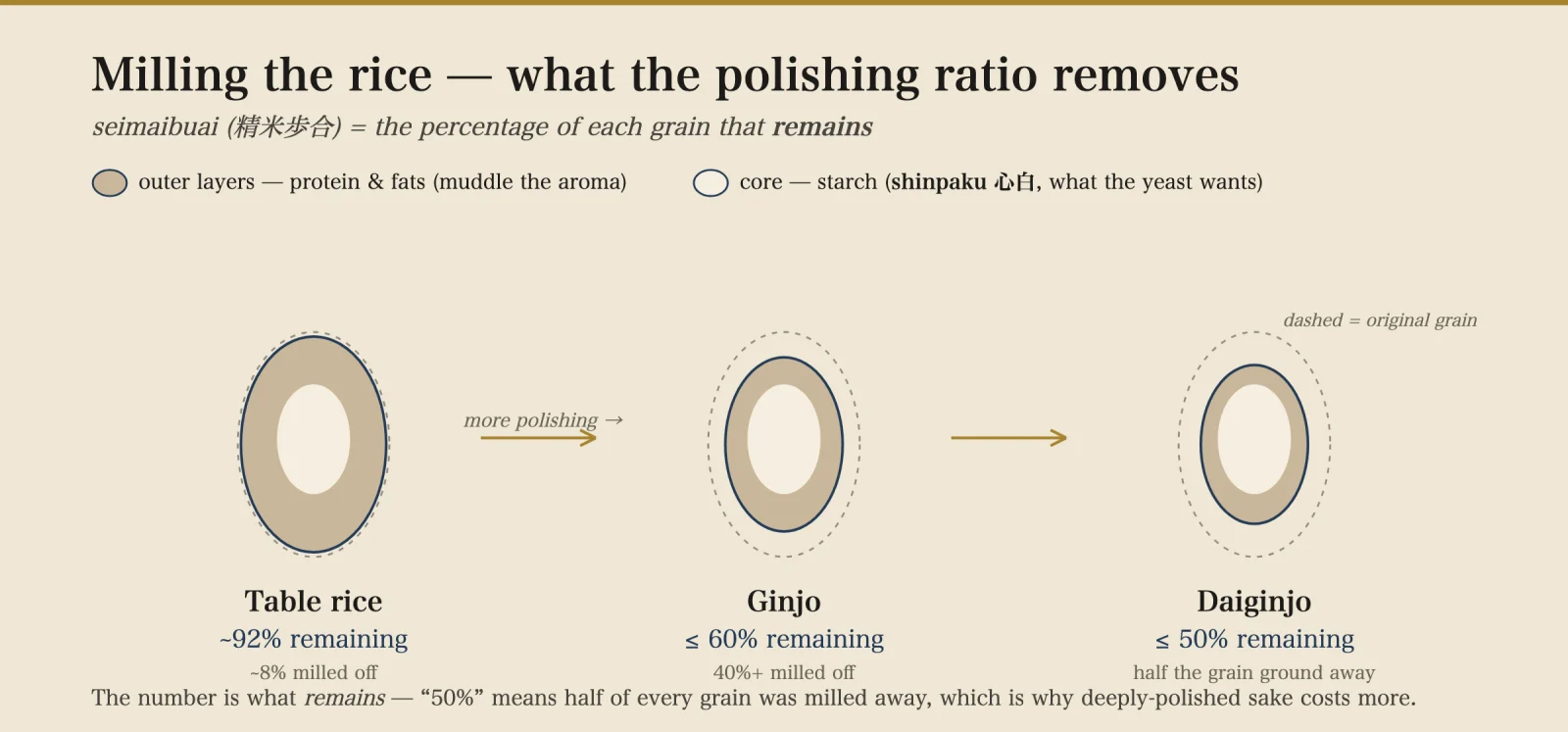
Lever 1: how far the rice is polished (seimaibuai). Before brewing, the outer layers of each rice grain are milled away. The number you see, the polishing ratio, is the percentage of the grain that remains. "50%" does not mean half kept for something else. It means half of every grain was ground off and discarded. A lower number is more polishing, more waste, more cost.
Why bother? The center of the grain is nearly pure starch, the sugar the yeast wants. The outer layers carry protein and fats, and in the tank those aren't neutral: excess protein throws heavy, off flavors, and excess lipids actually suppress the fruity aromas. Polishing isn't purification for its own sake; it removes the flavor-muddlers so the fermentation can go clean and fragrant. That is the physical reason a deeply polished sake smells of melon and pear while a lightly polished one smells of grain. For scale, eating rice loses only about 8% of the grain; sake removes at least 30%, and brewers have gone to a near-mythical 1% remaining, meaning 99% of the grain milled away.
Lever 2: added alcohol, or none (junmai). After fermentation, some sake gets a small dose of neutral distilled alcohol, the same spirit family as shochu and usually distilled from sugarcane molasses, stirred into the mash just before pressing. Sake made with no added alcohol, from rice, koji and water only, earns the word junmai ("pure rice"). That single line is the whole left-versus-right split of the grid.
At the premium tier, added alcohol is not a cheapening trick. Those fruity aroma compounds are barely soluble in water but dissolve readily in alcohol, so a small dose added before pressing actually pulls more aroma out of the mash and lightens the body toward a crisp, dry finish. A ginjo can therefore smell more fragrant than its junmai twin. For special-designation sake the dose is capped at 10% of the rice weight, versus roughly double that in ordinary table sake, and that is the source of the bad reputation.
The eight grades on one grid
Cross the two levers and you get the whole taxonomy. Read down for more polishing; read across for the pure-rice (junmai) versus alcohol-added columns.
| Polishing | Pure rice (junmai family) | Small alcohol added |
|---|---|---|
| ≤ 70% remaining | Junmai | Honjozo |
| ≤ 60% remaining | Junmai Ginjo | Ginjo |
| ≤ 50% remaining | Junmai Daiginjo | Daiginjo |
Every alcohol-added grade has a mirror-image junmai grade at the same polish: honjozo ↔ junmai, ginjo ↔ junmai ginjo, daiginjo ↔ junmai daiginjo. Putting "junmai" in front just means "the pure-rice version of this same tier." (There's also tokubetsu, or "special," junmai and honjozo, which qualify either by polishing to 60% or by a distinctive method the brewer must disclose. And note junmai itself has had no minimum polishing ratio since a 2004 rule change, so a plain junmai can be modestly or heavily milled by choice.)
Two guardrails make this a real standard, not shop jargon. To earn any of these names the rice must be inspection-graded, at least 15% of it must be koji rice (the koji mold doing the saccharification), and the actual polishing ratio must be printed on the label. The rules trace to National Tax Agency Notice No. 8, issued in 1989.
What each grade tastes like — and when to reach for it
The grid predicts style, not a ranking. Broadly:
- Ginjo and daiginjo (right column, deeply polished): the fruity ginjo-ka aroma of apple, pear, banana, melon and lychee, light-bodied, low in acid, smooth. Daiginjo is the more refined, more aromatic extreme. Serve cold, drink young, treat like a fine white wine.
- Junmai and junmai ginjo/daiginjo (left column): more of the rice and koji show through. Junmai is typically higher in acidity and umami with less overt sweetness, for weight and food-friendliness. Junmai daiginjo is widely regarded as the top grade: refined aroma plus that rice depth.
- Honjozo: clean, light, not showily aromatic, built to bring out the food rather than upstage it, and the classic bottle to warm gently for yakitori or grilled fish.
So when you're buying: want the aromatic showpiece to sip cold? Reach for a ginjo or daiginjo. Want something with body that stands up to dinner, or that you can warm? A junmai or honjozo. And that big price gap now makes sense. A junmai daiginjo costs multiples of a honjozo because it throws away half the rice and demands a slow, cold, labor-heavy fermentation. You're paying for discarded grain and brewer-hours.
Everything above sits inside the roughly 30% of Japanese sake that qualifies for these labels. The other ~70% is futsushu, ordinary table sake, polished less and dosed with far more alcohol to stretch volume, which carries no grade word at all. That's the tier the "junmai purist" reflex was really reacting to; awarded, deeply respected daiginjo are routinely alcohol-added on purpose. (See our gold-medal brewers for how far the craft end runs, and what jizake means for the small-batch world.)
The two levers are how polished and alcohol or not. When you're ready to put them into practice, our five best sake bottles for beginners span exactly this grid, from an easy junmai ginjo to a famous daiginjo.