
The number is right there on the back label, usually printed as 日本酒度 +5 or, on export bottles, SMV -2. Shops and apps sell it as the answer to the one question every beginner asks: is this sake sweet or dry? Plus is dry, minus is sweet, done.
Except the number is misleading. The Sake Meter Value doesn't measure sweetness. It measures density. Knowing that lets you predict how a bottle will taste instead of trusting the label.
The Sake Meter Value measures water, not sugar
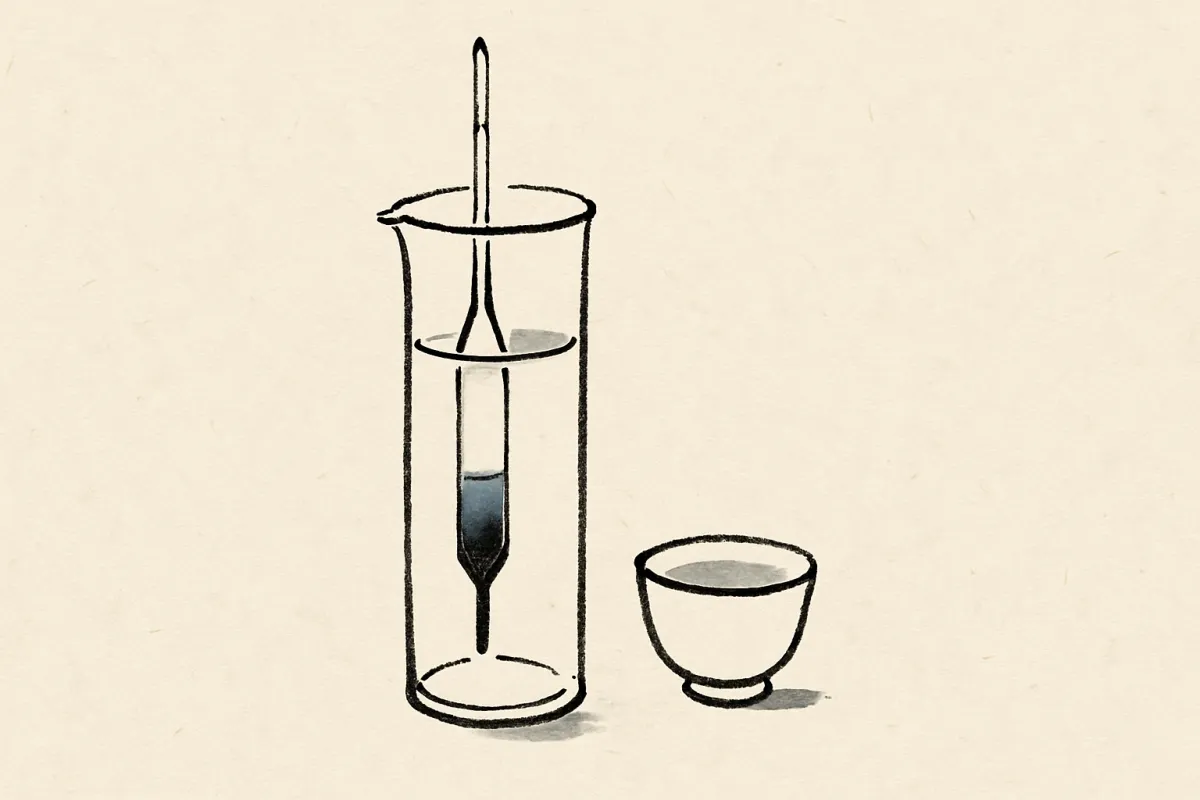
Nihonshu-do (日本酒度), the Sake Meter Value, is read with a floating hydrometer calibrated so that pure water at 4°C reads zero; sake itself is measured at 15°C. If the sake is lighter than that water baseline, the meter reads positive; if it's heavier, negative. The scale asks one thing: how does this liquid's weight compare to water? The formula behind the number is SMV = (1 / specific gravity − 1) × 1443, a density reading dressed up as a flavor rating. (The scale even inherits an 18th-century French one: one degree Baumé equals ten SMV points.)
Density stands in for sweetness because of the chemistry of the brew. During fermentation, yeast eats sugar and turns it into alcohol, a process that runs alongside the koji breaking down starch, all in one tank. Sugar is heavier than water; alcohol is lighter. So a sake that fermented far (little sugar left, lots of alcohol) comes out light and reads positive (dry). One stopped early, still sugary, comes out heavy and reads negative (sweet). Roughly −1.4 to +1.4 is treated as neutral, and most Japanese sake lands around +3 to +5.
That limitation is baked into the mechanism: because alcohol makes the liquid light, more alcohol pushes the number positive even if the sugar hasn't changed. A high-strength undiluted genshu can read bone-dry on paper and taste rounder in the glass, simply because its alcohol is doing the meter's talking. As the retailer SAKE Street puts it, SMV alone doesn't determine whether a sake tastes sweet or dry.
The second number that flips the first
Look again at the label and you'll find a companion figure: 酸度 (sando), the acidity. This is the number that makes the SMV lie, and the two are meant to be read together.
Acidity is the total of the organic acids in the sake, lactic (soft, round), succinic (savory, faintly bitter, the umami of shellfish), malic (fresh and tart), measured by titration. It usually runs from about 0.5 to 3.0, with 1.4 to 1.6 considered balanced. What matters is that acidity counterbalances sugar on the tongue, independent of the density the SMV recorded. Higher acid tastes drier and sharper; lower acid tastes sweeter and rounder. Acid produces kire, the clean, cutting finish prized in a dry sake.
So a sake at −3 ("sweet" by the meter) with high acidity can finish crisp and dry, while a +5 ("dry" by the meter) with low acidity can taste soft and off-dry. The same SMV can land on opposite ends of the palate. As one retailer's tasting guide puts it, acidity "can minimize the perceived sweetness of the residual sugar." The SMV alone is a rough guess; read against acidity, the two together predict the style. (There's a third, less common figure, amino acid content or アミノ酸度, that tracks umami and body: above about 1.0 reads rich and rounder, lower reads lean and dry.)
The two-number map
Cross the two axes (SMV for the sweet-dry guess, acidity for how much the palate overrides it) and every bottle falls into one of four corners. These are real bottles with their published numbers:
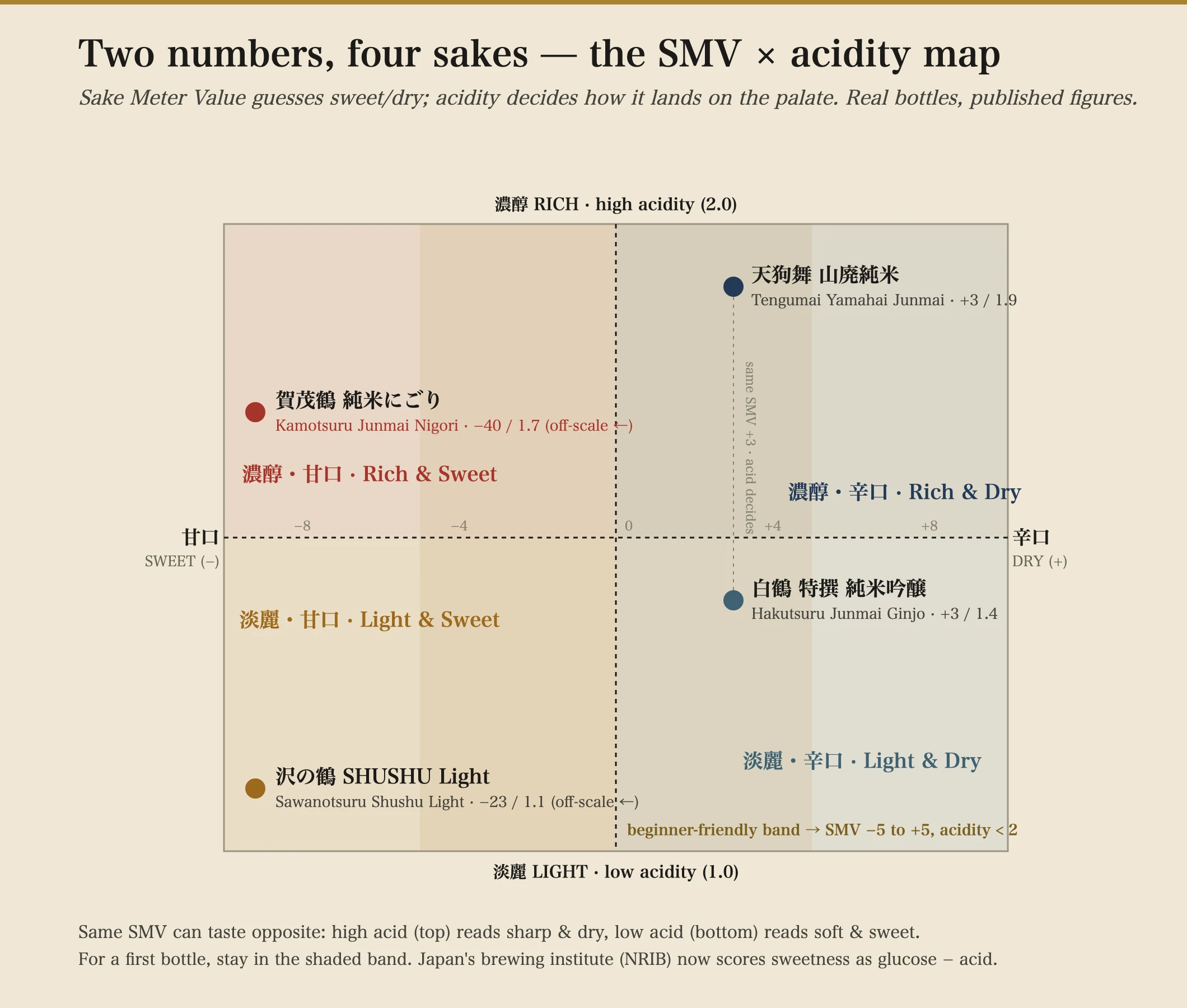
- Light & dry. Hakutsuru Tokusen Junmai Ginjo (+3 / 1.4): clean, crisp, faintly floral.
- Rich & dry. Tengumai Yamahai Junmai (+3 / 1.9): earthy, nutty, full-bodied. The same +3 as the Hakutsuru, yet the extra acid keeps this heavier sake tasting dry.
- Light & sweet. Sawanotsuru Shushu Light (−23 / 1.1): frankly sweet but clean and airy, because the acid is so low.
- Rich & sweet. Kamotsuru Junmai Nigori (−40 / 1.7): cloudy, creamy, dessert-like, a reminder the scale runs to extremes.
For a first bottle, aim for the middle of the board (SMV roughly −5 to +5, acidity under 2) and you'll dodge both the syrupy and the austere ends.
Even the regulator gave up on the single number
If this all sounds like an argument against trusting the SMV, know that Japan's own brewing authority made it first. Back in 1974, researchers led by Satō at what is now the National Research Institute of Brewing (NRIB / 酒類総合研究所) built combined indices (a sweetness-dryness value and a richness-lightness value) that folded acidity in with the density reading, precisely because SMV alone divided bottles inconsistently. In 2004 they went further, proposing a label formula that drops SMV entirely: AV = G − A, glucose content minus acidity. Sugar measured directly, minus acid. The four printed tiers you sometimes see (dry, slightly dry, slightly sweet, sweet) come straight off that number. The institution replaced its own scale, which is about as strong as "the number lies" gets.
So why is +SMV still everywhere, still whispering "dry equals refined"? Partly fashion. In the 1970s a Niigata sake, Koshi no Kanbai from Ishimoto Brewery, became a cult "phantom sake" on the strength of a then-unusual tanrei-karakuchi (light, dry) style. Through the 1980s "dry" hardened into shorthand for sophisticated, breweries chased positive numbers, and the national average drifted toward +3 to +5. That back-label number partly records a forty-year-old trend rather than the taste in the bottle.
Read both numbers, weigh the acid against the SMV, and don't trust any single figure on its own. Then pair it with what you already know: the grade on the front label tells you the style, and the right serving temperature can nudge a sake sweeter (warm) or sharper (cold) after you've poured it.