
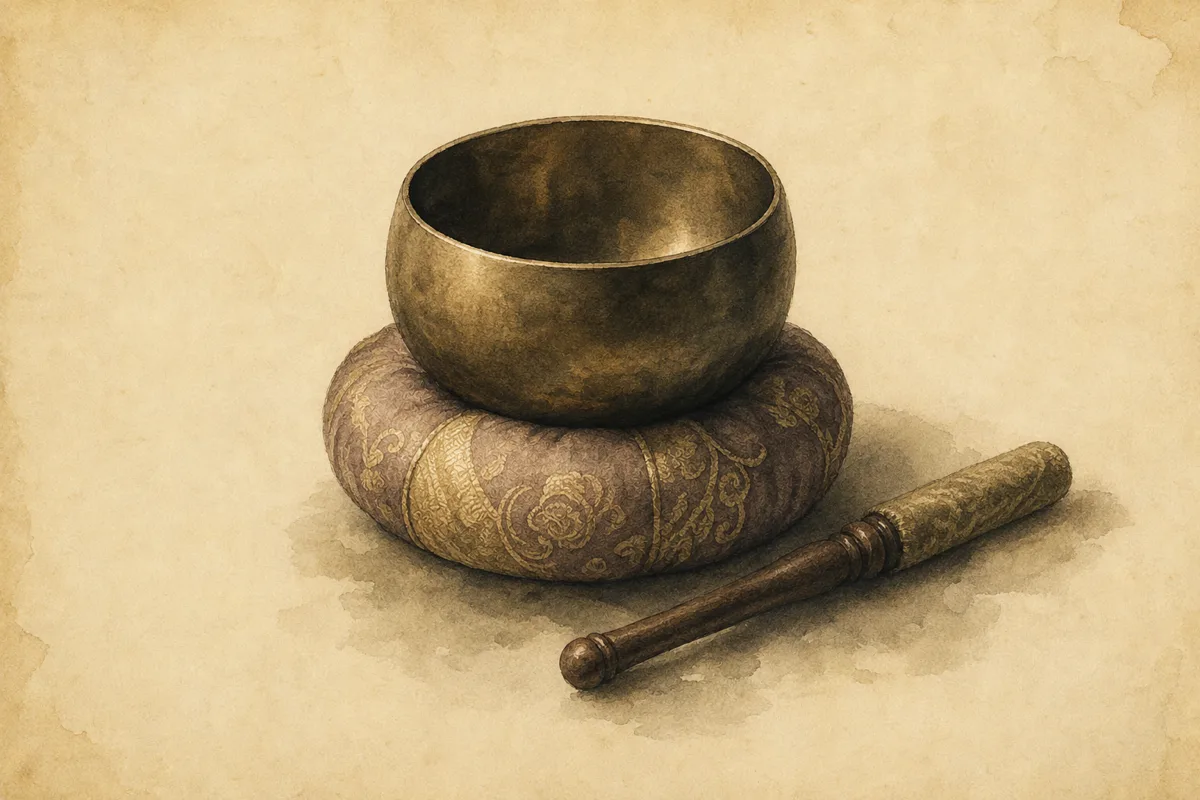
The object is a bronze bowl on a cushion. Outside Japan it is shelved with singing bowls, priced against them, and demonstrated the same way, with a wooden mallet dragged round the rim until the bowl hums. An orin is hit once and then left alone.
What it is
An orin (おりん), or rin, belongs to a class of Buddhist implements called bon'ongu, the ones whose job is to make a sound. The wooden fish drum is another.
Its home is the household altar. It sits on a cushion beside the incense and the offerings, and it is struck with a small padded stick, the rin-bō, at the opening of chanting, at points inside it, and at the close. It is the domestic descendant of the keisu, the large standing bell that does the same work in a temple, shrunk to fit a cabinet in a family home.
The name is unstable. Depending on the Buddhist sect it may be called rin, kin, kinsu, dobachi, or uchinarashi. Some sects call it keisu, which is also the temple bell's name, and some call it sahari, which is otherwise the name of the alloy it is cast from.
Struck, not rubbed
Japanese Buddhist ritual makes no use of the singing mode of bell operation. The rim is not rubbed. Nobody in the tradition is trying to sustain a tone by friction.
The rubbing technique is what the singing bowl market sells, and it is younger than the shelving implies. In the standing-bell literature, making and playing bowls specifically for singing is treated as a modern development rather than an inheritance from ancient Himalayan practice.
Nothing stops anyone rubbing an orin. But the bell was designed, cast, and tuned for a single strike and a long decay, and everything expensive about it serves that one event.
Sahari, and why it is hard to make
The good bells are cast from sahari (佐波理, also written 砂張), a bronze of copper and tin. What makes it sahari rather than ordinary bronze is how far the tin is pushed. The Nanjō workshop describes taking the proportion of tin to the limit.
More tin means a harder metal and a higher, cleaner voice, and it also means the casting gets harder to bring off and the finished bell gets brittle. A dropped sahari orin is not a repairable object. The alloy is driven as close to unworkable as the founder can hold it, because that is where the tone is. It is old in Japan too: sahari turns up among the treasures kept in the Shōsōin repository.
Brass is the common cheaper material. There are also copper alloys with zinc and silicon, and titanium bells at the modern end. As a rough map of the results, bronze is credited with the clearest tone and longest sustain, brass with a lighter and softer sound, titanium with something sharper. Thicker metal pushes the voice down, thinner lifts it, and a larger bell is lower than a small one.
Sellers claim something further for sahari, that it nari-agaru, the makers putting it at five or ten years of use before a bell reaches its best voice. That one is trade lore rather than measurement, repeated consistently by the people who sell the bells.
Kyoto and Takaoka sound different
Kyoto bells run to a clear high tone, delicate rather than heavy, and Japanese dealers describe them as thinner, lighter, and hand-beaten. Takaoka bells are the foundry product: thicker, with a heavier voice and a longer tail on the note. That is a generalisation about two trades rather than a rule, and the Kyoto workshop below breaks half of it by casting.
Takaoka's foundries pour metal at 1150 to 1250°C, and they pour altar fittings, temple bells and bronze statuary out of the same industrial base that produces its tinware. The city was designated Japan's first national traditional handicraft production area in 1975. Set it against Tsubame, where copper vessels are beaten rather than poured, and Japanese metalwork divides fairly cleanly into towns that melt and towns that hammer.
A wood-fired kiln in Uji
The Nanjō workshop in Uji, south of Kyoto, has been casting bells for something close to 190 years.
Its moulds are burnt-form casting. The clay is mixed with rice husks, and the husks are not filler. They have to burn away completely, because the voids they leave behind are how gas escapes the mould during the pour. Get that wrong and the gas stays in the metal.
That firing happens in a kiln fuelled with wood, at 600 to 700°C, and by the workshop's account theirs is close to the only one in the country still run that way.
At the end, three things are checked: the tone must not waver, it must go on, and it must be the same note wherever on the bell you strike it. Tap a bell at four points around its circumference and a cheap one will give you four slightly different bells.
Buying one
The dealer Hombo puts the range from around ¥3,000 to several million yen, and the spread is mostly material and method rather than decoration.
The advice from the Japanese trade is to listen to it first and buy one that suits the altar it will sit on. Sound is personal, and size is a matter of proportion to the cabinet.
An orin bought for meditation rather than for an altar is still an instrument built around a single strike and a long decay. That is the event the alloy, the casting and the tuning were all spent on.