
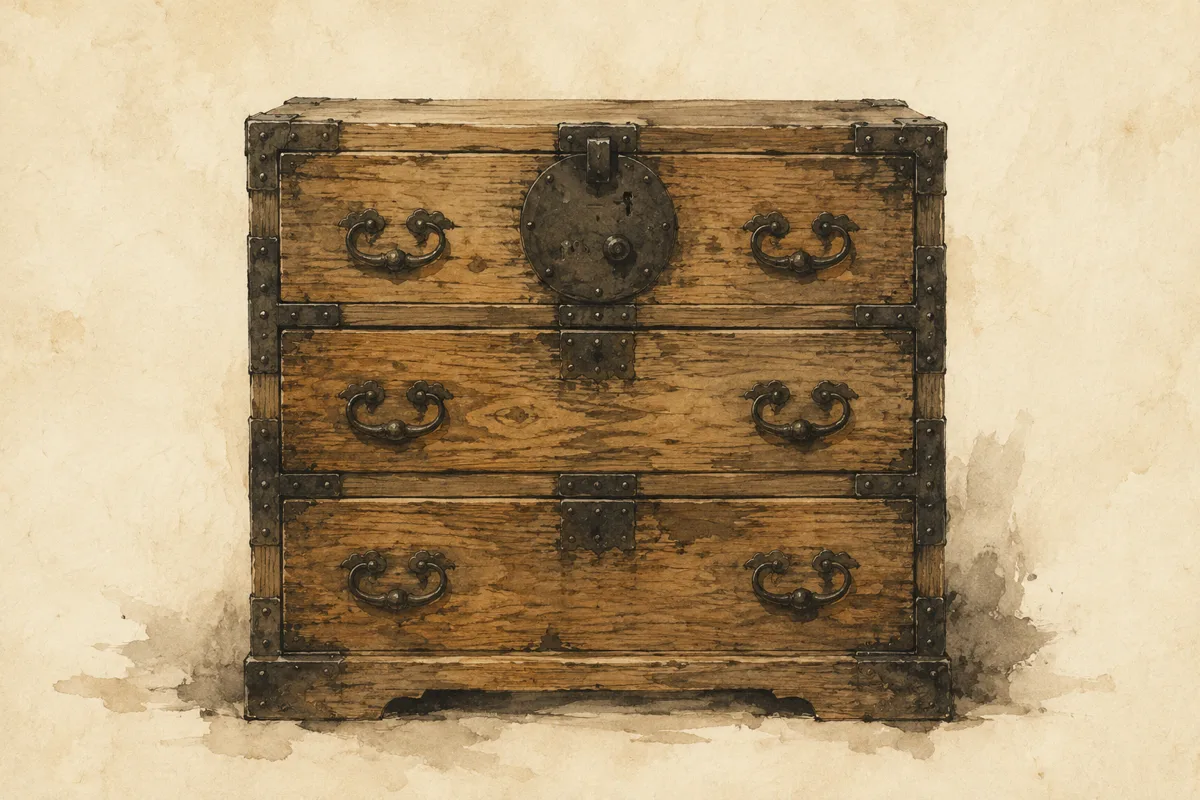
The iron on an old Japanese chest reads as ornament. A round lock plate the size of a saucer, corner straps ending in scrolls, drawer pulls shaped into dragons or peonies. It is ornament. It is also, first, a set of tools, and the chest would not survive being owned without them.
What the iron is for
A tansu is a wooden box that gets carried, dragged, loaded onto carts and boats and moved between houses, and its joints want to work loose under that handling. Japan Objects puts the job plainly: the metal strapping was there "to avoid flexing joints from opening or breaking during transport," and the placement of the iron "insured structural strength." The straps are a splint holding the carcass rigid.
The corners take the impacts a moving chest collects. The pulls give a hand something to haul on. And the lock plate, the showpiece on the front of many chests, is a working lock: drawer locks, Japan Objects notes, were "designed to keep drawers closed," and the auspicious symbols stamped around them came later, onto a fitting that already had to turn a bolt.
The sea chest, where the iron mattered most
The clearest case is the funa-dansu, the chest that went to sea. Merchant ships worked the Sea of Japan from the middle of the Edo period into Meiji, and each carried a strongbox for what could not be replaced: money, seals, and the accounting records that were the business itself. A funa-dansu locked. Behind its door sat drawers with iron locks, and the whole object represents, in Japan Objects' phrase, "a high-level craftmanship in hardware and joinery."
Here the ironwork is security hardware. The finest funa-dansu came from Sado, the island that sat on the main trading route, and they are recognisable by their thick iron hardware and unusual diamond-shaped handles.
Why the old chests carry so much of it
The heaviest-ironed chests are not the most functional ones; they are the latest, and the reason is as much cost as taste. In the Edo period, Japan Objects explains, ironwork was labour-intensive and expensive, so metal was used sparingly, a few sound fittings where they counted. Then Meiji brought a new technology: iron sheet pressing, which let sheet be made "considerably thinner and cut with shears." Suddenly hardware was cheap, and, in the source's words, that "encouraged diversity in tansu designs."
So the chest buried under sixty or a hundred fittings is often telling you as much about the price of iron as about the owner's wealth. The Iwayado chests of Iwate are the standard example, and a single one, by KOGEI JAPAN's count, may carry sixty to one hundred metal fittings covered in embossed pictures. Iwayado's hand-embossed hardware emerged in the 1820s and became widespread in Meiji, exactly as pressed sheet made the abundance affordable.
How the fittings are made
Iwayado works in two ways, and the difference is worth knowing. Some fittings are cast: molten iron poured into moulds, using the Nambu ironware tradition of the region, the same casting lineage behind its cast-iron kettles. Others are hand-embossed, and that process runs backwards from what you might expect. A design is pasted onto a coated iron or copper plate, then, as KOGEI JAPAN describes it, the worker engraves it "by beating with a chisel from the reverse side," and raises it into relief by hammering "from the reverse side to give a more three-dimensional finish." The plate is then cut out, filed, and given an antirust coat, so the dragon on the drawer front was raised from behind rather than carved from the face.
There is a thread here that runs back to weapons. Sendai chests became famous for their metalwork because, according to Japan Objects, the hardware "was commissioned from former sword-fitting craftsmen." When the market for sword furniture collapsed in the Meiji period, the men who had chiselled tsuba and scabbard fittings needed new iron to decorate, and a merchant's chest was waiting. It is the same migration that carried Higo inlay from gun barrels onto cufflinks after the sword market collapsed.
Reading a chest by its iron
For anyone standing in front of an antique, the hardware is the most legible part of the chest. Take the collector guidance for what it is, a practical checklist rather than a museum verdict, but the tells are consistent. Hand-forged iron carries a hammer texture, the subtle irregularity of a surface struck many times, and no two forged pieces are quite identical even in a matched pair; cast or stamped reproductions look uniform and flat by comparison.
Then look at how the metal is attached. Genuine old fittings are held by small, irregular hand-made nails, not modern screws, so screw holes that fail to line up with older mounting points suggest hardware that has been swapped. Patina should make sense: rust gathers where moisture naturally sat, at low corners and drawer bottoms, while a bright even rust brushed across a whole surface is a fake's shortcut. And the motifs place the chest. A five-petal cherry blossom with ivy points toward Yonezawa; heavy iron and diamond handles toward Sado; an elaborate lock plate toward Sendai and its sword-smiths. The cranes, turtles and pines are not random luck symbols but a regional signature, which is why the iron, more than the wood, is where a tansu tells you where it came from.
If you want the other half of the object, the timber that all this iron is fixed to, the paulownia and keyaki of the chest itself is its own subject. But it is the hardware you should read first.