
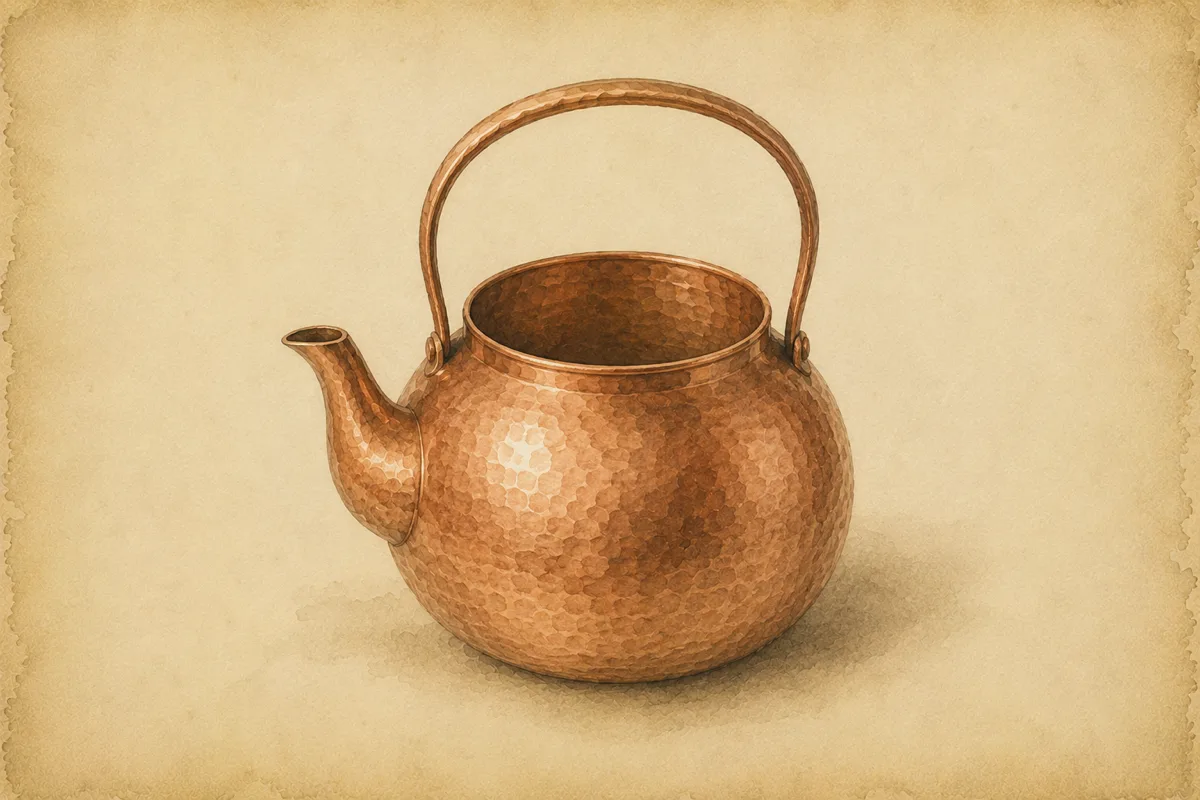
A sheet of copper resists being made into a kettle. Left alone it stays flat, and every blow that curves it also stiffens it against the next one. Tsuiki is that resistance being worn down with a hammer.
One sheet, no seam
Tsuiki doki (鎚起銅器) is hammered copperware: teapots, kettles, vases and pitchers formed out of a single flat sheet of copper. No soldered seam runs up the side. No two halves are joined. The vessel is a continuous piece of metal that was once a disc lying on a bench.
It is made in Tsubame, in Niigata Prefecture, which is currently the only place in Japan producing hammered copperware at all. Japan designated it a national Traditional Craft in 1981.
The hammer marks left across the surface are not applied as a texture. They are the record of the forming.
Shrinking, not stretching
A flat disc could be made into a deep vessel by stretching, the metal thinned out and pushed down into a hollow. Tsuiki does the opposite. The artisan hammers to shrink the copper rather than stretch it, driving the walls inward so the material gathers and stands up. The vessel rises out of the sheet instead of being pressed into it.
The sequence starts with sinking, where the edges of the sheet are lifted by working a large base with a mallet. Then comes raising proper: the piece is worked over different anvil stakes that let the artisan bring the outer edges inward and build the wall upward. As that happens the copper wrinkles, because material is being crowded into a smaller circumference. Controlling those wrinkles is most of the skill. A wrinkle that folds over onto itself cannot be worked back out.
The work does alternate. The hammer both extends and contracts the metal across a piece's life. But shrinking is the move that makes a tall vessel out of a flat circle, and it is what puts tsuiki in a different family from work that is simply stretched or pressed.
Why it has to be heated
Hammering hardens copper. A sheet that has been worked for an hour is stiff, springy and heading toward cracking, so the piece is annealed: heated to around 650°C to soften it, then worked again until it stiffens, then annealed again.
The cycle is most of the work. To finish one seamless kettle, an artisan will anneal it roughly fifteen times. Between those heatings the copper is being struck, by one estimate, several hundred thousand times. A finished surface has a dense, faintly porcelain-like quality.
A single water kettle can call for dozens of different stakes, torikuchi or ategane, iron rods set into carved holes in the wooden block the artisan sits at, each matched to a curve. The hammers multiply the same way, chosen by stage rather than by preference.
The spout is the hard part
A body raised from one sheet is difficult. A body and its spout raised from the same sheet is the summit of the craft, and it is what Gyokusendo, the Tsubame house founded in 1816, became known for.
A spout is a narrow tapering tube that has to emerge from the wall of the vessel, made of wall material, without being torn, without being thinned to foil at the tip, and without wrecking the geometry of the body it grows out of. It is the same fight as the rest of the piece, at the point where the copper has least room to give. The ordinary solution is to make a spout separately and attach it. The seamless spout refuses the join.
Where the color comes from
Tsuiki pieces get their color from a chemical reaction, sometimes after the surface has been carved with a tagane chisel or embossed, occasionally with gold or silver inlay. For the dark purple, the piece is coated in tin, fired at around 800°C, then boiled in a solution of green rust and copper sulfate. Leaving it in the solution longer takes it to brown.
Gyokusendo's coloring methods were developed under its fourth head and remain in use. They produce colors that go on deepening as the object is handled and used, which means a tsuiki piece is not finished when it leaves the workshop in the sense that a painted object is.
How the craft got to Tsubame
The technique is an import that stayed. Copperware production began in Tsubame in the middle of the Edo period, when artisans from Sendai brought tsuiki methods to the area. The reason it took hold there was supply: high-grade copper was being extracted at Mount Yahiko, close by.
Foreign judges got there first. Gyokusendo made its debut at the 1873 Vienna World Exposition, took a bronze medal at the 1893 Columbian Exposition in Chicago, silver medals in 1904 and 1910, and the top prize at the 1926 Philadelphia World's Fair. A Tsubame tsuiki flower vase was presented to Emperor Meiji in 1894. Formal designation at home came much later: Niigata Prefecture named the work an Intangible Cultural Asset in 1958, the Agency for Cultural Affairs followed in 1980, and national Traditional Craft status arrived in 1981.
The 1990s collapse
Awards did not keep the workshop alive. Its business did, and in the 1990s that business broke.
Gyokusendo's main product had become the corporate gift, and when that demand collapsed the workshop shrank from 30 artisans to 15. In 1995 the seventh-generation head, Motoyuki Tamagawa, took over a company in serious trouble and changed who it was selling to. The work moved from wholesale distribution to direct sales, and from formal gifts to things people buy for themselves: guinomi sake cups, beer cups. Overseas exhibitions started in 2003 in Paris and Frankfurt, and in 2011 the workshop built a custom wine cooler with KRUG.
The pivot worked. 21 artisans work there now, and roughly 90% of sales come through its own stores, in Tsubame, Ginza and Nishiazabu, with about 50% of sales coming from inbound foreign visitors. The workshop that was shedding staff in the 1990s now gets 30 to 50 applications a year, 80% of them from women.
The town moved the same way. Gyokusendo helped start the Tsubame-Sanjo Factory Festival in 2013, an open-workshop event. The 2024 edition drew 38,592 visitors to 109 participating companies, 42% of them from outside Niigata.
Raising and casting
Raising is one way Japanese metal becomes an object. Casting is another, and it melts the metal and pours it into a mold. In Nambu ironware from Iwate, the clay mold is destroyed to release each kettle, so the form exists first as a void and the metal takes its shape by filling it. Raising never melts anything. The metal starts solid and stays solid, and the form is arrived at by moving it, blow by blow, over a stake.
A cast iron kettle carries surface pattern pressed into the mold before the pour, and its weight comes from a thick wall that had to flow. A raised copper kettle carries the toolmarks of its own making and can be thin, because nothing about the process required bulk. Pick up the two versions of what looks like the same thing, an iron kettle and a copper one, and the difference in your hand is mold against stake.