
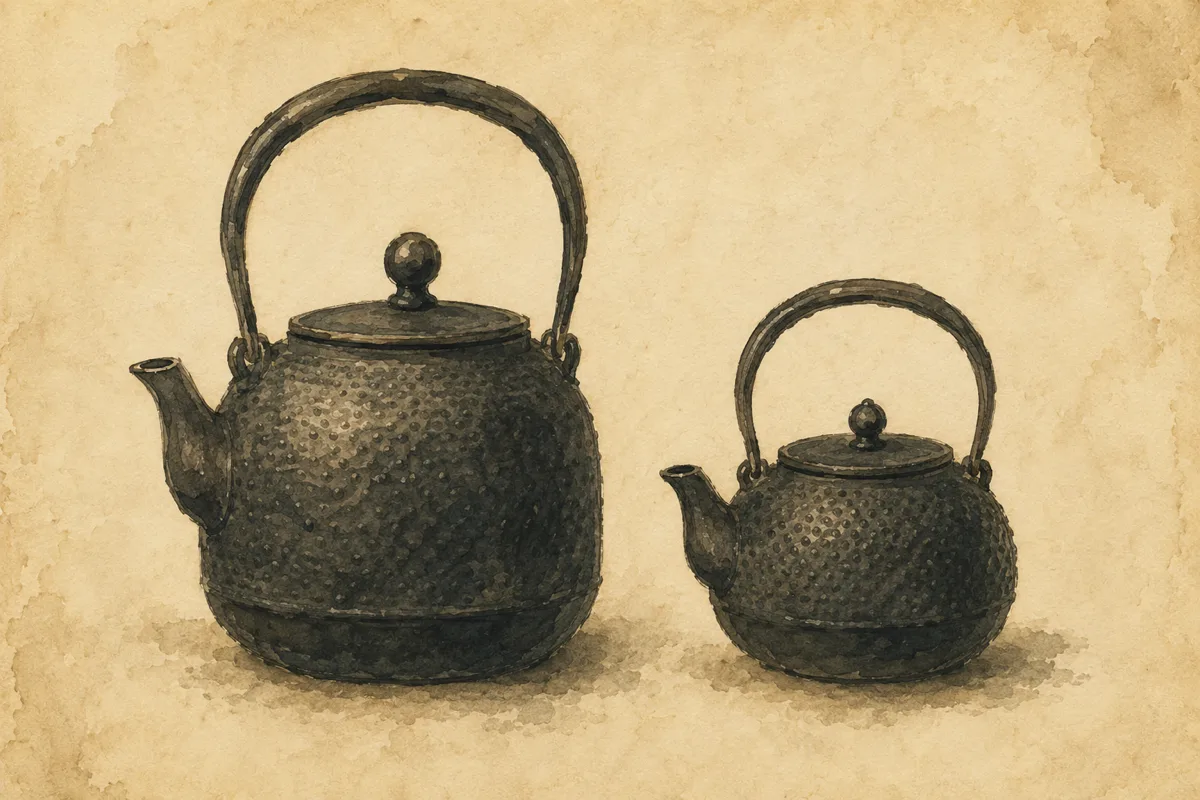
Two black iron pots, identical at a glance. The product page for one says it is fine on a gas burner. The page for the other says, in bold, never to place it on a heat source. Both are sold as cast-iron teapots.
They are not the same object, and the difference is not quality. It is inside them, and you can see it the moment you lift the lid.
The split: one boils, one steeps
A tetsubin (鉄瓶) is a kettle. Bare, uncoated iron inside, a spout, a lid, a handle arching over the top. It goes directly over a flame or a charcoal brazier and its job is to boil water. You do not put tea leaves in it.
A tetsukyusu (鉄急須) is a teapot. Same cast iron on the outside, but the interior is coated with enamel, a glassy layer fired onto the metal. It is built to steep tea, it usually comes with a removable mesh strainer, and it must not be heated on a burner.
Which one you want depends on what you are trying to do with it. Japanese households often keep both, the tetsubin working on the heat and the tetsukyusu doing the pouring.
Telling them apart
Take the lid off and look at the inside wall. Bare iron reads dull grey or brownish, matte, a little rough. Enamel is glassy and reflective, most often black, like the inside of a coated pan.
Yellow kitchen light flattens the difference, and an old lined pot dulls with tea stain. When the wall is ambiguous, go to the rim where the lid seats: enamel is fired onto a finished casting, so the coating stops at that edge in a hard line with raw metal below it. Bare iron has no such edge to find, because there is nothing sitting on top of it.
Retailers muddle this constantly. "Cast-iron teapot" covers both, and most of what sells under that phrase outside Japan is enamel-lined. Do not trust the label.
Why the enamel is there
The lining is not a cheapening. It does two things a bare kettle cannot.
First, it stops rust. Bare iron and standing water are a bad combination, so a tetsubin has to be emptied and dried after every use, with real attention, while an enamel-lined pot is far more forgiving of an ordinary rinse. It also makes cleaning simple: tea residue wipes off a glassy surface with a soft sponge, whereas on bare iron you are told not to scrub at all, because the interior develops a protective layer over time that you do not want to take off.
What the enamel costs you is the iron itself. The lining seals the metal away from the water, which is the entire design intent, so the iron-enrichment claim attached to Japanese ironware does not carry over. Water in a tetsukyusu never meets iron. On a bare tetsubin it does, though how much iron ends up in the cup rests on tradition rather than measurement.
What happens if you heat the wrong one
Enamel is glass, and glass and iron do not expand at the same rate when they heat. Put a lined teapot on a burner and the coating can craze, crack, or chip, sometimes into the tea. Once the lining is broken the iron under it is exposed to water, and rust starts where you cannot reach it. There is no repair. A tetsubin has the opposite problem: nothing protects it but care, and if you leave water sitting in one overnight it will rust.
The care each one demands
| Tetsubin (bare iron) | Tetsukyusu (enamel-lined) | |
|---|---|---|
| Job | Boils water | Steeps tea |
| Over a flame | Yes, that is the point | No |
| Tea leaves inside | Never | Yes, usually with a strainer |
| After use | Empty at once, dry the body and lid separately in open air | Rinse, wipe with a soft sponge, dry |
| Interior scrubbing | Avoid; the interior layer is protective | Fine, gently |
| Adds iron to water | Claimed traditionally, variable | No |
Drying is where most people fail. The lid gets set aside to dry on its own because moisture trapped under it is exactly where rust starts, and a warm kettle emptied straight after use mostly dries itself from its own residual heat.
Sizes, and what that tells you
Capacity sorts the two almost as reliably as the lining does. Tetsubin run from around half a litre at the small end to roughly five litres for large ones, because a kettle is sized to how much water you want hot. Teapots cluster at serving volumes.
So a listing that pairs a large capacity with a drop-in strainer is worth a second look. It is not proof of anything, but the two features pull in opposite directions, and one of them is usually copy-paste.
Where the two objects came from
They are not equal in age, which is part of why the naming is such a mess.
The tetsubin's exact origin is uncertain. One line of descent traces it to the tedorigama, a spouted, handled kettle in use around the era of the tea master Sen no Rikyū (1522–1591). What clearly drove it into ordinary homes was sencha, the steeped leaf tea that arrived in Japan around the middle of the 17th century and spread through the 18th, as an informal alternative to the whisked tea of the formal ceremony. Sencha needs hot water poured over leaves in a separate pot, and that is a kettle's job. By the 19th century tetsubin had gone from plain iron vessels to heavily worked, decorated pieces.
Iwate and Yamagata are the two prefectures best known for making them. Iwate's tradition, Nambu ironware, was designated a national Traditional Craft in 1975, and if you want the casting process and the hailstone-dot surface in detail, that is its own story: what a Nambu tetsubin actually is.
The enamel-lined teapot is the modern descendant, built for a market that wanted the look and the heat retention without the maintenance.
Choosing
Buy a tetsubin if you want a kettle: something to put on the heat, to grow a layer inside over years, and to dry conscientiously every single time. It is a slower object, and it will not tolerate being forgotten.
Buy a tetsukyusu if you want a teapot: something that steeps a pot of leaf tea, keeps it hot on the table, and tolerates being cleaned like normal teaware.
The expensive error is not picking the wrong one. It is buying one while believing it is the other, and finding out on the burner. If you end up with the tetsubin, the next thing to get right is how you handle temperature.