
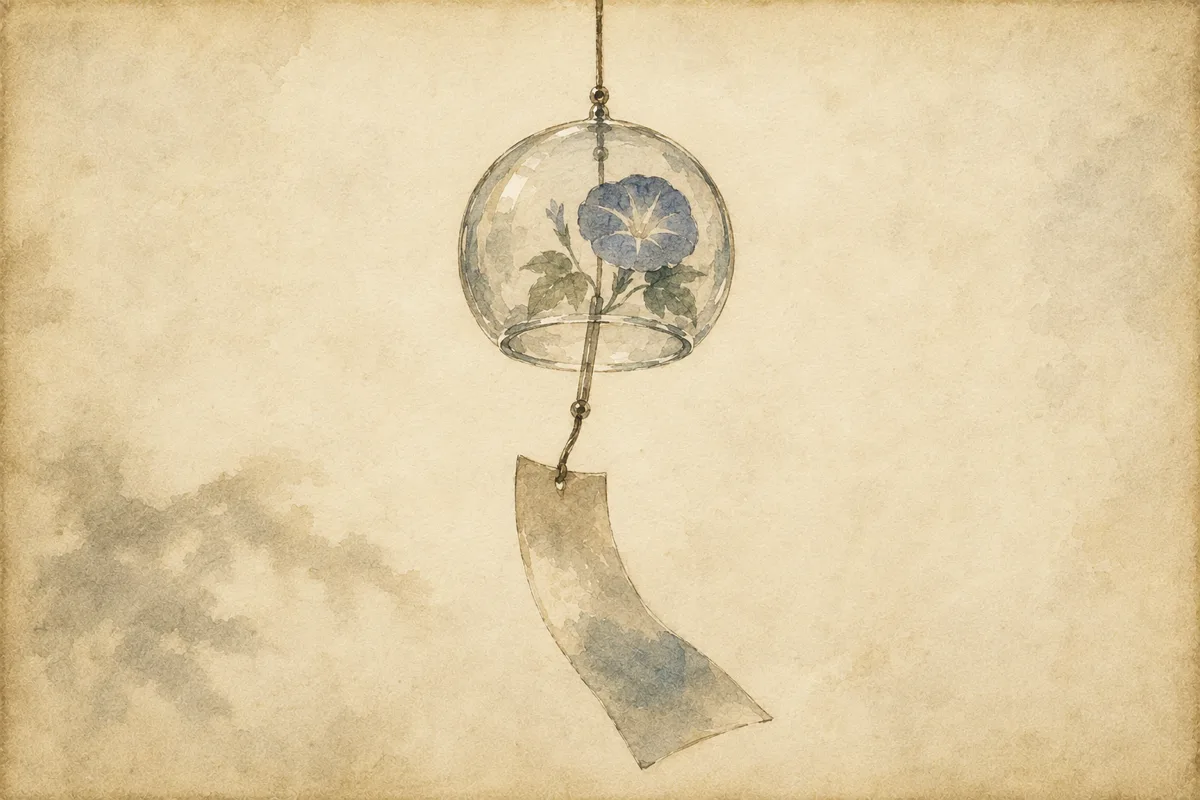
You do not ring a furin. It is a bell, but it has no rope and takes no strike, and the person who owns one may go a whole day without touching it. The wind rings it, through a slip of paper.
How it is built
A furin has three parts. There is the bell itself, open at the bottom. Inside hangs a clapper, a small weight on a thread. Tied to the bottom of that clapper is a strip of paper, the tanzaku, which hangs down past the rim into the open air.
The paper is the working part. It is a sail. A breeze pushes it, the push travels up the thread to the clapper, and the clapper knocks against the inside of the bell. Take the paper off and the same breeze does almost nothing, because the clapper alone gives the wind too little to catch. The whole object is a machine for turning a small amount of moving air into a sound, and the paper is the part that reads the wind.
A bell that marked a boundary
Before it was a summer ornament, the ancestor of the furin was a warning and a ward.
Its line runs back through a bronze bell called the fūtaku, hung at the corners of temple and pagoda eaves, and further back to a Chinese device, the senfūtaku, that was hung in bamboo and read for fortune by the way the wind moved it. The bronze bell was not decorative. Its dull garan-garan was thought to drive off evil, and the range its sound reached was treated as a protected zone: within earshot of the bell, by the old belief, calamity did not fall.
That older meaning survives faintly in the modern object. One account has physicians of the Kamakura and Muromachi centuries hanging small bells outside the homes of the sick, on the same logic, which is roughly where the bell steps down from temple eave to private house. What began as a sonar line drawn around holy ground ends up as a thing you hang at your own window. The furin still marks a boundary of a kind. It just marks the edge of your own summer now.
The glass one, blown in Tokyo
Glass wind bells turn up in Japanese records in the Kyōhō era of the early eighteenth century. Glassmakers from Nagasaki, then the only port open to European trade, carried the material inland and showed it as a spectacle in Osaka, Kyoto and Edo. Glass was new and startling, and by one account a glass furin of that period would cost, in today's money, something on the order of two to three million yen. It was a rich man's curiosity before it was anyone's window decoration.
The Tokyo descendant of that trade is the Edo furin. It is blown by mouth, without a mould, so no two are the same size. Two details make its voice. The first is the rim: the mouth of the bell is left deliberately rough and jagged rather than ground smooth, and that ragged edge is what gives the Edo furin its particular tinkle where the clapper drags across it. The second is the painting, which is done on the inside of the glass. Flowers and goldfish and morning glories are laid on from within, so the colour sits behind the glass where no hand can wear it away.
The name Edo furin is younger than it sounds. It was coined around 1965 by the second-generation maker at the Shinohara workshop in Tokyo, to say plainly that these were glass bells still blown by the old Edo method in the old city, at a moment when that was becoming worth pointing out.
The iron one, poured in Iwate
The other great furin is the opposite object in almost every way. A Nambu furin is cast iron, made in Iwate in the far north as an offshoot of the same iron-casting tradition that produces the region's heavy kettles. It is poured into a sand mould rather than blown, patterned in the metal, and finished by hand.
Iron buys a different sound. Where the glass bell tinkles and stops, the iron bell gives a single high, clear note that hangs in the air far longer, the riiin that Japanese ears associate with the season. It is prized enough that the sound of the Nambu wind bells at Mizusawa was named to the Ministry of the Environment's 1996 list of one hundred soundscapes of Japan worth keeping. The country decided, formally, that this particular ringing was worth not losing.
So the two traditions divide the way Japan's metal towns divide generally: Iwate melts and pours iron, while Tokyo blows and paints glass. The season's one sound is reached by two opposite crafts.
The coolness is learned
The reason to hang any of them is the claim that the sound makes the heat easier to bear. This is worth being careful about, because the claim is real and the mechanism is not what it first appears.
The furin does not cool the air. What it seems to cool is the listener, and only a particular listener. On a 2019 episode of the NHK programme Chico-chan ni Shikarareru, participants sat in a room held at 30°C and listened to a furin. The skin temperature of the Japanese participants fell. The skin temperature of the foreign participants rose. The bell was the same. The ears were different.
The explanation offered is a conditioned reflex. A person raised in Japan has heard the furin thousands of times in the presence of actual moving summer air, until the sound alone is enough to make the brain report a cool wind is coming and the body to answer through the nervous system, narrowing blood flow at the skin. A person who did not grow up with that pairing hears a pleasant chime, relaxes, and warms very slightly instead. This was a television experiment rather than a controlled study, with no published figures, and it is best treated as a strong illustration rather than proof. But it points at something true about the whole object. The furin is not a cooling device. It is a cue, and the cue only fires in someone who has been taught it.
That puts the furin close to its old temple ancestor after all. The bronze bell did not physically repel disease; it marked a zone that people had agreed to read as safe. The glass bell in the window does not physically lower the temperature; it marks a stretch of afternoon that a Japanese listener has been trained to read as cool. In both cases the sound does its work inside the person who hears it, which is a strange and rather good thing for a bell to do.
Buying and hanging one
A furin needs moving air, so it goes where air moves: an open window, a verandah, an eave. Indoors in a sealed, still room it is mute, which is the single most common disappointment.
Choose by sound and by season. The iron Nambu bell gives a long, clear, carrying note and a heavier object; the glass Edo bell gives a lighter, closer tinkle and a painted body to look at as much as listen to. Neither will do anything measurable to a thermometer. Whether it cools you is a question about your own ears, and if you did not grow up with one, the honest answer is that you may have to hang it for a few summers before it starts to work.