
Raden: The Mother-of-Pearl Inlay That Makes Lacquer Glow Blue
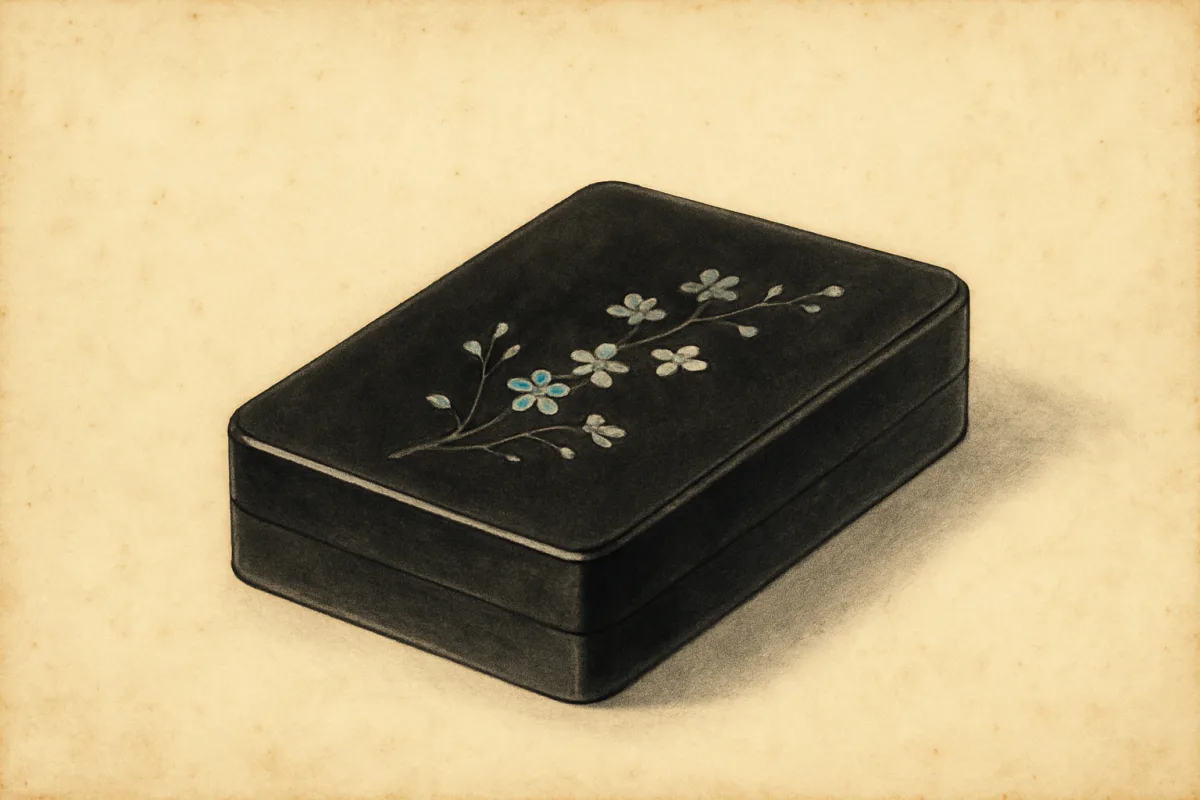
Tilt a raden box under a lamp and the shell inside it changes color as you move, a slick of blue-green that slides toward violet, then back. The instinct is to call it paint, or an iridescent coating, some clever lacquer trick. It is shell: real mother-of-pearl, sliced almost as thin as paper and set into the black lacquer surface. And the blue is not even the shell's own color. It is the black underneath, showing through.
That last point is what raden is really about. Once you understand it, raden stops being decorative shell and starts making sense.
Real shell, carved into the surface
Raden (螺鈿) is inlay. The formal definition is blunt about it: "a method of inserting nacre into a carved surface of lacquer or wood." Nacre is mother-of-pearl, the lustrous inner lining of certain shells. So a raden artisan is not painting a picture; they are cutting shapes out of shell and fitting them into the lacquer like tesserae. As with sprinkling gold to make maki-e, the shell and the medium stay separate. Maki-e is the sister craft; the two often share a single surface.
Three shells do most of the work, and they are not interchangeable. Abalone (awabi) throws the loudest color, a blue-to-purple gradient that swings hard with the viewing angle. Great green turban shell (yakōgai), a large spiral from the southern seas, is milkier, showing greens and pinks when it is sliced thin. Pearl oyster (chōgai), the shell that grows pearls, is the quiet one, a settled silver-white favored for tea utensils. Because abalone and turban shell both go bluish when thin, they get grouped under one nickname: aogai, "blue shell."
The number that explains the blue
Everything depends on how thick the shell is.
| Thick shell (atsugai) | Thin shell (usugai / aogai) | |
|---|---|---|
| Thickness | 1–2mm | 0.05–0.15mm (aogai ≈0.1mm) |
| How it reads | strong gleam, but the color is duller | transparent interference color; glows blue-green |
| Does the ground matter? | no — the shell is opaque | yes — the black lacquer shows through and colors it |
| How it's worked | carved and set like hard mosaic | laid on, over-lacquered, ground back |
Shave a piece of shell down to roughly 0.1mm and its own interference color, the shimmer from its stacked microscopic layers, reads clean and transparent instead of chalky. The shell also becomes thin enough to see through. Laid over black lacquer, that thinness "allows the black color underneath to shine through, so the shells look blue." The craft even has a name for it: aogai-nuri, blue-shell lacquer. Artisans push the effect deliberately, working charcoal black beneath the shell to pull the blue forward. Thick shell stays opaque, the ground never reaches your eye, and the color stays whiter and flatter.
The blue is a collaboration: the shell's shimmer plus the dark ground drinking the rest of the light. The same shell laid on white instead of black would look nothing like it. In raden, black lacquer isn't just a color choice; it is doing optical work. Some modern makers chase the effect to its limit: the Kanazawa artist Terumasa Ikeda grinds his shell down to 0.05mm, so it glows like a lit screen.
Hide it, then find it again
The making runs opposite to intuition. First the shell is thinned to an even sheet, either ground down on a rotary stone (surikai) or boiled and peeled apart (hegikai), then cut to shape with a fine saw or punched out against a template. The pieces are inlaid into a carved recess or glued onto the lacquer. Then the artisan does the strange part: they coat the whole thing in black lacquer until the shell vanishes completely. The design disappears.
Only then is it brought back. The surface is ground and polished with charcoal, whetstones, and deerskin, cycle after cycle over days or weeks, until the shell surfaces again, now perfectly flush with the lacquer around it, no ridge to catch a fingernail. Layer the lacquer thick enough and the buried shell seems to float below a lens of gloss. It is patient work: a single pair of raden chopsticks runs about four months. Like togidashi maki-e, the design is buried in lacquer, then ground back. It depends entirely on urushi curing hard in a damp cabinet rather than drying.
A camel, a lute, and 1,300 years
Raden did not begin in Japan. The thick-shell technique traveled a long road, with origins traced to Egypt and maturing in Tang-dynasty China, where lacquer-backed shell was set into bronze mirrors. It arrived in Japan from Tang during the Nara period (710–794). The single object that proves it is still in Nara.
In the Shōsōin, the 8th-century treasure house of Tōdai-ji, sits the Raden Shitan no Gogen Biwa: a five-stringed lute of red sandalwood, inlaid with mother-of-pearl. Its plectrum guard shows a musician riding a camel, with birds and a tropical tree; its back is a Tang flower pattern worked entirely in shell. It is the only surviving five-stringed wooden lute of its kind anywhere, about 108cm long, and the scratches on its tortoiseshell guard show it was actually played, not just displayed. The Shōsōin itself dates to 756, when Empress Kōmyō dedicated over 600 objects to honor Emperor Shōmu, dead forty-nine days. Most of its treasures are Japanese-made, but the designs carry Iran, India and Central Asia along the Silk Road. The lute is raden's founding document.
The craft kept going. By the 1670s Edo makers like Somada Kiyosuke were tiling surfaces with minute shell fragments in a style still called Somada ware, and today the same thin-shell aogai runs down black-lacquer fountain pens that flash blue-green in the hand. But the mechanism has not changed since the biwa. It is always shell, always cut thin, always set into the dark, glowing with a color it borrows from the black beneath it.