
A 210 mm gyuto, the everyday chef's knife of a Japanese kitchen, sells for about $40 to $400. Same length, same silhouette, a tenfold spread in price. So where does the money actually go, and how much do you need to spend before the extra stops buying a better knife?
Break the price into four stacked costs. Three of them buy cutting performance. The fourth, increasingly, buys rarity and a name.
The four costs stacked into the price
1. The steel. Japanese cutting steels (carbon grades like White and Blue paper steel, or stainless like VG-10 and the powdered SG2/R2) run higher carbon and higher purity for extreme hardness and a keener edge, and they cost more per kilogram than the AUS-8 or X50CrMoV15 stainless in most Western mid-range knives. It's a real cost, but the smallest of the four. What each steel does is the steel guide's job.
2. The hand labor. The big cost. A hand-finished Japanese knife passes through a chain of artisans: a forger shapes and hardens the blade, a sharpener grinds the bevels and sets the edge, and a handle-maker fits the handle, each adding hours. A factory-stamped Western knife, by contrast, is roughly 10–15 minutes of automated production. Scale multiplies the gap: a Japanese workshop might make 50–200 knives a week, while a large Western brand can turn out 50,000, spreading its fixed costs across vastly more blades. Low volume plus hand-work is most of what you're paying for. (How that chain works, and why sharpening is treated as a career equal to forging, is covered in how a Japanese knife is made.)
3. Hard modes. Some blades are simply harder to make, and the labor detaches from everyday utility. Grinding a true single bevel demands exacting work on both faces. Forging a honyaki (a single hard steel with no soft cladding, water-quenched so only the edge hardens) cracks blades routinely, so only a handful of smiths attempt it. A master single-bevel yanagiba can run upwards of $1,000, and honyaki, which Knifewear reckons is under 1% of Japanese production (a master finishing maybe 30 a year), "can cost thousands." Extraordinary to make, and not something a home cook needs.
4. The handle, the finish, and the name. Premium handle woods like ebony and rosewood (shitan) are, as the Osaka retailer Seisuke puts it, "a more premium, less accessible resource," and fitting them takes trained, careful hands. On top of that sits the least tangible cost: a respected maker's name "carries weight (and value) in the culinary world." This tier shades out of performance and into prestige.
How much to spend
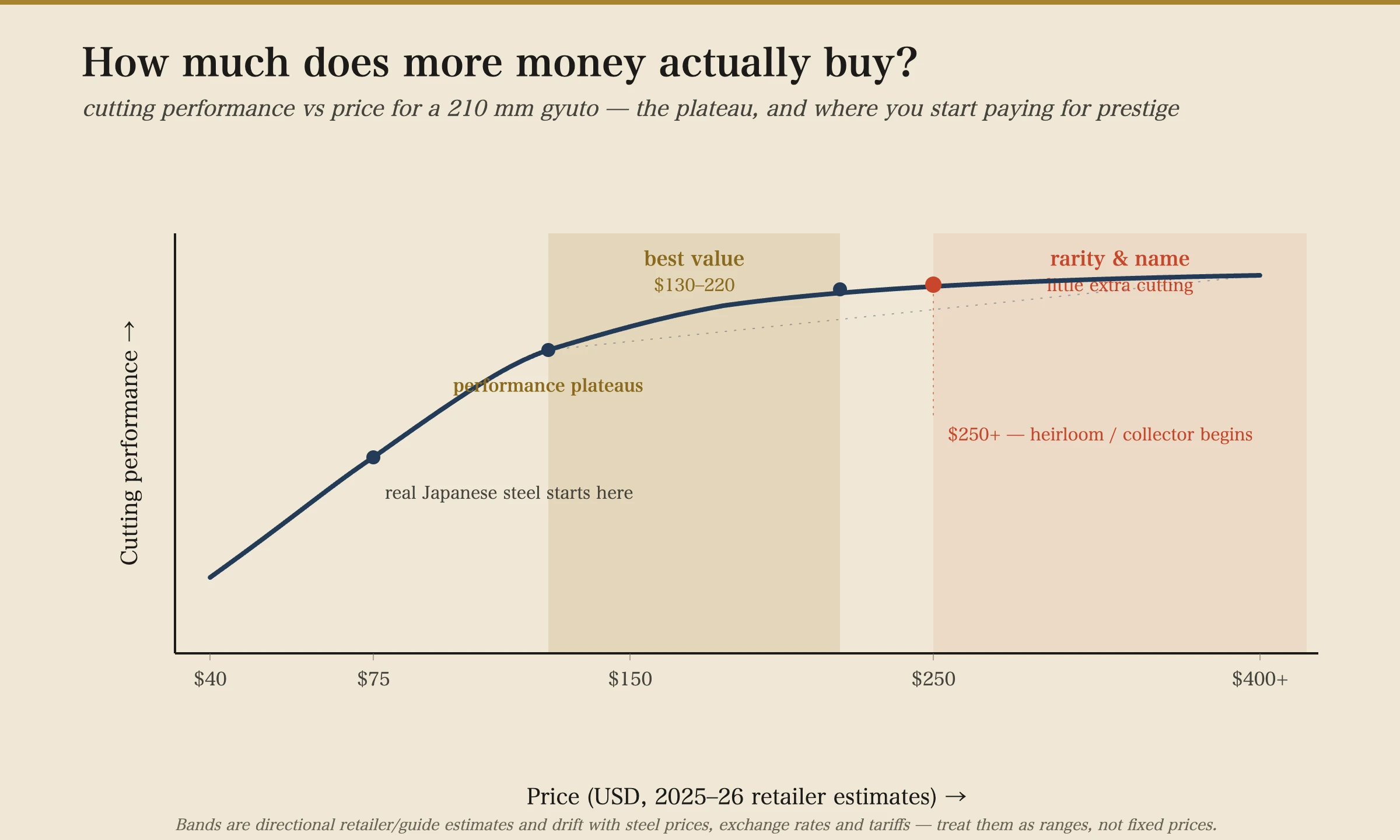
Add the first three costs and you get a curve: cutting performance rises steeply as you climb out of supermarket steel, then flattens. Buying guides describe the tiers like this:
| Price (2025–26) | What you're getting |
|---|---|
| Under $75 | Basic stainless, machine-forged. Sharp out of the box, dulls sooner. |
| $75–150 | "A true balance between price, durability, and professional capability." Real performers live here — Tojiro DP, Iseya, Global. |
| $130–220 | The practical sweet spot for a proper Japanese gyuto — good clad steel, wa-handle, reputable seller. |
| $150–250 | Premium steel (SG2, VG-MAX), more hand-crafting, refined balance — with diminishing returns for a typical home cook. |
| $250+ | Hand-forged, luxury finish, "collector's quality, heirloom." Buying rarity and artistry, not more cutting. |
For most home cooks the performance plateau arrives around $130–220. Below it you can still get a genuinely good knife; the $75–150 band already clears "a true balance between price, durability, and professional capability." Above it, you're mostly paying for finish, scarcity, and a signature. That's a perfectly good reason to spend more, as long as you know that's what you're buying and not extra sharpness.
The math that makes the expensive one cheaper
One reframe dissolves a lot of sticker shock. A cheap knife gets replaced; a good Japanese knife gets sharpened, for decades. Spread the price over that life and the numbers invert. One maker does the arithmetic plainly: a $250 knife used for 30 years is about $8 a year, "less than a quarter of what you'd spend replacing cheap knives over the same period." The expensive knife is often the cheaper one.
Where performance ends and prestige begins
None of these dollar figures are laws. They're retailer and guide estimates in 2025–26 US dollars, and they drift with steel prices, exchange rates, and tariffs, so the figures are approximate. The "50–200 versus 50,000 a week" and "10–15 minutes" figures come from one maker's blog: directionally right, not an audit. The line between performance and prestige isn't sharp. Somewhere past the plateau, more money stops buying a sharper knife and starts buying a rarer one.
The price of a Japanese knife comes apart into four costs. Buy the first three (real steel, real hand-work, and the geometry you'll actually use) and you've bought the knife. Everything above that, from a master's honyaki to a name that carries weight, is the part you pay for because you want to, not because your onions can tell the difference. When you're ready to match a budget to a blade, the shapes guide and the shop are the next stop.