
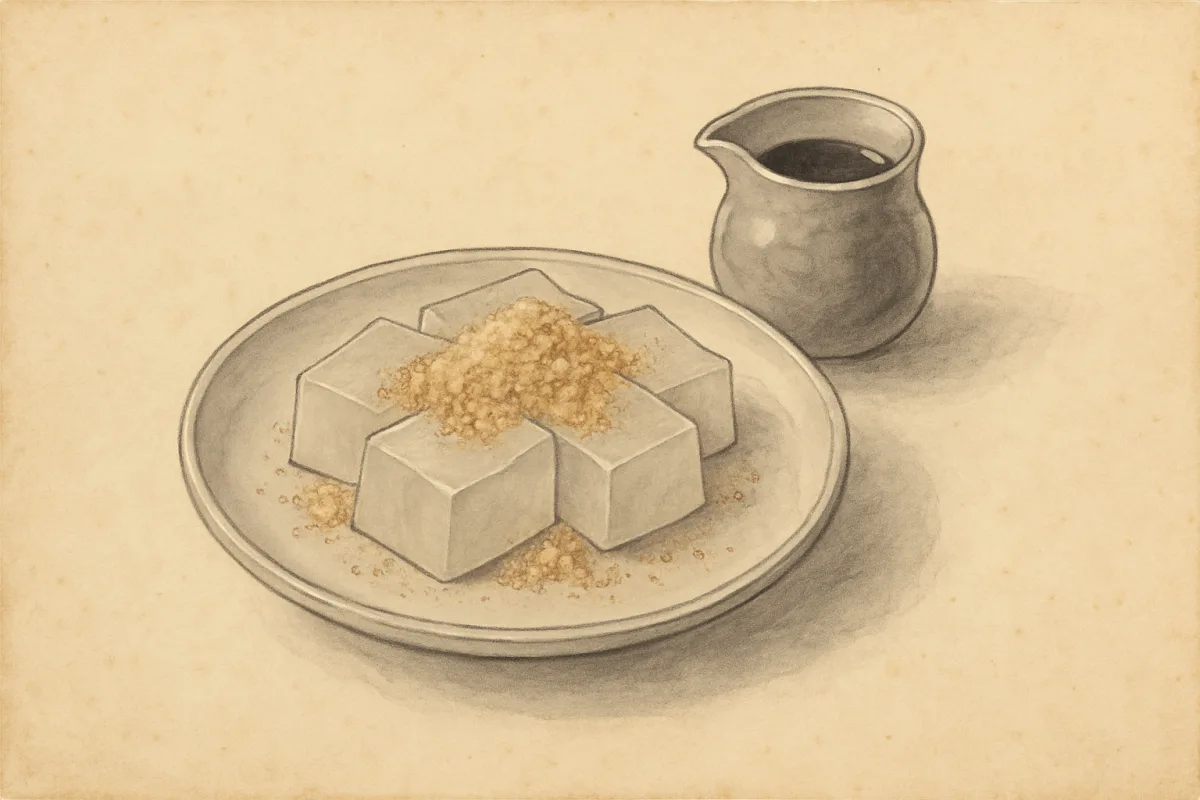
You bite into it and your whole mental model of mochi breaks. It's see-through where mochi is opaque white. It wobbles and gives way where mochi stretches into ropes. It melts almost the instant it hits your tongue where mochi clings and pulls. It's dusted with tan soybean flour and slicked with a dark syrup, and it is called warabi mochi, so surely it's a kind of mochi? It isn't. There's no rice in it at all. Warabi mochi (蕨餅) is a "mochi" that isn't mochi in any real sense: it's a jelly, set from the starch of a fern root.
Not rice, but fern-root starch
Real mochi is glutinous rice, steamed and pounded into a single elastic body (see what mochi is). Warabi mochi takes a different road entirely. Its base is warabiko (蕨粉), starch extracted from the underground rhizome of the bracken fern (warabi), the same wild plant whose young fronds show up as a mountain vegetable. Cook that starch with water and sugar and it doesn't pound into a chewy mass; it sets into a soft, quivering jelly. Structurally it has more in common with a kanten jelly than with a rice cake: different material, different physics, a separate branch of the sweets family. That's why it slips through the usual wagashi sort by rice-versus-wheat-versus-agar: bracken starch is a fourth thing.
The jelly itself is almost flavorless, which is the point of the toppings. Kinako (roasted soybean flour) brings a warm, nutty, faintly peanut-like note; kuromitsu (a dark, molasses-heavy unrefined-sugar syrup) brings the sweetness. On warabi mochi they aren't garnish. They are the flavor.
A sweet made for summer
Warabi mochi is eaten chilled, and its cool, watery-clear, semi-translucent body simply looks like relief in a Japanese August. It's the same visual logic that makes mizu-yōkan and other clear sweets summer food: translucency signals coolness. It's most strongly tied to the Kansai region (Nara and Kyoto especially), and also to Okinawa. And since Japan's tapioca and bubble-tea boom, a looser, pourable nomu warabimochi ("drinkable warabi mochi"), served in a cup and sipped through a fat straw, has spread through cafés and convenience stores and pulled the sweet in front of a whole new, younger audience. That's probably how a lot of travelers meet it now.
The real-vs-fake problem (the clear one is usually the fake)
The crystal-clear, pure-looking cube on most shelves is usually the substitute. Genuine 100% bracken-starch warabi mochi, hon-warabimochi, is amber to brownish-black, because warabiko itself carries color; the raw starch even comes as clay-colored pebbles rather than a white powder. It's dark because it's real.
And it's rare because of one brutal number: a bracken rhizome is only about 5% recoverable starch. You dig, wash, crush, settle, and dry a large mass of root for a small heap of powder, and you can only do it seasonally. So genuine bracken starch has cost, as of 2021, 30 to 35 times as much as sweet potato or tapioca starch. So the shelves fill with the cheap stand-ins instead.
| Starch | Source | Color of the sweet | Texture | Price / rarity | How to spot it |
|---|---|---|---|---|---|
| Hon-warabiko (real) | bracken-fern rhizome (~5% yield) | amber to brown-black | soft, melts fast | ~30–35× the substitutes; seasonal, scarce | dark; clouds dark in water; lasts ~1 day, hardens if chilled |
| Sweet potato starch | sweet potato | pale, translucent | closest to the real melt | cheap, keeps well | clear; the common "closest" fake |
| Tapioca starch | cassava | clear | firmer, springier, elastic | cheap, keeps well | bubble-tea bounce; too chewy |
| Warabi mochiko (blend) | mostly sweet-potato/tapioca + a little bracken | whitish | jelly-like | affordable | labeled "warabi mochiko"; check the ingredient list |
Two field tests fall out of that table. First, water: real warabiko clouds the water dark, while the sweet-potato/tapioca blends cloud it whitish. Second, keeping: true hon-warabimochi hardens and turns cloudy in the fridge, so it's sold as a same-day, room-temperature sweet. If the package boasts a long shelf life, it isn't pure bracken. When in doubt, read the ingredients: sweet potato starch, tapioca starch, or potato starch means substitute or blend.
A courtly past, with an asterisk
Warabi mochi is old. It's traditionally traced to the Heian period (794–1185) as an aristocratic delicacy, and it's widely repeated that it was a favorite of Emperor Daigo (r. 897–930). Enjoy that line, but hold it loosely: it circulates in food writing without a firm primary citation, so it's lore more than documented history. What's on steadier ground is that pure bracken starch grew scarce by the Edo period (1603–1868), even as warabi mochi itself spread to the public through Edo-era tea houses, the same era that democratized so much of the sweets shelf. The scarcity that drove today's substitute starches, in other words, is centuries old.
In short: not mochi, no rice, a jelly from a fern root, flavored by what's dusted and poured over it, cooled for summer, and if it's truly made of bracken, dark, costly, and gone by tomorrow.