
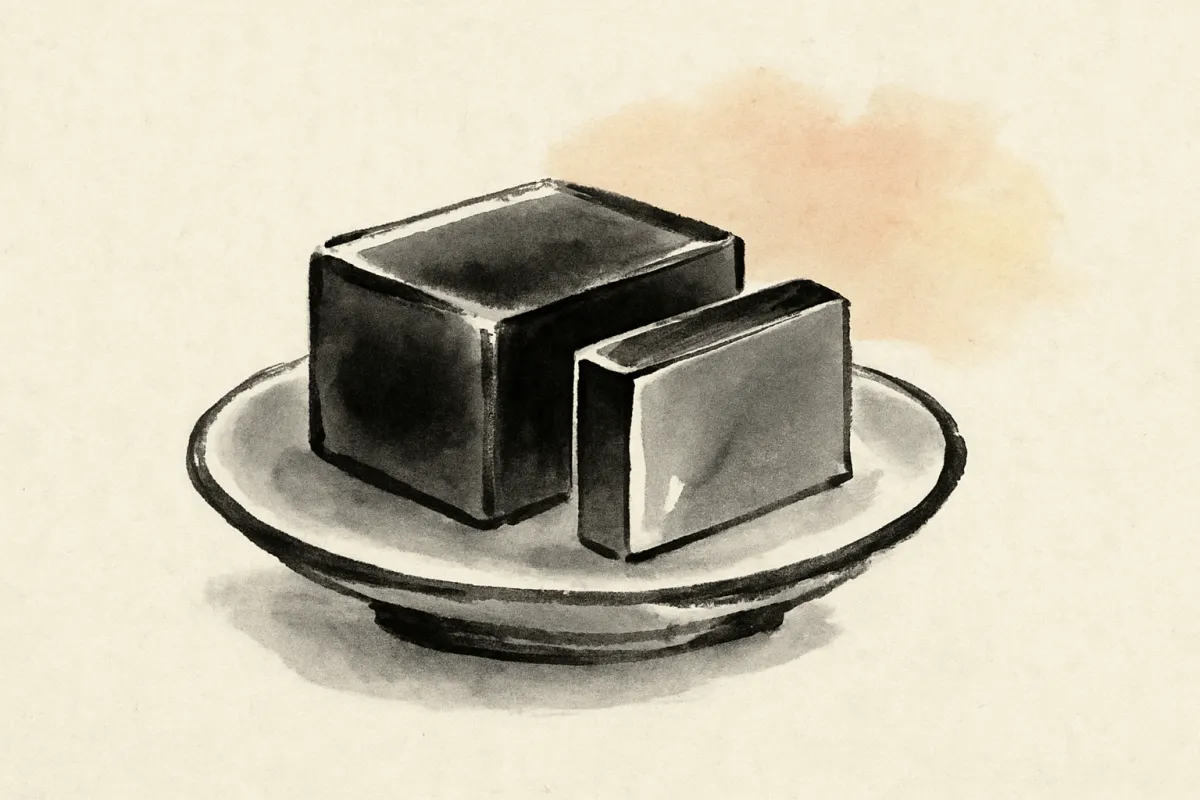
Slice into a block of yōkan and you meet it: a dense, translucent jelly that holds a knife-sharp edge and doesn't melt on a warm plate. Spoon up an anmitsu and it's there again, clear cubes with a clean, brittle bite. If you've ever opened a vegan dessert recipe, you've met its Western name: agar agar, the plant-based stand-in for gelatin. All of it is one material: kanten (寒天), a gelling agent pulled from seaweed. Where anko is the sweet bean paste at the center of wagashi and mochi is the chewy rice body, kanten is the third core material, behind every clear, firm "jelly" sweet in the craft.
What it is
Kanten is agar, a jelly-forming polysaccharide from the cell walls of red algae. The premium source is Gelidium, known in Japan as tengusa; the cheaper industrial source is Gracilaria, or ogonori. Chemically it's two fractions: agarose, about 70%, a long straight-chain sugar polymer that does the actual gelling, and agaropectin, about 30%, which is charged and largely doesn't set. The seaweed is boiled to release the gel, then that gel is dried into a shelf-stable ingredient sold in three forms: bar (kaku/bō-kanten), thread (ito-kanten), and powder (funmatsu-kanten), the last being the easy, consistent modern one.
Most searchers want one fact: gelatin is boiled animal collagen from skin and bone, but agar is seaweed. So kanten is plant-based (vegan, vegetarian, gluten-free), which is why it travels the world as a gelatin substitute. It is also nearly calorie-free and roughly 80% dietary fiber, the reason a "kanten diet" became a Japanese health fad: it bulks a dessert with fiber instead of sugar.
It behaves nothing like gelatin
Swap agar for gelatin expecting the same wobble and the result is different, because the two set and melt on completely different schedules. Agarose chains cross-link into a water-trapping mesh as the hot solution cools, and those junctions only fall apart at high heat. That leaves a big gap between the temperature agar sets at and the one it melts at, which physicists call hysteresis.
| Kanten (agar) | Gelatin | |
|---|---|---|
| Source | Red seaweed (plant) | Animal collagen (skin, bone) |
| Diet | Vegan, gluten-free | Not vegan |
| Sets (gels) at | ~32–42 °C, room temperature | ~13–15 °C, needs a fridge |
| Melts at | above ~85 °C, near boiling | ~30–35 °C, body heat |
| To dissolve | must be boiled (~90–95 °C) | just warm it |
| Texture | firm, clean, brittle "cut" | soft, jiggly wobble |
The practical consequences follow. Kanten sets at room temperature, so you don't need a refrigerator to firm a jelly. Once set it stays solid in a warm room and in your mouth; it does not melt on the tongue the way gelatin does, which is how a summer mizu-yōkan keeps its edge on the plate. And you have to bring it to a boil to activate it; merely warming it won't dissolve the agar. One more warning for the home cook: at an equal dose agar sets much firmer, so a gelatin recipe used one-for-one turns rubbery. Use far less.
Invented by throwing it out
Kanten was discovered by accident. It is a Japanese invention: the story goes that an innkeeper named Mino Tarōzaemon, at the inn Minoya in Fushimi, Kyoto, threw out leftover tokoroten (the fresh, undried seaweed jelly, itself brought from China over a thousand years ago). Left in the Kyoto winter, it froze overnight and dried out over the following days. Reboiled, the desiccated mass dissolved and set into a jelly that was whiter, clearer, and free of the seaweed smell: the first kanten. A thrown-away leftover had turned out to be a better, storable ingredient. (Sources split on the date: English Wikipedia says 1658; Japanese accounts tie it to a 1685 visit by Lord Shimazu of Satsuma, likely a discovery in the 1650s and a famous banquet later.)
The name carries the winter in it. 寒天 means "cold sky," and it is said to have been given by the eminent Zen master Ingen Ryūki, founder of the Ōbaku school, fitting for a cold-season food that also suited meat-free Buddhist cooking. As demand grew, production climbed into the cold inland mountains where hard nightly freezes and dry days could repeat the freeze-thaw drying: Suwa in Nagano for bar kanten, and Yamaoka in Gifu for thread kanten, which still makes about 90% of Japan's supply. It's brutal, seasonal work, running through the deep-winter freeze, and a vanishing one: Gifu counted 129 hand-agar makers in 1957, and only about a dozen remain, undercut by cheap industrial agar.
The seaweed that ended up under a microscope
The same property that keeps a mizu-yōkan from slumping had a second life nobody planned. Because agar stays solid until near boiling, it doesn't liquefy at the 37 °C body temperature at which microbes are grown, the temperature where gelatin turns to soup. So in 1882, in Robert Koch's laboratory, Fanny Hesse suggested the agar she used to set fruit jellies to her husband Walther, and it swiftly replaced gelatin as the base of laboratory culture media. The clear jelly in your anmitsu is, chemically, the standard petri-dish medium: the same freeze-dried seaweed a Kyoto innkeeper stumbled on by accident, now under every microbiologist's microscope.
See a clear, firm jelly sweet, or "agar agar" in a vegan recipe, and you can trace the whole chain: tengusa seaweed dived from the rocks, boiled into tokoroten, frozen and dried one winter into kanten, and set with sugar (and often anko) into yōkan, mizu-yōkan, anmitsu, and the crystal-clear kingyoku. One material, three forms, and a thousand-year story that runs from a Kyoto inn to the petri dish.