
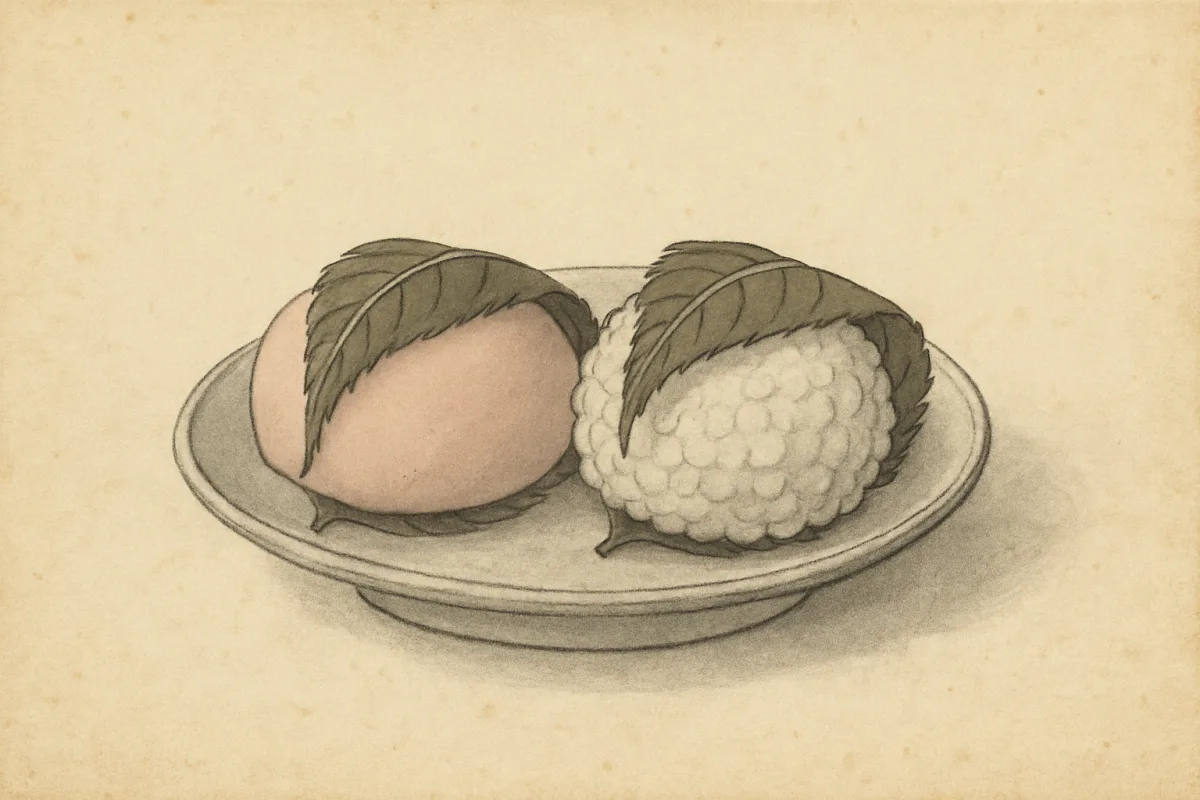
Say sakura mochi to a Tokyoite and an Osakan and they will picture two different sweets. The Tokyoite sees a smooth pink pancake folded around bean paste. The Osakan sees a grainy pink dumpling, its rice grains still visible, sitting in its own leaf. Both are right. Sakura mochi is one name for two completely different confections, and the only things they reliably share are the color, the red bean paste inside, and a single salted cherry leaf wrapped around the outside. That leaf makes everyone hesitate at first bite.
Two questions, then: which style is in front of you, and whether you eat that leaf.
Two sweets, one name
When you need to tell them apart, the Tokyo/eastern style is called Chōmeiji (長命寺) and the Osaka/western style is called Dōmyōji (道明寺), each named after the temple it's tied to.
Chōmeiji is the crêpe. A thin batter is griddled flat like a tiny pancake, tinted pink, and folded or rolled around a core of anko. It's smooth-skinned and softly chewy. The original shop uses wheat flour; many modern makers use a glutinous-rice-flour batter instead, so the Tokyo version often isn't rice cake at all in spirit.
Dōmyōji is the grainy one. It's built from dōmyōji-ko (道明寺粉), glutinous rice that has been steamed, dried, and coarsely ground, so it never becomes a smooth flour. Steamed back into a dough and pressed around the anko, it keeps its pebbly, visible grains, which is why it's often compared to ohagi. It's the more widely available of the two nationwide.
| Chōmeiji (Kantō / Tokyo) | Dōmyōji (Kansai / Osaka) | |
|---|---|---|
| Base | Wheat-flour (or rice-flour) batter | Dōmyōji-ko, coarse glutinous rice |
| Method | Griddled thin like a crêpe | Steamed, coarsely ground rice |
| Look / texture | Smooth pink skin, soft, chewy | Grainy, pebbled, rice grains visible |
| Region | Eastern Japan | Western Japan |
The filling, the pink, the leaf all match; the starch technology does not — two entirely different approaches. It's the cleanest edible example of Japan's east–west culinary split, and proof that not everything called "mochi" is pounded rice.
The look, and where it started
The Tokyo version has a founding date, which is rare for a sweet. In 1717 (the 2nd year of the Kyōhō era), a man named Yamamoto Shinroku, gatekeeper of Chōmeiji temple in Mukōjima since 1691, opened a teahouse, Yamamoto-ya, at the temple gate. Around the same time the eighth shōgun, Tokugawa Yoshimune, planted cherry trees along the Sumida River, and Mukōjima filled with blossom-viewing crowds. Shinroku, sweeping fallen cherry leaves off the temple grounds, is said to have pickled them in salt in a barrel rather than waste them, and wrapped his bean-paste sweet in them to welcome visitors. The signature wrapper began as thrift. Yamamoto-ya still operates today, over three centuries later.
The Osaka version came later and copied east. Dōmyōji-ko is named for Dōmyōji temple, a nunnery in Fujiidera, Osaka, where nuns once made dried steamed rice as a preserved travel food. A shop called Tosaya in Kitahorie, Osaka, is credited with turning it into a sweet during the Tenpō era (1830–1844), in imitation of the popular Edo original.
The pink is the same idea in both: a deliberate seasonal signal, not a flavor. It tells you this is a spring sweet, eaten at hanami and at Hina-matsuri (Girls' Day, March 3), the season it belongs to on the wagashi calendar.
Now, the leaf
The wrapper is a cherry leaf, not a blossom, from the Ōshima cherry (Ōshima-zakura), chosen because its leaves are large, thin, and nearly hairless — easy to wrap. Roughly 80% of Japan's pickled cherry leaves come from the Izu region, much of it around Matsuzaki in Shizuoka. Salt-pickling is what wakes up the leaf's defining aroma: coumarin, a sweet, almond-and-vanilla, faintly hay-like scent. The leaf does three practical jobs: it perfumes the sweet, it keeps the dough and anko from drying out, and it works as a little plate.
That leaves the real question: do you eat it?
It's disputed, and both choices are legitimate. The leaf is fully edible. But Chōmeiji, the very shop that invented sakura mochi, tells you to remove it: as far as they're concerned, the leaf is there for aroma, moisture, and as a wrapper, and its job is done before you bite. Plenty of eaters keep it on anyway, for the salty-sour snap against the sweet bean paste. There's a practical reason, too: Chōmeiji reportedly wraps its sweet in three leaves, which is a lot of salt to eat, while a standard one-leaf version is more balanced whole.
A rule you can use: peel the leaf off for a pure, floral, cleanly sweet mochi; eat it together for a salty counterpoint. Neither is wrong. If it's your first one, try a bite with the leaf and a bite without, and decide which you prefer. That comparison is half the pleasure.
What to do with the one in your hand
Look at the skin. Smooth pink crêpe means you're holding a Tokyo Chōmeiji; grainy, pebbled rice means an Osaka Dōmyōji. Either way, the pink is spring, the leaf is coumarin and salt, and the choice to eat it is yours, since even the inventors disagree. If you want to try both styles side by side, a good wagashi counter will have them in season; our shop guide points to makers to seek out. And this part is strange: you're eating a fallen leaf someone swept up three hundred years ago and decided not to throw away.